The Drivetrain Dilemma: Open vs. Limited Slip Carriers
When building a capable off-road rig, a dedicated track car, or a heavy-duty tow vehicle, the differential sits at the very end of the drivetrain, tasked with translating transmission torque into forward motion. For decades, the debate between an open differential and a limited slip differential (LSD) has dominated garage forums and build sheets. However, as we move through 2026, with vehicles growing heavier and powertrains producing unprecedented low-end torque, the conversation must expand beyond just the carrier gears. The true bottleneck in any axle upgrade is often the weakest link in the containment system: the differential seals.
Upgrading from an open carrier to a clutch-type or helical LSD fundamentally alters the internal thermodynamics, fluid shear rates, and lateral axle loading of your housing. If you are investing $600 to $1,200 in a premium carrier, ignoring the material science of your axle and pinion seals is a guaranteed path to premature failure, gear oil contamination, and destroyed wheel bearings. This buyer’s guide compares open and limited slip differentials while providing a deep-dive framework for selecting, sourcing, and installing the correct differential seals to match your specific setup.
Core Mechanics: How Open and LSD Carriers Differ
The Open Differential
The open differential is a marvel of basic mechanical engineering, utilizing a set of spider gears and side gears to allow the outer wheel to spin faster than the inner wheel during a turn. In standard applications—such as the venerable GM 8.5-inch 10-bolt or the Dana 30 front axle—an open diff provides smooth, predictable street manners and minimal driveline bind. However, its fatal flaw is torque biasing: it will always send power to the wheel with the least resistance. If one wheel lifts off the ground or hits ice, the open diff sends 100% of the available torque to that spinning wheel, leaving the vehicle stranded.
The Limited Slip Differential (LSD)
Limited slip differentials solve the traction deficit by mechanically linking the two axle shafts. There are two primary designs dominating the aftermarket:
- Clutch-Type LSD (e.g., Eaton Posi, Auburn Gear): Utilizes a stack of friction clutches and preload springs to force both wheels to turn together. Under high torque, the clutches can slip, allowing for cornering, but generating immense internal heat.
- Helical/Gear-Type (e.g., Torsen, Detroit TrueTrac): Uses complex worm and spur gear sets to multiply torque to the wheel with grip without the need for friction clutches or specialized fluid additives.
While the LSD provides vastly superior traction, the internal friction and heat generated—especially in clutch-type units—drastically raises the operating temperature of the gear oil. This thermal spike is exactly where standard differential seals begin to fail.
The Thermal and Chemical Threat to Differential Seals
A differential seal’s primary job is to retain high-viscosity gear oil while keeping out water, dirt, and debris. Most factory open differentials are equipped with standard NBR (Nitrile Butadiene Rubber) axle seals. NBR is cost-effective and performs adequately in continuous operating temperatures up to 250°F (121°C).
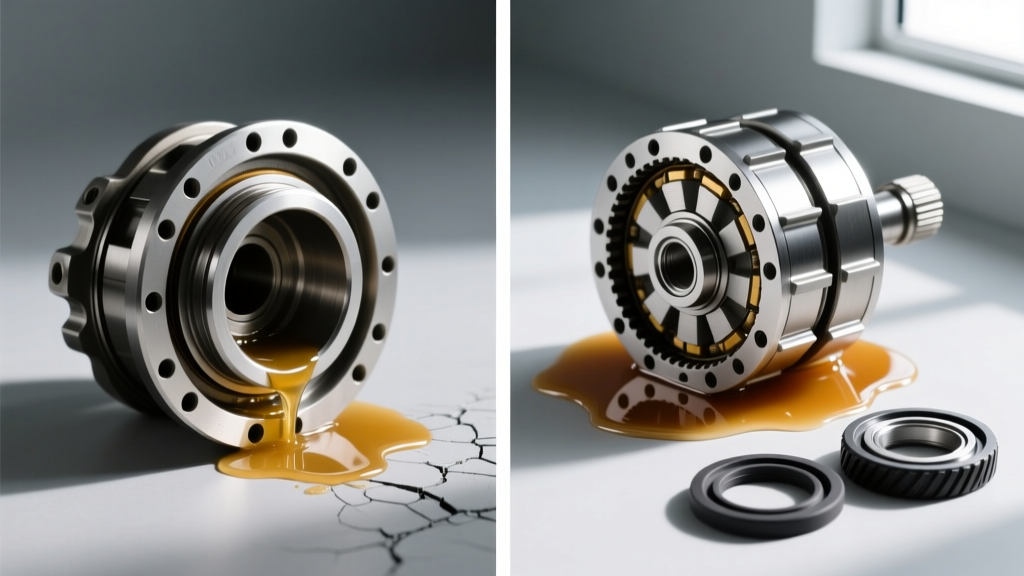
However, when you swap in a clutch-type LSD and subject the axle to heavy loads, towing, or off-road crawling, internal differential temperatures can easily surge past 275°F (135°C). At these thresholds, NBR seals begin to harden, crack, and lose their lip tension. Furthermore, clutch-type LSDs require specialized GL-5 gear oils fortified with friction modifiers (like GM EOS or Ford XL-3). These chemical additives can cause cheap rubber compounds to swell and degrade, leading to weeping seals and eventual bearing washout.
Material Science: Upgrading to Viton (FKM)
For any limited slip application, high-performance differential seals manufactured from FKM (commonly known by the brand name Viton) are mandatory. Viton seals maintain structural integrity and lip flexibility at continuous temperatures up to 400°F (204°C) and exhibit superior resistance to the aggressive EP (Extreme Pressure) additives and friction modifiers found in modern synthetic 75W-90 and 75W-140 gear oils. According to engineering data from SKF Automotive, upgrading to fluoroelastomer sealing lips can increase seal service life by over 300% in high-thermal axle environments.
2026 Buyer’s Matrix: Carrier Setups and Seal Pairings
When purchasing your differential components, you must match the seal material and part number to both the axle housing and the carrier type. Below is a comparative matrix for popular light-truck and SUV axles.
| Axle Platform | Carrier Type | Recommended Seal Material | Example Part Number (National/Timken) | Avg. Cost (Per Seal) |
|---|---|---|---|---|
| GM 8.5' 10-Bolt | Open | NBR (Standard Nitrile) | 710984 | $9.00 - $14.00 |
| GM 8.5' 10-Bolt | Clutch LSD | FKM (Viton High-Temp) | 710984V (or equivalent SKF) | $18.00 - $26.00 |
| Ford 8.8' (31-Spline) | Open / Torsen | NBR / HNBR | 710647 | $11.00 - $16.00 |
| Ford 8.8' (31-Spline) | Clutch LSD | FKM (Viton High-Temp) | 710647V | $22.00 - $30.00 |
| Dana 44 (Front/Rear) | Open | NBR (Standard Nitrile) | 10986 (Inner) | $8.00 - $12.00 |
| Dana 44 (Front/Rear) | Clutch LSD | FKM (Viton High-Temp) | 10986V | $19.00 - $28.00 |
Note: Always verify part numbers against your specific axle shaft diameter and housing bore. Aftermarket axle shafts (e.g., from Yukon or Moser Engineering) may require different seal profiles than OEM shafts.
Fluid Chemistry: Matching Oil to the Carrier and Seal
The relationship between your differential fluid and your seals is symbiotic. Using the wrong fluid will destroy an LSD carrier, but using the right fluid with the wrong seal will still result in leaks.
- Open Differentials: Require a standard API GL-5 75W-90 or 80W-90 gear oil. No friction modifiers are needed. Standard NBR seals handle these fluids perfectly.
- Clutch-Type LSDs: Require API GL-5 gear oil plus a limited slip friction modifier. The modifier prevents the clutch packs from chattering and binding during low-speed turns. Synthetic oils like Amsoil Severe Gear or Red Line 75W90 already contain these modifiers. Viton seals are required to resist the solvent properties of these additives.
- Helical/Gear LSDs (TrueTrac, Torsen): Do not require friction modifiers, as they operate on gear binding rather than clutch friction. Standard GL-5 is sufficient, though high-temp Viton seals are still recommended for heavy towing applications due to gear mesh heat.
For a comprehensive breakdown of OEM fluid specifications and additive requirements, drivetrain engineers frequently reference the technical bulletins provided by Spicer Parts and Timken regarding seal compatibility with synthetic EP lubricants.
Precision Installation: Torque Specs and Seal Drivers
A $25 Viton differential seal will fail in 500 miles if installed improperly. The sealing surface on the axle shaft must be pristine, and the seal must be driven perfectly flush into the housing bore. Here are the critical installation parameters for a standard semi-floating axle:
1. Preparation and Shaft Inspection
Before sliding the axle shaft back into the housing, inspect the seal journal (the area where the seal lip rides). If the old seal wore a groove into the steel shaft, the new seal will leak immediately. You can use a press-on sleeve (like a Speedi-Sleeve) to provide a fresh sealing surface, or replace the axle shaft entirely.
2. Packing the Bearings and Seal Lips
Never install a dry seal. Pack the wheel bearing with NLGI Grade 2 wheel bearing grease, and lightly coat the inner lip of the differential seal with the same grease or a dab of your chosen gear oil. This prevents the seal lip from burning up during the first few miles of operation before the differential fluid splashes up to the axle tubes.
3. Driving the Seal
Use a dedicated seal driver tool that matches the exact outer diameter of the seal housing. Never hammer a seal directly with a steel drift, as this can cock the seal in the bore, bending the internal garter spring and ruining the seal's tension.
4. Axle Retainer and Pinion Nut Torque Specifications
Once the shaft is seated, the axle retainer plate nuts must be torqued to specification to ensure the bearing and seal are preloaded correctly. For a GM 10-bolt 8.5-inch or Ford 8.8-inch, the axle shaft retainer nuts typically require 35 to 45 lb-ft of torque.
If you are also replacing the pinion seal (a common requirement when swapping carriers due to pinion nut removal), remember that the pinion nut dictates crush sleeve preload. For a GM 8.5-inch 10-bolt, the pinion nut torque is generally between 125 and 175 lb-ft to achieve a rotational preload of 15 to 30 in-lbs. For a Dana 44 or Ford 8.8-inch, pinion nut torque ranges from 160 to 220 lb-ft. Always use an inch-pound torque wrench to measure rotational drag, rather than guessing based on the foot-pound torque of the nut.
Final Verdict: Budgeting for the Complete Upgrade
When planning your axle upgrade, do not treat the differential seals as an afterthought. An open differential is ideal for low-stress, budget-friendly highway cruisers where standard NBR seals and basic GL-5 fluid will last 100,000 miles. However, if your build demands a limited slip differential for traction, you must budget an additional $60 to $120 for premium Viton differential seals, high-quality synthetic gear oil, and the necessary friction modifiers. By treating the seals as a critical, heat-managing component of the drivetrain rather than just a rubber plug, you ensure that your axle upgrade delivers reliable, leak-free performance for years to come.