The Intersection of Tribology and Hydraulic Actuation
In the realm of modern drivetrain engineering, the differential is no longer just a simple mechanical gearset designed to allow wheels to rotate at different speeds. As we navigate through 2026, the proliferation of active torque-vectoring differentials, electronically controlled limited-slip differentials (eLSD), and advanced AWD coupling systems has transformed the axle into a complex hydraulic and electro-mechanical hub. For automotive technicians and DIY enthusiasts alike, understanding the visual and physical condition of differential fluid is the first line of defense against catastrophic drivetrain failure.
While traditional solid axles rely on splash lubrication, modern active systems utilize dedicated hydraulic pumps to actuate clutch packs. In these systems, maintaining the correct oil differential pressure across the control valves and clutch actuators is entirely dependent on the fluid's viscosity and chemical stability. When gear oil or specialized hydraulic coupling fluid degrades, its ability to transmit hydraulic force diminishes, leading to clutch slip, erratic torque distribution, and eventual mechanical destruction. This preventive maintenance guide will decode the visual indicators of differential fluid condition and explain how they correlate to hydraulic performance and axle health.
Decoding Standard Axle Fluid: A Color and Condition Matrix
For traditional open, locking, and mechanical limited-slip differentials (such as the ubiquitous Dana 44, GM 8.6-inch 10-bolt, or Ford 8.8-inch axles), the gear oil serves primarily as a lubricant and extreme-pressure (EP) barrier. The color and physical texture of the drained fluid provide an immediate, unfiltered history of the axle's internal operating environment.
| Fluid Color / Condition | Chemical / Mechanical Cause | Diagnostic Action Required |
|---|---|---|
| Translucent Amber / Honey | Fluid is within normal service life. EP additives (Zinc, Phosphorus, Sulfur) are intact. | No action. Reinstall or top off to the bottom of the fill hole. |
| Opaque Dark Brown / Black | Thermal breakdown and normal oxidation. EP additives have depleted, but no acute mechanical failure. | Perform full drain and refill. Monitor service intervals; consider a higher viscosity synthetic if towing. |
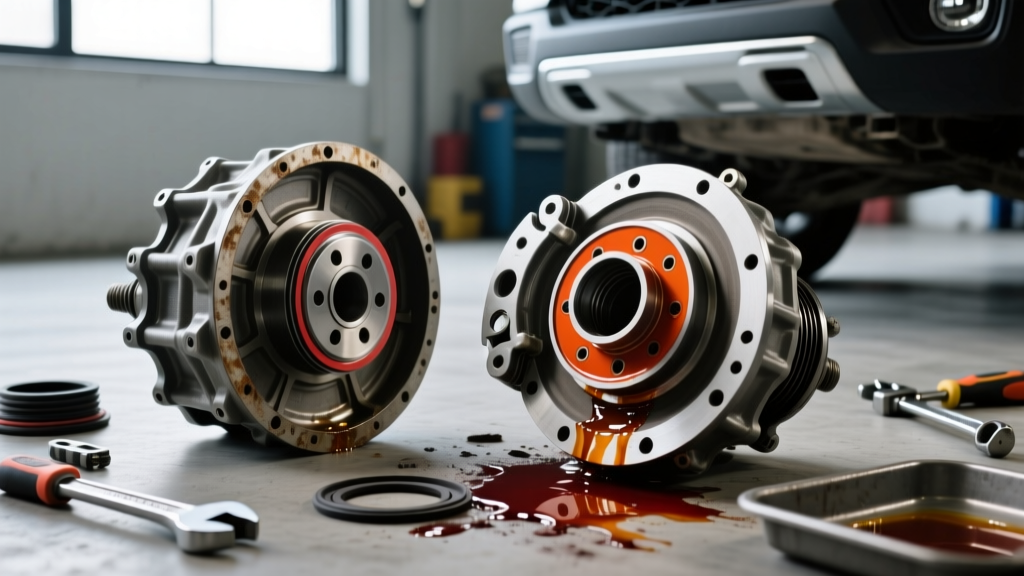
| Milky, Frothy, or 'Chocolate Milk' | Water intrusion via a compromised axle seal, submerged breather tube, or condensation buildup. | Immediate flush required. Inspect axle seals and replace the differential breather valve. Water destroys the fluid's load-bearing film. |
| Glittering / Metallic Flakes | Active wear of the ring and pinion gears, spider gears, or carrier bearings. Magnetic plug will be heavily loaded. | Critical failure imminent. Requires differential teardown, bearing replacement, and gear pattern inspection. |
| Chunky / Brass-Colored Shavings | Synchro or clutch-pack wear (in LSDs). Bronze thrust washers are disintegrating. | Rebuild the limited-slip clutch pack or replace the carrier assembly. |
The sulfur-phosphorus EP additives found in high-quality 75W-90 gear oils (such as AMSOIL Severe Gear) are designed to sacrifice themselves under extreme localized heat and pressure, preventing gear welding. As these additives deplete over 30,000 to 50,000 miles, the fluid naturally darkens. However, if the fluid smells distinctly of burnt sulfur and contains suspended particulates, the gear teeth are experiencing micro-pitting due to a loss of the protective boundary layer.
Active AWD Systems: When Oil Differential Pressure Drops
The diagnostic paradigm shifts dramatically when dealing with active AWD couplings and torque-vectoring differentials. Systems like the Haldex Generation 5 (found in VW MQB and Audi Quattro ultra platforms) or Honda's SH-AWD rely on hydraulic fluid to engage multi-plate clutch packs. In these architectures, the fluid is not just a lubricant; it is the hydraulic medium that transfers force.
When the specialized fluid in these units shears down or becomes contaminated with microscopic clutch friction material, its viscosity index drops. This degradation directly impacts the system's ability to maintain the necessary oil differential pressure between the hydraulic pump and the accumulator or clutch piston. If the pressure delta falls below the ECU's threshold, the system will trigger a fault code (e.g., VW's 'AWD Malfunction' or Honda's 'SH-AWD Warning') and default the vehicle to front-wheel drive to protect the clutches from burning up.
Expert Insight: The Haldex Gen 5 system is notorious for pump strainer clogging. Unlike earlier generations, Gen 5 lacks a traditional accumulator, relying entirely on continuous pump pressure. If the fluid degrades and sheds clutch material, the microscopic debris clogs the pump's internal mesh strainer. The pump cavitates, oil differential pressure drops to zero, and the rear axle completely disconnects. Preventive fluid changes every 20,000 miles are non-negotiable for these units.
Specific Active Differential Fluids and Failure Modes
- Haldex Gen 5 / Gen 6 (VW/Audi/Volvo): Requires specific fluid (e.g., VW G 060 175 A2). Fresh fluid is a distinct translucent yellow-green. If drained fluid appears grey or opaque black, the clutch pack friction material is actively shedding. Capacity is typically small (approx. 650ml - 850ml), making it highly susceptible to rapid saturation.
- Honda SH-AWD (Super Handling All-Wheel Drive): Uses Dual Pump System Fluid II (DPSF-II, Part #08200-9007). This system uses twin hydraulic clutches to overdrive the outer rear wheel during cornering. Fluid shear here results in sluggish torque vectoring and noticeable understeer during aggressive cornering.
- ZF Active Kinematics / Torque Vectoring Diffs: Found in high-performance European applications. These systems operate at extremely high hydraulic pressures (often exceeding 40 bar). Fluid that has lost its anti-foaming agents will cause cavitation in the high-pressure pump, leading to erratic torque distribution and hydraulic whine.
2026 EV and Hybrid Drivetrain Considerations
As the automotive landscape in 2026 is heavily populated by EVs and PHEVs, differential maintenance has evolved. Many electric vehicles utilize integrated drive units (IDUs) where the electric motor, reduction gearbox, and differential share a common fluid bath. In these systems, the fluid must not only lubricate the hypoid gears but also act as a dielectric coolant for the electric motor windings.
If the fluid in an EV IDU degrades and its dielectric breakdown voltage drops, it can lead to electrical arcing and bearing fluting (electrical discharge machining damage). While the concept of oil differential pressure is less relevant in splash-lubricated EV reduction gears, the fluid's color remains a vital diagnostic tool. A milky or highly darkened fluid in an EV drive unit indicates severe thermal cycling or moisture ingress, which compromises the fluid's electrical insulation properties, potentially leading to catastrophic motor stator failure.
Preventive Maintenance Protocol: Specs and Procedures
To maintain optimal axle health and ensure hydraulic systems can generate the required pressure differentials, adhere to the following preventive maintenance protocols. Always consult the specific OEM service manual, but the following represents industry-standard baselines for common platforms.
1. Standard Solid Axle (e.g., GM 8.6" 10-Bolt / Dana 44)
- Interval: Every 30,000 miles for normal use; every 15,000 miles for severe towing/off-road.
- Fluid Spec: 75W-90 GL-5 Synthetic. (Add friction modifier if equipped with a mechanical clutch-type LSD).
- Capacity: Typically 2.0 to 2.5 quarts.
- Torque Specs: Fill and drain plugs (if equipped) should be torqued to 25-35 lb-ft (approx. 34-47 Nm). Always use a new crush washer or apply PTFE tape to tapered NPT plugs.
- Procedure: Remove the fill plug before the drain plug to ensure you can refill the unit. Inspect the magnetic drain plug for excessive ferrous fuzz.
2. Haldex-Style AWD Coupling (Gen 5 / Gen 6)
- Interval: Every 20,000 to 30,000 miles. (Ignore OEM 'lifetime' or 60,000-mile claims; independent tribology data proves clutch material saturation occurs much earlier).
- Fluid Spec: OEM specific (e.g., G 060 175 A2). Do not substitute with standard gear oil.
- Capacity: ~650ml to 850ml (varies by exact housing).
- Torque Specs: Drain plug 15 Nm (11 lb-ft); Fill plug / inspection port 32 Nm (24 lb-ft).
- Procedure: Use a specialized extraction pump or syringe to evacuate the old fluid. If the vehicle has over 60,000 miles without a filter/strainer service, the pump must be dropped and the internal mesh strainer cleaned with brake cleaner to restore proper oil differential pressure.
3. Cost Analysis and Professional Servicing
For DIYers, a standard axle fluid change costs between $40 and $80 in high-quality synthetic fluids and shop supplies. For active AWD systems requiring specialized OEM fluids and pump-strainer cleaning, expect to pay between $150 and $300 at an independent specialist. Dealership pricing often exceeds $400, and many dealerships refuse to clean the Haldex pump strainer, opting instead to sell a $1,200 replacement pump when it inevitably cavitates due to neglected maintenance.
By treating differential fluid analysis as a core pillar of your preventive maintenance routine, you can predict failures before they strand you. Whether you are monitoring the metallic sheen of a Dana 60 or ensuring the hydraulic integrity of a torque-vectoring AWD system, the fluid tells the story of your drivetrain's health. Respect the chemistry, adhere to the torque specs, and your axles will deliver power reliably for hundreds of thousands of miles.