The Thermal Vulnerability of Nissan Jatco CVTs in Extreme Heat
Nissan owners in regions with extreme summer temperatures—such as Arizona, Texas, and the Middle East—face a unique mechanical adversary: ambient heat soak. The Jatco JF016E (CVT8) and JF017E (CVT8 HT) transmissions, widely used in the Rogue, Altima, Pathfinder, and Murano, are highly sensitive to thermal loads. When executing a Nissan CVT transmission cooler upgrade, understanding the thermal limits of Nissan's NS-3 fluid is critical.
NS-3 fluid operates optimally between 176°F and 194°F (80°C–90°C). Once internal transmission temperatures cross 212°F (100°C), the fluid's viscosity begins to shear, and the TCM (Transmission Control Module) starts incrementing the internal 'fluid deterioration' counter. At 248°F (120°C), catastrophic varnishing occurs, leading to stepper motor failure, valve body sticking, and the infamous CVT belt/chain slip that triggers fail-safe limp mode.
Expert Insight: In 110°F+ ambient conditions, your vehicle's OEM radiator-integrated cooler is often counterproductive. Engine coolant in the radiator can exceed 210°F during heavy traffic, meaning the factory 'cooler' is actually transferring engine heat into your transmission fluid.
Sizing and Selecting the Right Auxiliary Cooler for High Ambients
For hot climate driving, tube-and-fin coolers are generally inadequate due to their lower thermal dissipation rates and high pressure drop. You must utilize a stacked-plate or high-efficiency plate-and-fin design. As of 2026, stacked-plate coolers offer the best balance of high surface area and low flow restriction, which is vital because Nissan CVT fluid pumps are not designed to overcome massive hydraulic restrictions.
Recommended Cooler Specifications for Hot Climates
| Cooler Brand & Model | Design Type | GVW Rating | Core Dimensions | Hot Climate Suitability |
|---|---|---|---|---|
| Derale 13960 (Series 9000) | Stacked-Plate | 23,000 lbs | 11.3' x 8.75' x 1.25' | Excellent (Low pressure drop, high dissipation) |
| Hayden 678 (Rapid-Cool) | Plate-and-Fin | 24,000 lbs | 10' x 11.3' x 0.75' | Very Good (Slim profile for tight bumper gaps) |
| Tru-Cool LPD4739 | Plate-and-Fin | 30,000 lbs | 11' x 11.25' x 1.25' | Excellent (Best for heavy towing in desert heat) |
Note: Always verify physical clearance behind your Nissan's front bumper cover and condenser before purchasing. The Derale 13960 is the gold standard for the JF016E due to its 1/2-inch NPT or 3/8-inch barb fittings and minimal flow restriction.
Routing Strategy: Series vs. Bypass in 110°F+ Ambients
The most debated topic in Nissan CVT cooling is whether to route the auxiliary cooler in series with the OEM radiator cooler or to bypass the radiator entirely.
The 'Series' Route (Standard Best Practice)
Fluid exits the transmission, enters the radiator cooler, then flows to the auxiliary cooler, and returns to the transmission. This is ideal for regions with cold winters, as the radiator helps the CVT reach operating temperature quickly. However, in extreme desert heat, the radiator pre-heats the fluid before it hits the auxiliary cooler, reducing the cooler's delta-T (temperature differential) efficiency.
The 'Bypass' Route (Extreme Hot Climate Only)
For dedicated hot-climate vehicles (e.g., Phoenix, Dubai) that rarely see sub-50°F weather, bypassing the OEM radiator cooler and running a standalone auxiliary cooler with a thermostatic bypass valve is the ultimate setup. The thermostat ensures the fluid bypasses the cooler on cold mornings to prevent overcooling, but routes 100% of the fluid to the massive stacked-plate core once the fluid hits 180°F.
Step-by-Step Installation & Torque Specifications
Improper installation is the leading cause of post-upgrade CVT failure. The aluminum casing of the Jatco CVT is relatively soft, and overtightening cooler line fittings will strip the threads or crack the case.
- Locate the Lines: On the JF016E, the cooler lines are typically located near the front differential area. The upper line is generally the pressure (out) line, and the lower is the return. Verify by starting the vehicle cold and feeling which line pressurizes first.
- Crush Washers: Never reuse OEM aluminum crush washers. Order Nissan part # 31236-1XF0A (or equivalent metric aluminum crush washers for your specific banjo bolt size).
- Cutting & Splicing: If using a barb-style cooler, cut the OEM rubber hose using a dedicated hose cutter to ensure a perfectly square edge. Use fuel-injection style worm-gear clamps or constant-tension spring clamps to prevent high-pressure blowouts.
- Torque Specs: If your application uses metric banjo bolts directly into the transmission case, torque them to 15–18 Nm (11–13 lb-ft). If using bracket-mounted adapters, torque to 22 Nm.
Airflow Ducting: The Secret to Desert Survival
Mounting a cooler in front of the AC condenser is only half the battle. In thin, 110°F air, you must maximize the velocity and volume of air passing through the fins. According to thermal management data cited by Derale Performance, an auxiliary cooler loses up to 30% of its efficiency if mounted flush against the condenser without an air gap.
Ducting Best Practices
- Maintain a 1/2-Inch Air Gap: Use the provided nylon mounting rods with foam isolators to ensure the cooler does not physically touch the AC condenser. This allows air to expand and pull heat from both surfaces.
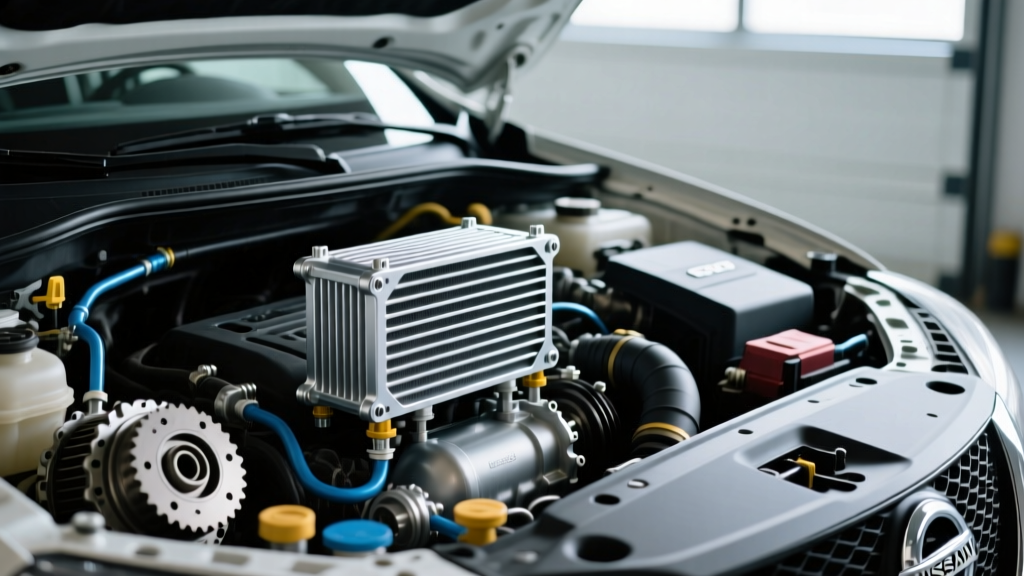
- Fabricate a Sheet Metal Shroud: If your Nissan has a large open gap in the front bumper cover (common on the Rogue and Pathfinder), fabricate a simple aluminum sheet metal duct that forces incoming ram-air directly into the face of the cooler, preventing air from escaping around the edges.
- Zip-Tie Warning: Never push zip-ties through the AC condenser or radiator fins to mount your cooler. Puncturing a condenser in a hot climate will lead to an immediate AC system failure. Use the bolt-on bracket kits provided with premium coolers.
Post-Install Fluid Management & TCM Reset Procedures
Adding an auxiliary cooler increases the total fluid capacity of your transmission system. The JF016E typically holds around 7.5 to 8.5 quarts of NS-3 fluid depending on the specific vehicle application. Your new cooler and lines will require an additional 0.5 to 1.5 quarts.
Critical Warning: Never mix NS-3 with older NS-2 or generic 'multi-vehicle' CVT fluids. The friction modifiers in NS-3 are specifically calibrated for the high-torque lockup clutches in the CVT8 series.
The Deterioration Data Reset
As documented in the Nissan Factory Service Manuals, the TCM tracks the thermal abuse the fluid has endured. If your CVT was previously subjected to severe overheating, the TCM may have already altered its line-pressure mapping to compensate for degraded fluid. After installing the cooler and topping off with fresh NS-3 fluid, you must use a bi-directional OBD2 scanner (such as an Autel MaxiSys, Snap-On Zeus, or Nissan Consult-III) to perform the 'Fluid Deterioration Date Reset'.
Failing to reset this counter will cause the TCM to command unnecessarily high hydraulic line pressures, resulting in harsh engagements, accelerated belt wear, and reduced fuel economy, completely negating the benefits of your new cooling system.
Real-World Hot Climate Diagnostic Checklist
Even with a robust Nissan CVT transmission cooler upgrade, extreme conditions can trigger anomalies. Use this checklist if you experience issues post-installation:
- Issue: Transmission takes too long to shift out of low gear on cold starts.
Diagnosis: Overcooling. The auxiliary cooler is too large for the ambient winter temperature, preventing the NS-3 fluid from reaching its 176°F optimal viscosity. Install a thermostatic bypass valve. - Issue: Whining noise from the transmission at highway speeds.
Diagnosis: Cavitation. The aftermarket cooler has too high of a flow restriction, starving the CVT fluid pump. Switch to a stacked-plate design with larger internal fluid galleries. - Issue: Fluid weeping from the banjo bolts after a 500-mile drive.
Diagnosis: Thermal expansion/contraction cycles in extreme desert heat have loosened the fittings. Re-torque to 16 Nm while the transmission is at operating temperature, and verify the crush washers have fully deformed and sealed.
By prioritizing thermal efficiency, proper routing, and strict adherence to Nissan's torque and software reset protocols, your CVT will comfortably survive the harshest summer environments, pushing the lifespan of the JF016E and JF017E well past the 150,000-mile mark.