Evolution of Nissan All-Wheel Drive: From ATTESA to e-4ORCE
Nissan has long been a pioneer in all-wheel drive (AWD) technology. Enthusiasts revere the legendary ATTESA E-TS (Advanced Total Traction Engineering System for All-Electronic All-Wheel Drive) that debuted in the R32 Skyline GT-R, utilizing a rear-biased mechanical layout with an electronically controlled clutch pack. Today, however, the mainstream Nissan lineup—including the Rogue, Pathfinder, and Murano—relies on transverse-based Intelligent AWD systems, while the new Ariya and X-Trail e-POWER utilize the cutting-edge e-4ORCE dual-motor setup. Understanding the mechanical and electronic operation of these modern systems is critical, especially when diagnosing failures and navigating the Nissan drivetrain warranty for costly component replacements.
Mechanical Anatomy of Nissan Intelligent AWD
In modern transverse-engine Nissan crossovers, the AWD system is primarily managed by a Power Transfer Unit (PTU) and a rear electromagnetic coupling. The PTU bolts directly to the transaxle housing. It receives torque input from the transmission's ring gear and uses a set of hypoid gears to redirect rotational force 90 degrees to the rear driveshaft.
The Electromagnetic Clutch Pack
Unlike full-time 4WD systems with a locked center differential, Nissan's Intelligent AWD operates as a front-wheel-drive-biased system. Under normal cruising conditions, 100% of the torque is sent to the front wheels to maximize fuel efficiency. When the AWD Control Module detects wheel slip, steering angle changes, or heavy throttle application, it modulates current to the electromagnetic coil in the rear differential. This compresses a multi-plate clutch pack, smoothly transferring up to 50% of the available torque to the rear axle. The modulation is pulse-width modulated (PWM), allowing for millisecond-level torque vectoring that prevents the binding associated with older viscous couplings.
e-4ORCE: The Electrified AWD Paradigm
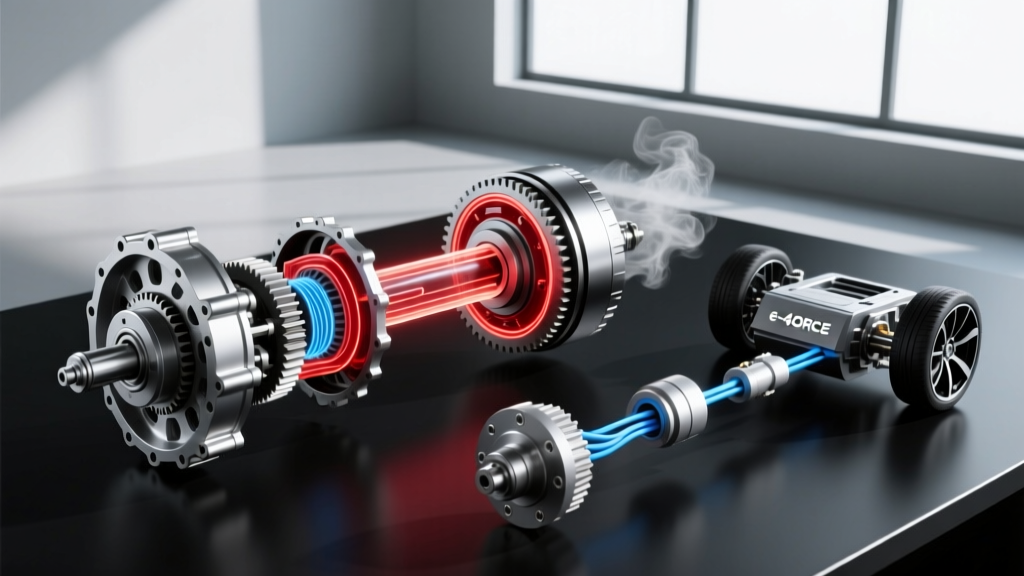
With the introduction of the Ariya and the e-POWER series, Nissan has moved away from mechanical driveshafts in its electrified models. The e-4ORCE system utilizes independent front and rear electric motors. According to Nissan's global engineering releases, e-4ORCE doesn't just manage traction; it actively manages vehicle pitch and dive by balancing regenerative braking between the front and rear motors. Because there is no mechanical PTU, driveshaft, or rear differential clutch pack, the traditional mechanical failure points are eliminated, fundamentally changing what is covered under the Nissan drivetrain warranty for electric vehicles.
Critical Maintenance: Fluids, Capacities, and Torque Specs
The most common cause of PTU and rear coupling failure in Nissan's mechanical AWD systems is fluid degradation. The PTU is located near the hot catalytic converter and exhaust manifold, causing the hypoid gear oil to oxidize rapidly. Many owners mistakenly believe these units are 'sealed for life,' which leads to catastrophic gear whine and eventual seizure.
- PTU (Transfer Case) Fluid: Requires Nissan Genuine Transfer Fluid (Part # 999MP-TF0000P) or an equivalent Dexron VI ATF depending on the specific Jatco transfer case model. Capacity is typically small, around 0.40 to 0.55 liters.
- Rear Differential Fluid: Requires API GL-5 75W-90 Synthetic Gear Oil or Nissan Genuine Differential Fluid (Part # 999MP-DF0000P). Capacity is approximately 0.55 liters.
- Torque Specifications: When performing service, the PTU drain and fill plugs must be torqued to 35 Nm (26 lb-ft). The PTU-to-transaxle mounting bolts require 45 Nm (33 lb-ft), and the rear driveshaft flange bolts at the differential should be torqued to 40 Nm (30 lb-ft).
Expert Tip: Under severe driving conditions (frequent towing, extreme heat, or mountain driving), the PTU fluid should be replaced every 30,000 miles. Failure to do so can give Nissan grounds to deny a claim under the Nissan drivetrain warranty due to negligence.
Navigating the Nissan Drivetrain Warranty Coverage
Nissan does not offer a standalone 'drivetrain' warranty; rather, drivetrain components are covered under the comprehensive 5-Year/60,000-Mile Powertrain Limited Warranty. This warranty covers the internal lubricated parts of the engine, transmission, transfer case (PTU), drive shafts, and differentials. However, it is vital to understand the boundary between a covered internal failure and an excluded wear-and-tear item.
For exact terms, owners should always consult Nissan's official warranty portal, but below is a practical breakdown of how 2026 repair costs align with warranty coverage for AWD components.
| AWD Component | Warranty Status (Under 60k Miles) | Common Failure Mode | 2026 Out-of-Pocket Replacement Cost |
|---|---|---|---|
| Power Transfer Unit (PTU) | Covered (Internal gears/bearings) | Hypoid gear stripping, bearing seizure | $1,800 - $2,600 |
| Rear Electromagnetic Coupling | Covered (Internal clutch/coil) | Coil burnout, clutch pack glazing | $950 - $1,400 |
| Propeller Shaft (Driveshaft) | Covered (U-joints/Center bearing) | Center support bearing collapse | $800 - $1,200 |
| CV Axle Boots & Joints | Excluded (Wear/Environmental damage) | Torn boots, grease contamination | $250 - $600 per axle |
| AWD Control Module / Sensors | Covered (Under 3yr/36k Bumper-to-Bumper) | Water intrusion, steering angle sensor fault | $400 - $850 |
Common AWD Failure Modes and Diagnostic Trouble Codes (DTCs)
When an AWD system malfunctions, the vehicle's fail-safe mode typically defaults to FWD to protect the driveline. Technicians will often encounter specific DTCs that dictate whether a repair is a simple sensor swap or a major mechanical teardown.
C1105 & C1111: Sensor and Module Faults
DTC C1105 (Rear Wheel Speed Sensor) and C1111 (AWD Control Module) are common electronic gremlins. If a wheel speed sensor fails, the AWD module cannot calculate slip accurately and will disable the rear coupling. These electronic components are only covered under the 3-year/36,000-mile basic warranty, meaning owners outside this window will pay out-of-pocket, even if the Nissan drivetrain warranty is still active for mechanical parts.
Metal Contamination in the PTU
If a driver ignores a whining noise emanating from the passenger side firewall, the PTU's internal bearings may disintegrate. When a dealer inspects the PTU fluid and finds heavy metallic glitter (indicating catastrophic gear wear), they will authorize a full PTU replacement under the powertrain warranty. However, if the fluid is completely burnt or absent, the warranty claim will likely be denied for lack of maintenance.
Summary: Protecting Your Drivetrain Investment
Nissan's AWD systems are highly capable, balancing fuel economy with all-weather traction through sophisticated electromagnetic clutch packs and advanced control modules. Whether you are driving a mechanical Intelligent AWD Rogue or an electrified Ariya, understanding the limits of your coverage is essential. Adhere strictly to the 30,000-mile severe-service fluid intervals for the PTU and rear differential, keep detailed maintenance records, and ensure that any diagnostic work is performed by technicians who understand the nuances of Nissan's torque-vectoring logic. By doing so, you ensure that if a major component fails, the Nissan drivetrain warranty will perform exactly as intended, saving you thousands in out-of-pocket repair costs.