The MT-82 Transmission: A Masterclass in Clutch Hydraulics
For enthusiasts and daily drivers alike, the Ford Mustang GT equipped with the TREMEC MT-82 6-speed manual transmission offers a visceral connection to the road. However, as these vehicles age and power levels increase, clutch pedal problems become a notorious point of failure. Whether you are experiencing a spongy pedal that sinks to the floor, a stiff pedal that binds during engagement, or a violent vibration at the friction point, diagnosing the issue requires a deep understanding of the specific TREMEC architecture.
Unlike older cable-driven setups, the MT-82 relies on a complex hydraulic circuit and an internal Concentric Slave Cylinder (CSC). When evaluating the various parts of a car clutch in this specific platform, technicians must look beyond the friction disc and examine the hydraulic master cylinder, the plastic quick-connect lines, the pivot ball, and the dual-mass flywheel (DMF). This model-specific repair guide breaks down the exact failure modes, torque specifications, and diagnostic protocols required to restore optimal pedal feel in 2026.
Symptom Diagnostics: Decoding Pedal Feel
1. Spongy or Soft Pedal (Hydraulic Aeration & CSC Failure)
A soft, spongy pedal that fails to disengage the clutch fully is the most common MT-82 complaint. This is rarely caused by the friction disc itself. Instead, it points to hydraulic aeration or internal seal degradation.
- Plastic Quick-Connect Lines: The OEM hydraulic line uses a plastic quick-connect fitting at the master cylinder. Under high under-hood temperatures, this plastic degrades, allowing microscopic air ingress without necessarily leaking fluid.
- Internal CSC Seal Blowout: The Concentric Slave Cylinder operates inside the bellhousing. If a previous owner or inexperienced mechanic used a high-pressure motive bleeder (over 15 PSI), the internal CSC lip seal can invert or blow out, leading to a permanently soft pedal and fluid pooling inside the bellhousing.
2. Hard or Stiff Pedal (Mechanical Binding)
If the pedal requires excessive physical force to depress, the hydraulic system is likely functioning, but the mechanical linkage is binding.
- Pivot Ball and Fork Wear: The MT-82 utilizes a stamped steel clutch fork that rides on a hardened steel pivot ball. Over 60,000 miles, the factory grease dries out, and the fork wears a groove into the ball. This creates immense friction, resulting in a stiff pedal and a distinct 'creaking' noise when depressing the clutch.
- Aftermarket Pressure Plate Fingers: Upgrading to a high-clamp-load aftermarket pressure plate (like a McLeod Street Twin) without upgrading the master cylinder bore size will result in a brutally stiff pedal. The OEM 19.05mm master cylinder cannot efficiently move the volume required for heavy-duty diaphragm springs.
3. Vibrating Pedal (Resonance and Flywheel Issues)
A vibrating or chattering pedal upon engagement is a mechanical resonance issue transferring through the hydraulic fluid and pedal box.
- Dual Mass Flywheel (DMF) Spring Fatigue: The OEM Luk DMF contains internal arc springs designed to dampen torsional vibration from the Coyote V8. When these springs sag or break, the flywheel develops excessive radial play, causing a severe shudder felt directly in the clutch pedal.
- Throwout Bearing (TOB) Harmonics: The CSC integrates the throwout bearing. If the bearing race is pitted, it will transmit high-frequency vibration through the hydraulic line directly to the driver's foot.
Mapping the Parts of a Car Clutch: MT-82 Specifics
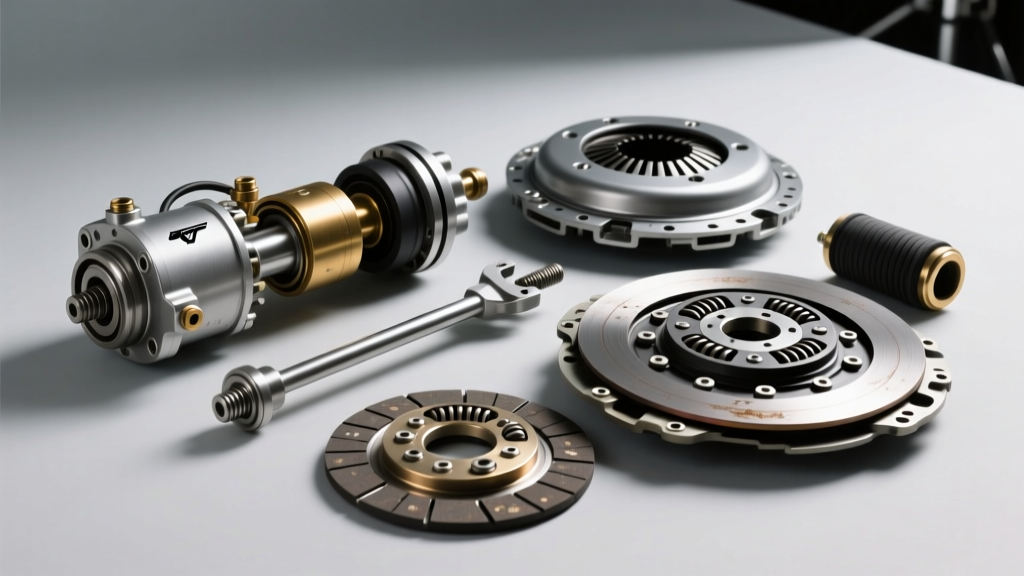
To properly diagnose and repair the system, you must source the correct OEM or high-quality aftermarket components. Below is a critical reference table for the MT-82 clutch system, including part numbers and exact torque specifications required for reassembly.
| Component | OEM / Aftermarket Part # | Torque Spec / Measurement | Common Failure Mode |
|---|---|---|---|
| Clutch Master Cylinder | Motorcraft BR3Z-7A543-A | 12 lb-ft (Firewall Nuts) | Internal bypass leak, pushrod wear |
| Concentric Slave Cylinder (CSC) | Ford BR3Z-7A548-A / Exedy ESC024 | 11 lb-ft (Hardline Flare Nut) | Heat soak, lip seal inversion |
| Hydraulic Line (Upgrade) | Stainless Braided (Various) | Hand-tight + 1/4 turn | Plastic fitting degradation |
| Dual Mass Flywheel (DMF) | Luk RepSet 05-072 / McLeod SFI | 59 lb-ft + 90 deg (M12 Bolts) | Internal spring sag, surface hot-spotting |
| Clutch Fork & Pivot Ball | Ford 7A507 / Aftermarket HD | 35 lb-ft (Pivot Bolt) | Grooving, lack of lubrication |
Advanced Diagnostic & Repair Protocol
Step 1: The External Hydraulic Bench Test
Before dropping the transmission, isolate the hydraulic system. Disconnect the hardline at the bellhousing and plug it. Have an assistant depress the pedal. If the pedal feels firm and the master cylinder pushrod travels its full 18mm stroke without sinking, your master cylinder and firewall are intact. The issue lies inside the bellhousing (CSC or mechanical binding).
Step 2: Transmission Drop and Internal Inspection
When removing the MT-82, support the transmission using a dedicated adapter plate to avoid bending the aluminum tail housing. Once the bellhousing is off, inspect the clutch fork contact pad. If you see a shiny, worn divot, the pivot ball must be replaced. Pro-Tip: When installing the new pivot ball and fork, coat the contact surfaces with high-temperature molybdenum disulfide (moly) grease, not standard lithium grease, which will melt and attract clutch dust.
Step 3: The MT-82 'Zip-Tie' Bleeding Method
Bleeding the MT-82 internal CSC is notoriously difficult because the slave cylinder sits lower than the master cylinder, trapping air in the line. Do not use a pressure bleeder set above 12 PSI, or you risk blowing the new CSC seal.
- Fill the reservoir with fresh Motorcraft DOT 4 LV (Low Viscosity) fluid.
- Open the bleeder screw on the CSC hardline.
- Depress the clutch pedal to the floor and secure it using a zip-tie or bungee cord wrapped around the pedal arm and the steering column.
- Leave the vehicle overnight. The slow, continuous pressure allows microscopic air bubbles to migrate up the line and into the reservoir without agitating the fluid.
- In the morning, close the bleeder screw, remove the zip-tie, and pump the pedal 20 times to seat the CSC piston against the pressure plate fingers.
2026 Market Pricing and Sourcing Realities
When planning your repair, it is vital to account for current market rates. As of 2026, the OEM Ford CSC (Part # BR3Z-7A548-A) typically retails between $180 and $240 on platforms like RockAuto. However, labor is the primary cost driver. Because the MT-82 requires complete removal to access the CSC, expect shop labor to range from $800 to $1,200 depending on your region.
If you are upgrading to handle modified power levels (450+ RWHP), bypassing the OEM DMF for an McLeod Racing Single Mass Flywheel and Street Twin clutch kit is highly recommended. While the initial parts cost is higher ($900 - $1,400), it eliminates the DMF spring failure point entirely and provides a much more linear, predictable pedal feel.
Expert Summary: Preventing Premature Failure
The longevity of the MT-82 clutch system relies heavily on heat management and fluid maintenance. The CSC is positioned dangerously close to the exhaust downpipes. Installing a high-quality heat shield wrap on the exhaust and changing the hydraulic fluid every 24 months will drastically reduce the thermal degradation of the CSC seals. By understanding how the specific parts of a car clutch interact within the MT-82 ecosystem, you can accurately diagnose pedal anomalies and execute a repair that restores factory-perfect engagement.