While every automotive enthusiast knows that a clutch pedal will be found in a vehicle with a manual transmission, diagnosing the intricate mechanical and hydraulic linkages connecting that pedal to the release bearing requires specialized, model-specific knowledge. For owners of the 2011–2023 Ford Mustang equipped with the Tremec MT-82 6-speed manual transmission, throw-out bearing (release bearing) noise is a frequent and highly specific complaint. Unlike older pushrod setups, the MT-82 utilizes a complex external hydraulic slave cylinder actuating a stamped steel clutch fork, creating unique failure modes that generic repair manuals often overlook.
In this 2026 model-specific repair guide, we dissect the exact failure points of the MT-82 release system, map acoustic symptoms to mechanical faults, and provide the precise torque specifications and part numbers required to execute a permanent repair.
The MT-82 Release System Architecture
To accurately diagnose throw-out bearing noise, you must first understand how the MT-82 transfers hydraulic pressure into mechanical clamping force. The system relies on a Clutch Master Cylinder (CMC) located in the engine bay, which pushes fluid through a hard plastic hydraulic line to an external slave cylinder mounted on the passenger side of the aluminum bellhousing.
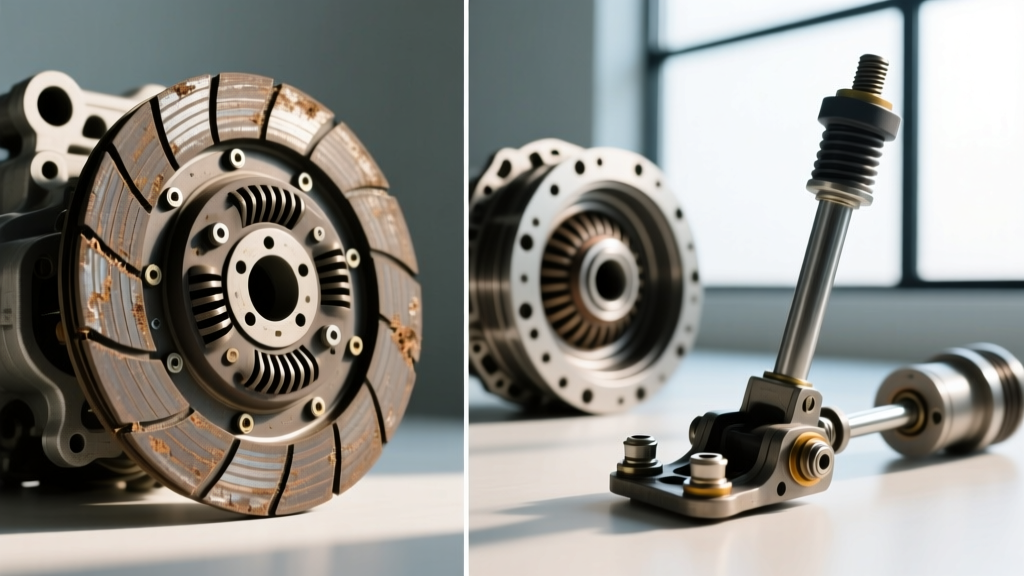
The slave cylinder pushrod actuates a stamped steel clutch fork. This fork pivots on a hardened steel ball stud threaded into the bellhousing. As the fork pivots, it pushes a carbon-faced release bearing along the input shaft bearing retainer collar, depressing the diaphragm spring fingers of the pressure plate. Because the MT-82 uses a constant-contact or near-constant-contact design depending on the specific clutch kit installed, the release bearing is under perpetual load, making it highly susceptible to premature wear if hydraulic free-play is incorrect or if the pivot geometry degrades.
Acoustic Diagnostics: Mapping Throw-Out Bearing Noise
Throw-out bearing noise is rarely a singular sound. The acoustic profile changes based on pedal position, engine RPM, and ambient temperature. Use the following diagnostic matrix to isolate the exact MT-82 failure point before ordering replacement parts.
| Pedal Position | Noise Profile | Likely MT-82 Culprit | Corrective Action |
|---|---|---|---|
| Released (Foot Off) | Continuous light growl or whirring | Release bearing riding on diaphragm springs due to lack of free-play | Inspect CMC pushrod adjustment; check clutch fork pivot ball wear |
| Depressed (Foot Down) | Loud grinding, rumble, or metallic scraping | Release bearing cage failure, dried internal grease, or pilot bearing failure | Replace release bearing; inspect input shaft bore and pilot bearing |
| Mid-Travel / Engagement Zone | High-pitched metallic chirp or squeak | Dry clutch fork pivot ball, worn fork pad, or binding slave cylinder pushrod | Lubricate pivot ball with moly grease; replace fork if grooved >0.5mm |
| Clutch Disengaged (Held Down) | Rattling or buzzing that disappears with slight RPM increase | Marcel spring fragmentation or loose diaphragm spring retainer rivets | Remove transmission; replace pressure plate assembly immediately |
The Infamous MT-82 Pivot Ball and Fork Wear
If your Mustang exhibits a rhythmic chirping sound exactly at the top inch of clutch pedal travel, the throw-out bearing itself may be perfectly fine. The MT-82 is notorious for clutch fork pivot ball wear. The stamped steel fork rubs against the hardened steel pivot ball under immense hydraulic pressure. Over 60,000 to 80,000 miles, the factory grease degrades, and the fork begins to gouge the ball stud.
Inspection Measurements and Tolerances
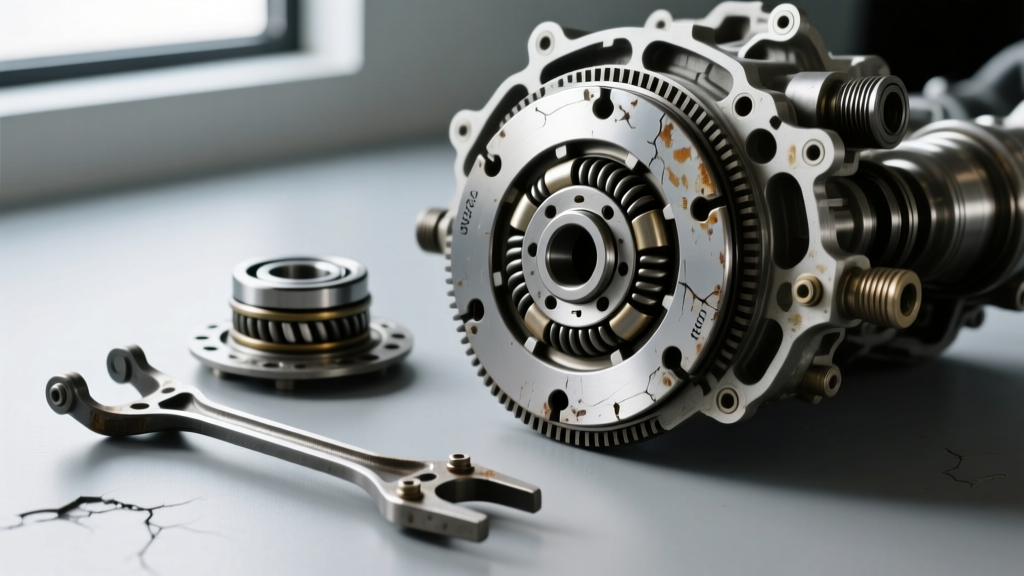
When the transmission is removed, you must measure the wear interface. According to TREMEC Drivetrain Solutions service guidelines and independent transmission specialists, the pivot ball diameter should remain within 0.002 inches of its factory spec (typically 0.750 inches). If the ball exhibits a flat spot or the fork pad has a groove deeper than 0.5mm, the geometry of the release system is compromised. This altered geometry forces the throw-out bearing to approach the pressure plate fingers at a slight angle, causing the carbon face to wear unevenly and generating a distinct squeal.
Pro-Tip for 2026 Builds: Many performance shops are now upgrading to aftermarket billet aluminum clutch forks with replaceable bronze pivot pads (such as those from Steeda or McLeod) to eliminate this wear point entirely when performing a throw-out bearing replacement.
Teardown Inspection: The Input Shaft Bearing Retainer
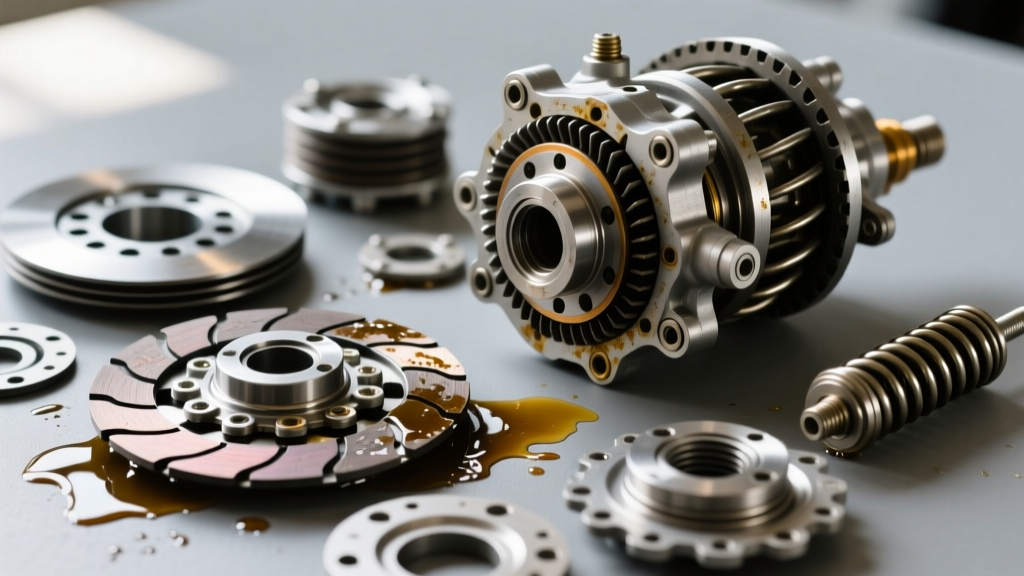
A critical, often-missed step in MT-82 clutch service is inspecting the input shaft bearing retainer collar (the sleeve the throw-out bearing slides on). The factory MT-82 release bearing features a plastic/nylon friction ring on its inner diameter to reduce noise and prevent the bearing from spinning the collar.
If the throw-out bearing has been subjected to extreme heat from a slipping clutch, or if it has simply reached the end of its service life, this plastic ring can melt or wear away. Once gone, the steel inner race of the bearing grinds directly against the steel retainer collar. This will score the collar deeply. If you install a new throw-out bearing on a scored collar, the new bearing will bind, overheat, and fail within 5,000 miles. If the collar is scored beyond light surface polishing with 400-grit emery cloth, the entire front bearing retainer assembly must be replaced.
MT-82 Reassembly Torque Specifications and Part Data
When reinstalling the MT-82 and replacing the release components, adherence to exact torque specifications is non-negotiable to prevent bellhousing distortion and input shaft misalignment. Below is the critical data for the 5.0L Coyote V8 MT-82 application.
Essential OEM Part Numbers
- Release Bearing: Motorcraft CM-8111 (or Ford Performance M-7548-M8 for heavy-duty applications)
- Clutch Fork Pivot Ball: Ford W716210-S437
- External Slave Cylinder: Motorcraft CM-8124
- Hydraulic Fluid: Motorcraft DOT 4 LV (Low Viscosity) High Performance Motor Vehicle Brake Fluid (PM-22)
Critical Torque Specifications
- Bellhousing to Engine Block (M10 Bolts): 37 lb-ft (50 Nm)
- Bellhousing to Engine Block (M12 Bolts): 59 lb-ft (80 Nm)
- Clutch Fork Pivot Ball to Bellhousing: 28 lb-ft (38 Nm) (Apply high-strength threadlocker)
- External Slave Cylinder to Bellhousing: 18 lb-ft (25 Nm)
- Flywheel to Crankshaft (5.0L Coyote): 59 lb-ft (80 Nm) + 90-degree final turn (TTY bolts must be replaced)
Hydraulic Bleeding Protocol for the External Slave
A new throw-out bearing will fail prematurely if the hydraulic system retains air, as aerated fluid compresses and prevents the clutch from fully disengaging. This causes the release bearing to drag against the spinning pressure plate fingers even when the pedal is fully depressed. The MT-82 hydraulic line features a notorious high-point trap near the bellhousing that makes gravity bleeding nearly impossible.
For a successful 2026 repair, use a pressure bleeder set to 15–20 PSI on the master cylinder reservoir. Have an assistant monitor the slave cylinder pushrod travel while you crack the bleeder screw on the external slave. You must cycle the clutch pedal slowly 30 to 40 times to force micro-bubbles out of the CMC internal valve mechanism. If the slave cylinder pushrod does not extend a minimum of 0.65 inches during disengagement, the system still contains air or the CMC internal seals are bypassing fluid—a common failure on 2011–2014 models that requires upgrading to the revised 2015+ CMC or an aftermarket Max Motorsports unit. Proper hydraulic health is just as vital as the mechanical throw-out bearing itself.
For further technical documentation on Tremec manual transmissions and clutch actuation systems, refer to the Ford Performance Parts Catalog and your specific vehicle's OEM service manual.