The 2026 Motorcycle Drivetrain Landscape: Beyond the Basics
When evaluating motorcycle drivetrain types, most riders stop at the superficial pros and cons: chains are loud but efficient, belts are quiet but fragile, and shafts are heavy but maintenance-free. As a senior drivetrain technician, I can tell you that this outdated binary thinking leads to catastrophic failures and unnecessary dealership bills. In 2026, modern metallurgy, advanced polymer composites, and precision CNC machining have fundamentally shifted the repair paradigms for these systems.
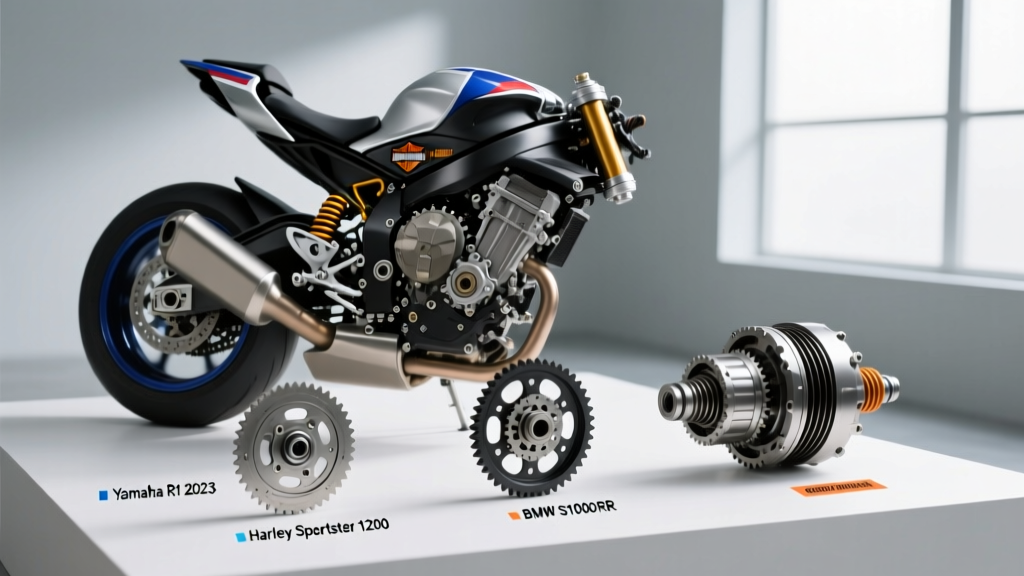
This model-specific repair guide bypasses generic advice. We will dissect the three primary motorcycle drivetrain configurations by anchoring our technical data to three benchmark platforms: the chain-driven Yamaha MT-07, the belt-driven Harley-Davidson Sportster S, and the shaft-driven BMW R 1250 GS. Expect exact torque specifications, OEM part numbers, fluid capacities, and real-world failure modes.
1. Chain Drive Systems: Yamaha MT-07 (CP2 Platform)
The chain drive remains the undisputed king of power transfer efficiency, routinely delivering 95% to 98% of crankshaft power to the rear contact patch. However, the Yamaha MT-07’s high-torque 689cc CP2 parallel-twin engine places immense tensile stress on the final drive components, accelerating stretch and sprocket wear if maintenance intervals are ignored.
OEM Specifications & Component Sourcing
- Chain Spec: 520 pitch, 104 links, O-ring or X-ring.
- OEM Replacement: DID 520 VX3 X-Ring Series (Approx. $135 USD).
- Sprockets: 15-tooth front (JT JTF1590.15), 43-tooth rear (JT JTR866.43). Always replace as a matched set to prevent accelerated pitch mismatch wear.
Precision Adjustment & Torque Protocol
The most common error in chain maintenance is over-tensioning. The MT-07 requires a static slack measurement of 20.0 mm to 30.0 mm (0.8 - 1.2 in) measured at the midpoint of the lower chain run. Over-tensioning causes excessive load on the transmission output shaft bearing, leading to premature weeping of the countershaft seal.
Critical Torque Specifications:
- Rear Axle Nut (27mm): 105 Nm (77 lb-ft). Always use a calibrated torque wrench; impact guns routinely stretch the axle threads.
- Countershaft Sprocket Nut (30mm): 76 lb-ft (103 Nm). Apply a medium-strength threadlocker (Loctite 243) if the factory locking tab is fatigued.
- Chain Adjuster Lock Nuts (12mm): 23 Nm (17 lb-ft). Ensure the left and right hash marks on the swingarm are perfectly symmetrical before final torquing to maintain rear wheel alignment.
Expert Insight: To measure chain stretch accurately, do not guess by pulling the chain off the rear sprocket. Measure the pin-to-pin distance over 17 pins. According to DID Chain's official engineering guidelines, if the 16-pitch length exceeds 272 mm on a 520 chain, immediate replacement is mandatory to prevent chain skip under heavy throttle application.
2. Belt Drive Systems: Harley-Davidson Sportster S (1250T)
Harley-Davidson’s transition to the liquid-cooled Revolution Max 1250T engine in the Sportster S brought modern sportbike performance to a brand historically defined by belt-driven cruisers. The belt drive utilizes a carbon-reinforced Kevlar matrix, offering near-silent operation and zero lubrication requirements, but it demands surgical precision during tensioning and alignment.
Belt Deflection & Alignment Parameters
Unlike a chain, a belt cannot tolerate lateral misalignment. Even a 2-degree tracking error will cause the belt to ride up against the pulley flange, resulting in severe edge fraying and eventual tensile cord exposure.
- Target Deflection: 3/8" to 1/2" (9.5 - 12.7 mm) upward travel.
- Measurement Force: Exactly 10 lbs (4.5 kg) of force applied at the midpoint of the lower belt run. Use a calibrated belt tension gauge (Harley P/N 95900-02B or equivalent).
- Rear Axle Torque: 95 - 105 ft-lbs (129 - 142 Nm) using a 1" (25.4mm) or specific OEM rear axle socket.
Failure Modes & Component Pricing
The most frequent failure mode on the Sportster S is not belt snapping, but hook wear on the belt teeth. This occurs when the belt is chronically under-tensioned, allowing the teeth to ratchet against the rear pulley under the 1250T's aggressive low-end torque delivery. A replacement OEM rear belt pulley assembly costs upwards of $450, while a Gates PowerGrip replacement belt retails for approximately $260. For deep dives into polymer belt degradation, the materials science publications via Gates Corporation remain the industry standard reference.
3. Shaft Drive Systems: BMW R 1250 GS (Paralever)
The BMW Paralever shaft drive is an engineering marvel, utilizing a single-sided swingarm and a dual universal joint setup to eliminate the shaft jacking effect inherent to older designs. While marketed as "maintenance-free," the reality is that the final drive unit requires meticulous, albeit infrequent, fluid and spline care to survive past 100,000 miles.
Final Drive Fluid Service Protocol
The hypoid gears inside the R 1250 GS final drive operate under extreme shear loads. BMW mandates the use of SAF-XO 75W-90 synthetic hypoid gear oil (BMW Part # 83222410058).
- Capacity: Exactly 200 ml. Overfilling will blow the final drive pinion seal under thermal expansion.
- Drain & Fill Plugs: M10x1 thread, 8mm Hex socket.
- Torque Spec: 10 Nm (7.4 lb-ft). Crucial: You must use a new aluminum crush washer (Part # 33117695230) on every service. Reusing old washers guarantees slow weeping and eventual gear starvation.
Spline Lubrication: The Silent Killer
Every time the rear wheel is removed for a tire change, the final drive splines are exposed. If these splines are reassembled dry, the micro-welding and subsequent galling will destroy the final drive crown wheel shaft—a $2,500+ repair. You must apply a high-molybdenum disulfide grease, such as Castrol Spheerol LMM or Honda Moly 60, to the male splines before re-seating the wheel. Wipe away excess grease to prevent dirt accumulation, which acts as a lapping compound.
Comparative Analysis: Drivetrain Efficiency & Lifecycle Costs
Understanding the long-term financial and mechanical footprint of your motorcycle drivetrain is critical for both DIY wrenches and fleet managers. The table below synthesizes real-world data for the three platforms discussed.
| Metric | Chain (Yamaha MT-07) | Belt (HD Sportster S) | Shaft (BMW R 1250 GS) |
|---|---|---|---|
| Power Transfer Efficiency | 95% - 98% | 90% - 95% | 85% - 90% |
| Routine Maintenance Interval | Every 500 - 1,000 miles (Lube/Adjust) | Every 5,000 miles (Tension Check) | Every 12,000 miles (Fluid Change) |
| Complete Replacement Cost | $200 - $250 (Chain + Sprockets) | $500 - $750 (Belt + Pulleys) | $2,000+ (Final Drive Rebuild) |
| Expected Lifespan | 15,000 - 25,000 miles | 40,000 - 60,000 miles | 100,000+ miles |
| Primary Failure Catalyst | Neglect, lack of lubrication, over-tensioning | Misalignment, debris ingestion, under-tensioning | Fluid starvation, dry spline assembly |
Expert Verdict & Final Wrenching Advice
There is no universally "best" motorcycle drivetrain; there is only the right drivetrain for the intended application and the owner's maintenance discipline. If you are tracking an MT-07 or riding off-road, the chain's serviceability and efficiency are non-negotiable. If you are commuting and touring on a Sportster S, the belt's zero-lube requirement outweighs its vulnerability to road debris. For the high-mileage adventure tourer on an R 1250 GS, the shaft drive's parasitic loss is a worthy trade-off for crossing continents without carrying a chain break tool.
Regardless of the system, the cornerstone of drivetrain longevity is adherence to OEM torque specifications and the use of calibrated measuring tools. Guesswork with a pry bar and a standard wrench is the fastest route to a stranded ride and a depleted bank account. Always consult your specific model's factory service manual for the most current revision of torque values and fluid specifications before turning a single wrench.