When automotive owners experience engine overheating or loud roaring noises at highway speeds, they frequently search for a fan clutch not working to diagnose their vehicle's thermal cooling fan. However, if you are a motorcycle rider or an ATV enthusiast, your machine operates on an entirely different mechanical philosophy. Motorcycles and modern ATVs do not use thermal fan clutches for cooling; instead, they rely on complex drivetrain clutches to transfer power from the engine to the wheels.
For beginners stepping into the garage, diagnosing powersports clutch issues can seem intimidating. Whether you are dealing with a slipping wet multi-plate clutch on a street bike or a failing CVT (Continuously Variable Transmission) centrifugal clutch on a UTV, understanding the specific symptoms, measurements, and repair costs is critical. In this 2026 beginner-friendly explainer, we will break down exactly how to diagnose clutch problems specific to motorcycles and ATVs, complete with real-world torque specs, part numbers, and diagnostic frameworks.
The 'Fan Clutch' Misconception in Powersports
Before pulling out your wrenches, it is vital to clear up a common beginner misconception. In cars and trucks, a fan clutch is a thermostatic device attached to the engine's cooling fan. It disengages the fan at low temperatures to save horsepower and engages it when the engine gets hot.
Motorcycles and ATVs, however, use electric radiator fans triggered by a coolant temperature sensor, or they rely entirely on liquid-cooling systems without mechanical fan clutches. Therefore, if your bike or ATV is overheating, you are likely looking at a failed electric fan relay, a clogged radiator, or a bad water pump—not a 'fan clutch.' The actual drive clutches on your powersports vehicle are located in the transmission (motorcycles) or the CVT housing (ATVs/UTVs), and their sole job is to manage torque delivery to the drivetrain.
Motorcycle Wet Multi-Plate Clutch Diagnostics
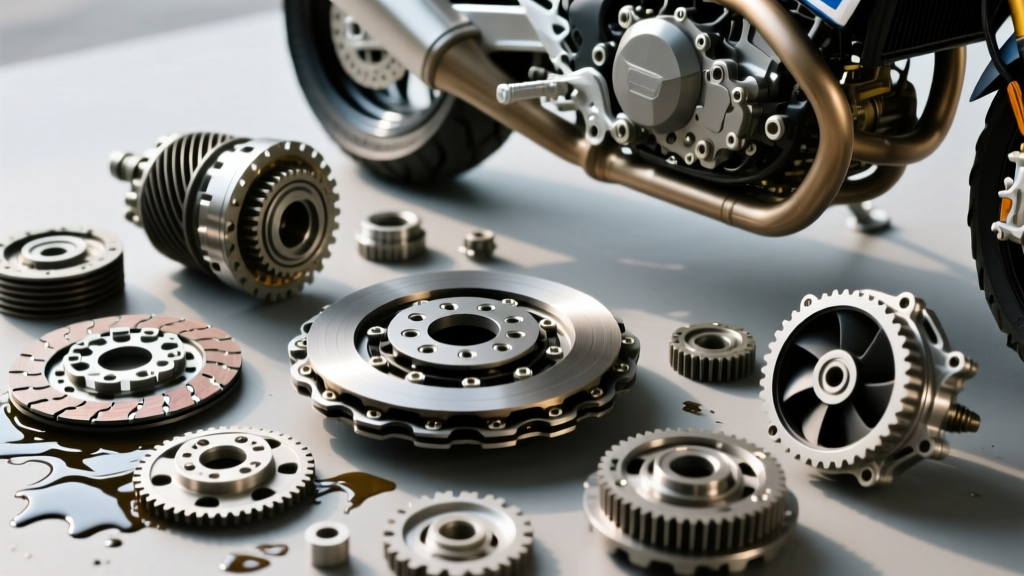
Most manual motorcycles use a 'wet' multi-plate clutch system. This means the friction plates and steel separator plates are bathed in engine oil, which cools the components and prevents them from burning up under heavy load. When this system fails, it typically manifests in two ways: slippage or chatter.
Identifying Slippage vs. Chatter
- Clutch Slippage: You roll on the throttle in third gear, the engine RPMs surge, but your road speed doesn't increase proportionally. This means the friction plates are worn out, the clutch springs have sagged, or you are using the wrong engine oil.
- Clutch Chatter: When releasing the lever from a stop, the bike shudders violently or grabs abruptly. This is usually caused by warped steel plates, contaminated oil, or a notched clutch basket.
Hard Measurements: When to Replace
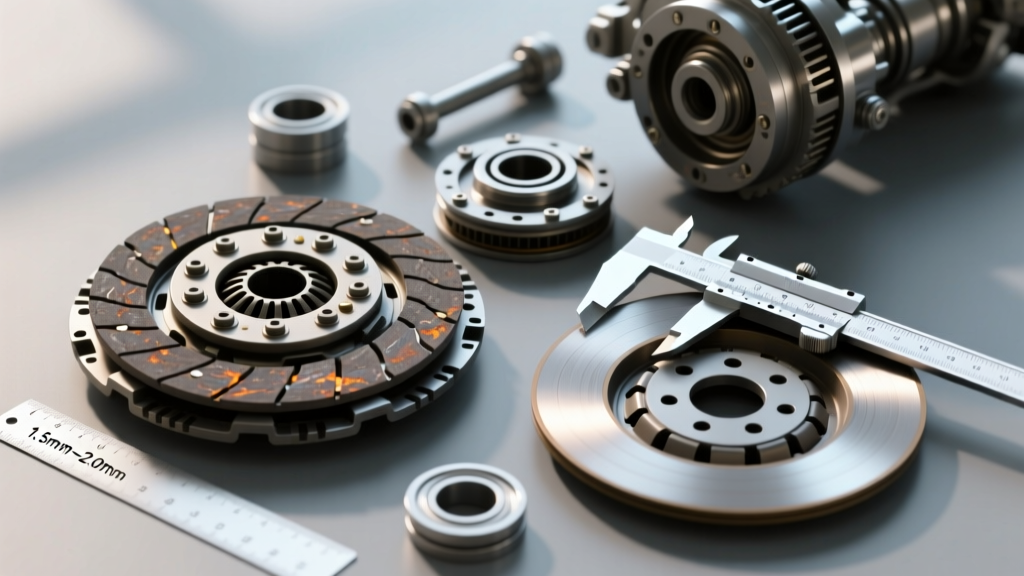
Diagnosing a wet clutch requires a set of digital calipers and a service manual. Let us look at a popular beginner and intermediate platform: the Yamaha MT-07 (CP2 engine). When you pull the clutch pack out, you must measure two critical dimensions:
- Friction Plate Thickness: The standard thickness is 3.0 mm. The absolute service limit is 2.8 mm. If your plates measure 2.75 mm, they are slipping and must be replaced. An EBC CK Series Kevlar clutch kit (Part #CK2414) costs around $115 and provides excellent bite.
- Clutch Spring Free Length: Standard length is 46.5 mm. The service limit is 44.2 mm. Springs lose their tension over time due to heat cycling. If they are compressed past 44.2 mm, they cannot apply enough clamping force, leading to slip under heavy acceleration.
Expert Torque Spec: When reassembling, the clutch boss center nut on the MT-07 requires exactly 65 Nm (48 lb-ft) of torque. Always use a universal clutch holding tool to prevent the basket from spinning while you torque the nut.
ATV and UTV CVT Centrifugal Clutch Failures
If you ride a Polaris RZR, Honda Foreman, or Can-Am Maverick, you likely have a CVT. A CVT does not use traditional friction plates; it uses a primary (drive) clutch, a secondary (driven) clutch, and a heavy-duty drive belt. These clutches rely on centrifugal force and mechanical ramps to change gear ratios infinitely.
Primary Clutch Symptoms (The Drive Clutch)
The primary clutch is attached to the engine crankshaft. Inside, it uses roller weights (or sliders) and a massive one-way bearing.
- Symptom: The ATV struggles to reach top speed, or the engine bogs down when climbing hills.
- Diagnosis: Check the roller weights. On a Polaris Sportsman 570, the factory roller weights are typically 62 grams. If the weights develop flat spots or shed material, the clutch sheaves will not open fully, robbing you of top-end ratio. Furthermore, if you hear a loud metallic grinding or 'freewheeling' noise when decelerating, the primary clutch one-way bearing has failed—a common issue requiring a $250 bearing and a specialized puller tool to extract.
Secondary Clutch and Belt Deflection
The secondary clutch is attached to the transmission input shaft and uses a helix and a torsion spring to clamp the belt.
- Symptom: Belt slip, a burning rubber smell, or a squealing noise at low speeds.
- Diagnosis: Check your belt deflection. With the ATV in park and the engine off, press down on the top span of the drive belt between the two clutches. The industry standard deflection for most Polaris and Can-Am CVTs is exactly 1-1/4 inches (32 mm). If the belt pushes down 2 inches, your secondary clutch spring is fatigued, or the belt is stretched. An OEM Polaris drive belt (Part #3211180) retails for roughly $190 to $220. Never reuse a glazed or cracked belt.
Symptom-to-Solution Diagnostic Matrix
Use this quick-reference table to pinpoint your powersports clutch issue based on what you are feeling on the trail or the street.
| Symptom | Vehicle Type | Probable Root Cause | Diagnostic Step | Est. Repair Cost (2026) |
|---|---|---|---|---|
| RPMs rise but speed does not | Motorcycle | Worn friction plates or wrong oil | Measure plate thickness with calipers | $90 - $150 (Clutch Kit) |
| Violent shudder from a stop | Motorcycle | Warped steel plates / notched basket | Check steel plates on a glass surface for flatness | $120 - $300 (Steel plates/Basket) |
| Loss of top speed / bogging | ATV / UTV (CVT) | Flat-spotted CVT roller weights | Open primary clutch and inspect weights for wear | $40 - $80 (Weights/Sliders) |
| Belt squeal / burning smell | ATV / UTV (CVT) | Improper belt deflection / weak spring | Measure belt deflection (Target: 1-1/4') | $180 - $250 (OEM Belt) |
| Loud grinding on deceleration | ATV / UTV (CVT) | Failed primary one-way bearing | Remove primary clutch and spin bearing by hand | $200 - $350 (Bearing & Tool) |
The Critical Role of JASO MA2 Fluids
One of the most common reasons beginners experience premature motorcycle clutch failure is using the wrong engine oil. Modern automotive oils (API SP/SN) contain friction modifiers like molybdenum to improve fuel economy in cars. If you put automotive oil in a motorcycle with a wet clutch, those friction modifiers coat the clutch plates, causing immediate and severe slippage.
Always look for the JASO MA2 certification on your oil bottle. The Japanese Automotive Standards Organization (JASO) MA2 standard guarantees a high dynamic friction coefficient specifically designed for wet clutch environments. As detailed in the JASO MA friction standards, MA2 oils ensure the clutch can handle the extreme shear forces of high-performance motorcycle engines without slipping. For more on maintaining your drivetrain, RevZilla's clutch maintenance guides offer excellent visual tutorials on cable free-play adjustments, which should be set to 2-3mm of slack at the lever to prevent the clutch from riding and burning up.
Final Thoughts for the Garage
While a 'fan clutch not working' is a valid concern for a Ford F-150 owner, powersports diagnostics require you to look at wet plates, CVT sheaves, and belt deflection. By investing in a $25 set of digital calipers, a factory service manual, and the correct JASO MA2 fluids, you can accurately diagnose and repair your motorcycle or ATV clutch in your own garage. Whether you are replacing a $115 clutch pack on your Yamaha or a $200 drive belt on your Polaris, understanding the hard measurements and mechanical principles will save you hundreds of dollars in dealership labor fees and keep you on the trail or the tarmac where you belong.
For official service intervals and CVT cleaning procedures, always consult your manufacturer's portal, such as the Polaris Official Maintenance Hub, to ensure your specific model's tolerances are met.