The Thermal Paradox: Overheating vs. Underheating in Modern Drivetrains
As we navigate the 2026 automotive landscape, transmission thermal management has become a highly nuanced science. Modern automatic transmissions, such as the GM 10L90, Ford 10R80, and the ubiquitous ZF 8HP series, operate under extreme internal pressures and utilize ultra-low viscosity (ULV) synthetic fluids. These fluids, like Dexron ULV and ZF Lifeguard 8, are engineered to minimize parasitic drag and improve fuel economy. However, they introduce a critical thermal paradox: they must reach optimal operating temperatures rapidly to prevent torque converter shudder and varnish buildup, yet they degrade catastrophically if subjected to sustained temperatures above 220°F (104°C) during heavy towing or off-road crawling.
This paradox forces enthusiasts and fleet managers to choose between two distinct thermal management philosophies: restricting flow to promote rapid warm-up via a transmission cooler bypass valve, or maximizing heat rejection at low speeds using an active system like a Mishimoto transmission cooler with fan. This comprehensive buyer's guide compares these two approaches, helping you determine which solution—or combination thereof—is required for your specific drivetrain.
Decoding the Transmission Cooler Bypass Valve
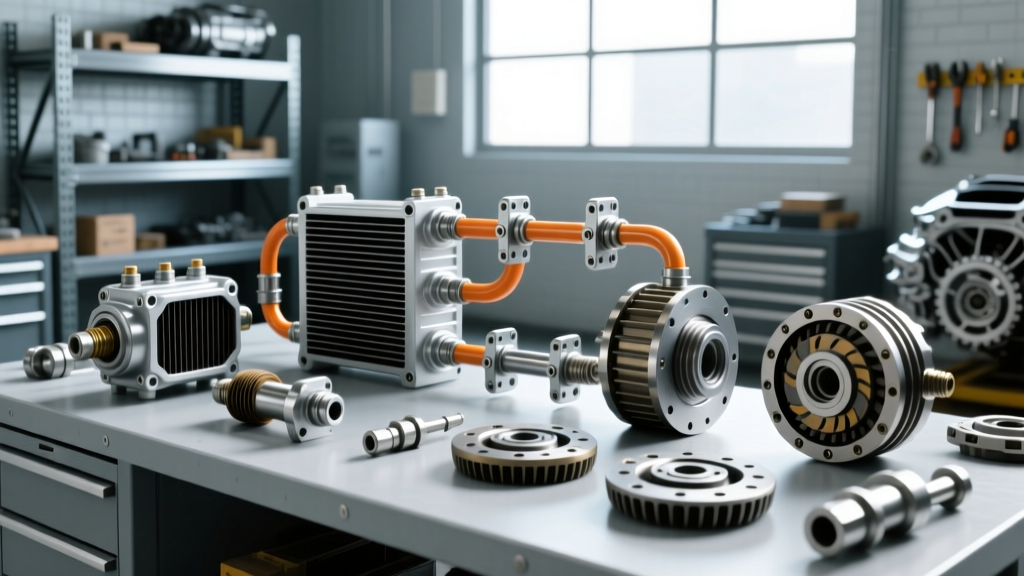
A transmission cooler bypass valve is a thermostatically controlled inline device designed to route hot transmission fluid directly back to the transmission sump, completely bypassing the external cooler until the fluid reaches a predetermined threshold. In most OEM and high-quality aftermarket applications (such as the Hayden 1018 or the OEM GM 13589411 update kit), this threshold is set between 180°F and 190°F (82°C - 87°C).
Why Modern Transmissions Demand Bypass Valves
According to technical bulletins from the Automatic Transmission Rebuilders Association (ATRA), cold fluid routing is a leading cause of premature clutch wear in 6-speed and 8-speed automatics. When ambient temperatures drop below 40°F (4°C), thick, un-warmed fluid forced through a massive front-mount cooler can result in transmission operating temperatures lingering below 140°F for hours. This causes severe shift flare, torque converter slip, and accelerated wear on the mechatronic sleeve in ZF 8HP units. By installing a thermostatic bypass valve, the fluid rapidly heats up through internal transmission friction and torque converter slip, engaging the cooler only when active heat rejection is actually necessary.
- Ideal Applications: Daily drivers in northern climates, GM 6L80/6L90 trucks experiencing cold-shift shudder, and European vehicles with ZF 8HP70/8HP90 transmissions.
- Cost Range: $45 to $120 for inline thermostatic bypass kits.
- Installation Complexity: Low. Requires cutting one OEM rubber cooler line and inserting the valve using hose clamps or barb-to-AN adapters.
Active Heat Rejection: The Mishimoto Transmission Cooler with Fan
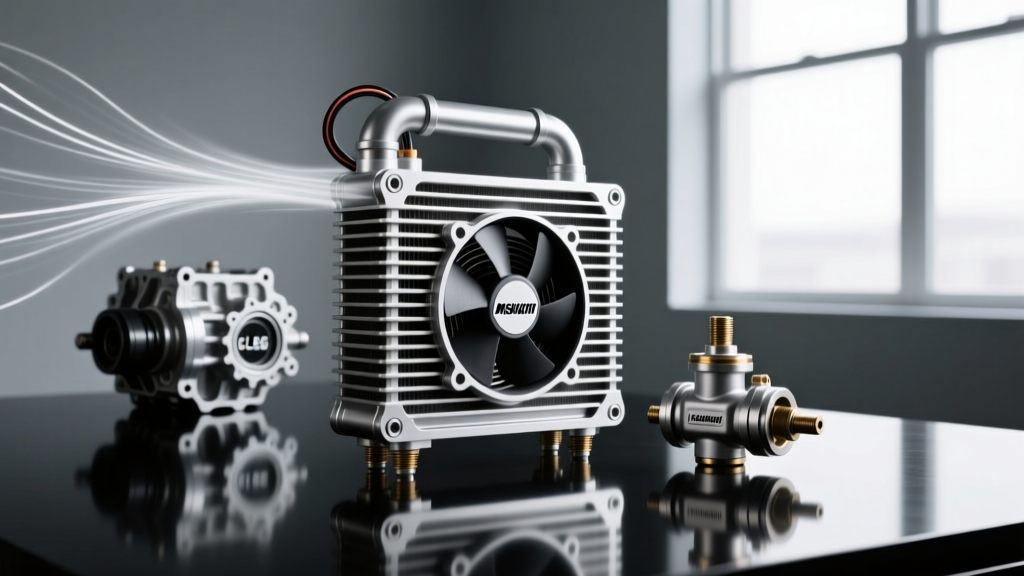
While a bypass valve manages cold-start thermal dynamics, it does nothing to increase the cooling capacity of the system when the vehicle is under extreme load at low speeds. This is where a Mishimoto transmission cooler with fan becomes an absolute necessity. Mishimoto's universal stacked-plate cooler kits (such as the MMTC-U series or specialized application kits) pair high-efficiency brazed aluminum cores with integrated 12V electric fans.
The Engineering Behind Stacked-Plate and Forced Airflow
Unlike traditional tube-and-fin coolers that rely entirely on ram-air effect, Mishimoto's stacked-plate design creates internal turbulence, maximizing the fluid-to-surface-area contact ratio. When you add an integrated 12-inch slim fan pulling upwards of 800 CFM, the cooler becomes independent of vehicle speed. Data published by the Mishimoto Engineering Tech Center demonstrates that fan-assisted stacked-plate coolers can drop transmission fluid temperatures by up to 35°F during idle or low-speed crawling, a scenario where passive coolers fail entirely.
- Ideal Applications: Heavy towing (8,000+ lbs), rock crawling, desert racing, and vehicles with aftermarket high-stall torque converters that generate massive idle heat.
- Cost Range: $280 to $450 for complete Mishimoto fan-assisted kits.
- Installation Complexity: Moderate to High. Requires mounting the cooler, routing a 10-amp fused relay harness to the battery, and fabricating or adapting -6 AN / -8 AN transmission lines.
Head-to-Head Comparison: Bypass Valve vs. Fan-Assisted Cooler
To visualize the distinct roles these components play, review the comparative data table below. Note that these components are not mutually exclusive; in high-end builds, they are often used in tandem.
| Feature / Metric | Thermostatic Bypass Valve | Mishimoto Fan-Assisted Cooler | Combined Sequential System |
|---|---|---|---|
| Primary Function | Promotes rapid fluid warm-up | Maximizes low-speed heat rejection | Total climate-independent control |
| Target Temp Range | 140°F - 180°F (Warm-up phase) | 190°F - 230°F (Load phase) | 180°F - 200°F (Optimal steady-state) |
| Best Transmission Models | ZF 8HP, GM 6L80, Ford 6R80 | GM 10L90, Allison 1000, 4L80E | 10L90 & Allison (Tow/Off-Road) |
| Power Draw | 0 Amps (Passive wax element) | 8 - 12 Amps (Active 12V fan) | 8 - 12 Amps |
| Average Cost (2026) | $65 - $110 | $300 - $450 | $380 - $550 |
Real-World Buyer Scenarios for 2026
Scenario A: The Winter Commuter and Light Duty Truck
If you drive a 2018-2024 Silverado with the 6L80 or 10L90 in a region where winter temperatures routinely drop below freezing, your primary enemy is underheating. Cold Dexron ULV fluid fails to engage the lock-up clutch properly, leading to RPM flare and poor fuel economy. Buyer Recommendation: Skip the massive front-mount cooler. Invest in an inline thermostatic bypass valve. It will solve your cold-shift shudder and protect the transmission from thermal shock without the complexity of wiring a fan.
Scenario B: The Overland Rig and Heavy Hauler
You are pulling a 10,000 lb toy hauler up an 8% grade in the Mojave Desert, or you are crawling trails in low-range 4WD where vehicle speed is under 5 MPH but engine RPM and torque converter slip are high. Ram-air is non-existent. Buyer Recommendation: A Mishimoto transmission cooler with fan is mandatory. The stacked-plate core combined with active airflow will prevent the fluid from crossing the 240°F danger zone, saving your clutch packs from glazing.
Scenario C: The No-Compromise Pro-Touring or Tow Build
For the ultimate setup, route the transmission output to a thermostatic bypass valve first. The 'cold' port loops back to the trans return line. The 'hot' port feeds the inlet of the Mishimoto fan-assisted cooler. This ensures the trans warms up rapidly on a cold morning, but has maximum active cooling capacity waiting for it the moment you put the hammer down.
Installation Protocol & Hardware Specifications
Proper installation is just as critical as component selection. The Transmission Digest frequently highlights cooler line restrictions and leaks as primary causes of post-installation failure. Follow these expert specifications when upgrading your cooling circuit:
- Line Sizing: Never reduce the internal diameter of the cooler lines. If your OEM lines are 3/8-inch, use -6 AN (3/8') braided stainless lines. For heavy-duty applications like the Allison 1000 or GM 10L90, step up to -8 AN (1/2') lines to prevent flow restriction and pressure drop across the cooler.
- Torque Specifications: When utilizing AN fittings, lubricate the threads with assembly oil. Torque -6 AN aluminum fittings to 15-20 ft-lbs, and -8 AN fittings to 20-25 ft-lbs. Over-torquing will crush the aluminum flare seats and cause slow weeping leaks that attract dirt and destroy trans bearings.
- Fan Wiring: Do not wire the Mishimoto cooler fan directly to a switched ignition source without a relay. The 10+ amp inrush current will fry standard automotive switches. Use a 30-amp Bosch-style relay, triggered by the ignition, and protected by an inline 15-amp fuse located within 12 inches of the battery positive terminal.
- Fluid Bleeding: A Mishimoto stacked-plate cooler and associated lines can hold up to 1.5 quarts of additional fluid. After installation, run the engine through all gear ranges (Park to Low) with the parking brake engaged to circulate fluid and purge air pockets before doing your final dipstick level check.
Final Verdict
Choosing between a transmission cooler bypass valve and a Mishimoto transmission cooler with fan is not about finding a universally 'better' part; it is about diagnosing your specific thermal deficiency. If your transmission struggles to reach operating temperature and suffers from cold-shift shudder, the bypass valve is your cure. If your fluid temperatures skyrocket during towing or low-speed off-roading, the fan-assisted Mishimoto cooler is an absolute necessity. By understanding the fluid dynamics of your specific transmission, you can build a thermal management system that ensures your drivetrain survives the harshest conditions of 2026 and beyond.