The Physics of Friction: Why Wear Alters Engagement and Starting
When drivers and technicians encounter clutch starting a car problems, the issue is rarely isolated to a single failing component. Instead, it is usually the culmination of microscopic wear across the hydraulic actuation system, friction materials, and flywheel assembly. By 2026, the automotive landscape is dominated by high-torque, turbocharged four-cylinder engines and advanced dual-mass flywheels (DMFs). These platforms generate immense low-end torque and thermal loads, accelerating wear patterns that were largely unseen in older, naturally aspirated powertrains.
Diagnosing a failure to start, a violent engagement shudder upon starting in gear, or a soft pedal requires a systematic approach to measuring physical degradation. This technical deep-dive explores the precise wear signs, hydraulic leverage loss, and lifespan indicators that dictate when a manual clutch system has reached its mechanical limit.
The Clutch Pedal Position (CPP) Switch and Starting Interlocks
One of the most misunderstood clutch starting a car issues involves the starter motor failing to crank. Modern manual vehicles utilize a Clutch Pedal Position (CPP) switch—a safety interlock that prevents the starter from engaging unless the clutch pedal is fully depressed. As the friction disc wears, the pressure plate diaphragm springs move closer to the release bearing. This physical shift alters the resting position of the hydraulic master cylinder pushrod.
Hydraulic Leverage and Lost Travel
Consider a typical hydraulic clutch system with a 0.75-inch (19.05mm) master cylinder bore and a 0.875-inch (22.22mm) slave cylinder bore. A mere 3mm loss of friction material thickness at the flywheel translates to roughly 12mm to 15mm of lost pedal travel at the master cylinder due to the pedal leverage ratio. If the CPP switch is mounted on a fixed bracket and lacks sufficient adjustment slots, this lost travel means the pedal may bottom out on the firewall bump stop before the switch registers the 'fully depressed' state. The result is an open circuit at the starter relay, mimicking a dead battery or faulty ignition switch when the true culprit is advanced clutch wear.
Friction Material Degradation and Engagement Shudder
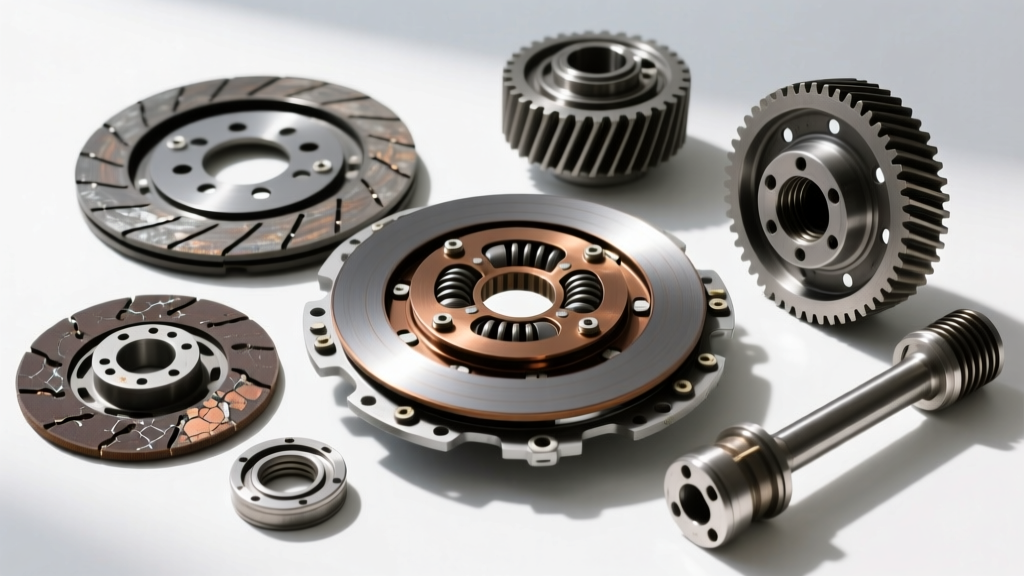
If the vehicle cranks but experiences violent chatter or shuddering when starting a car in gear, the friction interface is compromised. Original Equipment Manufacturer (OEM) organic clutch discs utilize a complex matrix of cellulose, fiberglass, and aramid fibers suspended in a phenolic resin binder. Over tens of thousands of thermal cycles, this resin can glaze, creating a localized high-friction/low-friction patchwork on the disc surface.
Marcel Spring Fatigue
Beneath the friction material lies the marcel spring—a waved steel cushion that provides progressive engagement. Under severe thermal stress (often exceeding 400°F during aggressive slip), the marcel spring loses its temper and flattens. When this occurs, the clutch engages abruptly rather than progressively, transferring torsional shock directly into the drivetrain. According to SAE International technical papers on tribological friction decay, once the marcel wave height compresses by more than 15% of its original specification, the disc must be replaced regardless of remaining friction material thickness.
Quantifying Clutch Lifespan: Material Compounds and Torque Limits
Clutch lifespan is not strictly a function of mileage; it is dictated by thermal capacity, torque load, and material composition. The table below outlines the expected lifespan and operational characteristics of common clutch materials found in modern performance and replacement applications, referencing data aligned with Exedy USA engineering guidelines.
| Friction Material | Avg Lifespan (Miles) | Torque Capacity (lb-ft) | Engagement Characteristic | Thermal Threshold |
|---|---|---|---|---|
| Organic (OEM) | 60,000 - 90,000 | 250 - 350 | Smooth, highly progressive | 400°F (204°C) |
| Kevlar / Aramid Blend | 80,000 - 120,000 | 350 - 500 | Slightly aggressive, requires heat | 550°F (288°C) |
| Cerametallic | 30,000 - 50,000 | 600 - 900+ | Abrupt, high chatter risk | 700°F (371°C) |
| Sintered Iron | 10,000 - 25,000 | 900 - 1,200+ | On/Off switch, race-only | 1,000°F (538°C) |
Concentric Slave Cylinder (CSC) Internal Bypass
In modern transaxles and rear-wheel-drive manual transmissions (such as the GM Tremec T56 Magnum or Ford MT82), external fork-actuated clutches have largely been replaced by Concentric Slave Cylinders (CSCs) that sit directly over the transmission input shaft. A frequent cause of incomplete disengagement—which makes starting a car in gear dangerous or impossible—is internal CSC seal degradation.
When the internal cup seals wear against the anodized aluminum bore, hydraulic fluid bypasses the piston under high pressure. The pedal may feel firm at the top of its travel but will slowly sink to the floor under sustained pressure. Diagnostic test: Depress the clutch pedal and hold it against the firewall for 60 seconds. If the pedal gradually drops or the transmission begins to creep into gear, the CSC is bypassing internally and requires immediate replacement.
Dual Mass Flywheel (DMF) Runout and Thermal Breakdown
To mitigate the torsional vibrations inherent in modern turbocharged engines, manufacturers rely heavily on Dual Mass Flywheels. A DMF contains internal arc springs and a specialized grease compound that dampens harmonic resonance. As a clutch system ages, heat from slipping transfers through the primary mass, degrading this grease into a hardened carbon paste.
Precision Measurement Specs
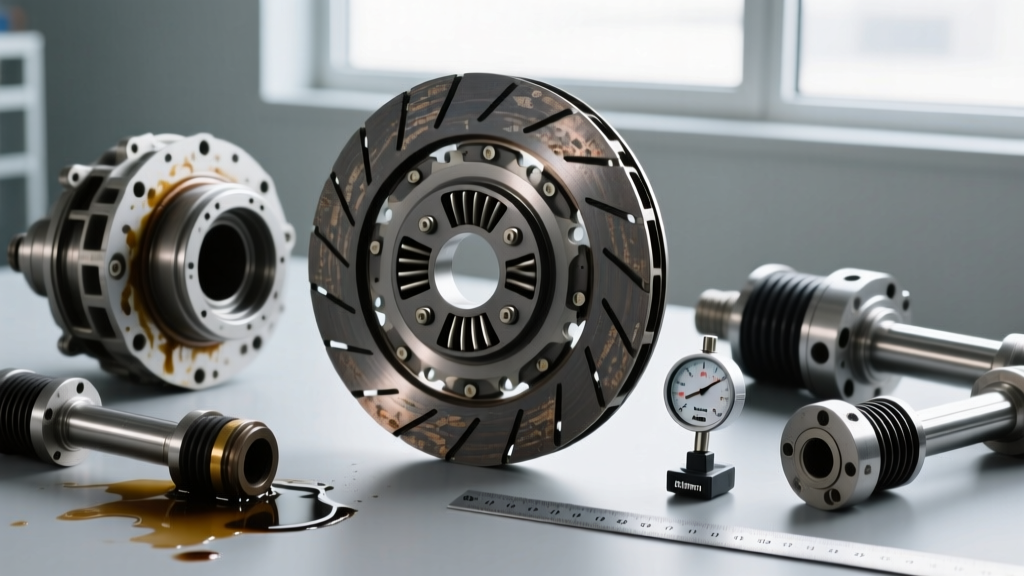
Diagnosing DMF wear requires precision tools, not just visual inspection. According to Schaeffler LuK Aftermarket engineering bulletins, technicians must measure both axial runout and rotational freeplay:
- Axial Runout: Mount a dial indicator on the engine block and measure the secondary mass surface while rotating the crankshaft. Maximum allowable runout is typically 0.050 inches (1.27mm) at the outer edge. Anything exceeding this indicates internal spring collapse or warped mass plates.
- Rotational Freeplay: Using a specialized DMF protractor tool, measure the rotational play between the primary and secondary masses. While specifications vary by application (e.g., Ford 6.7L Powerstroke vs. BMW N54), a general rule of thumb is that freeplay exceeding 20 to 25 degrees indicates broken or fatigued internal arc springs.
- Fastener Torque: When replacing the DMF, flywheel bolts must be treated as Torque-To-Yield (TTY). For example, many modern Ford EcoBoost applications require tightening M12 flywheel bolts to 74 lb-ft (100 Nm), followed by an additional 90-degree turn. Reusing old TTY bolts risks catastrophic flywheel detachment under load.
Clutch Fork Pivot Ball and Bellhousing Wear
For platforms that still utilize external release forks, the pivot ball is a critical, often-overlooked wear item. The spherical pivot point endures immense lateral pressure from the diaphragm spring. Over 100,000 miles, the pivot ball can wear a groove into the fork, or the stud itself can pull out of the bellhousing by fractions of a millimeter. This wear introduces erratic leverage ratios, causing the clutch to engage inconsistently and making the physical act of starting a car in gear feel 'notchy' or unpredictable. If the pivot ball shows a wear ridge exceeding 0.020 inches, both the fork and the pivot stud must be replaced as a matched set.
Summary of Diagnostic Action Items
Resolving clutch starting a car issues requires looking past the starter motor and battery. Technicians and advanced DIYers must evaluate the CPP switch alignment relative to hydraulic travel loss, test the CSC for internal bypass, measure DMF rotational freeplay with a protractor, and inspect the friction disc's marcel springs for thermal fatigue. By relying on precise dial indicator measurements and manufacturer-specific torque sequences rather than guesswork, you can accurately determine whether a system requires a simple hydraulic bleed, a CPP switch adjustment, or a complete clutch and flywheel replacement.