The Intersection of LSD Operation and Bearing Longevity
In the realm of drivetrain engineering, the limited slip differential (LSD) represents a critical compromise between open-differential predictability and locked-axle traction. However, the internal friction mechanisms that allow an LSD to transfer torque to the wheel with grip also introduce unique stress vectors into the axle assembly. When maintenance intervals are ignored or incorrect fluids are used, the resulting internal degradation doesn't just ruin the clutch packs—it initiates a catastrophic failure cascade that compromises the carrier and pinion bearings. For axle specialists and advanced DIYers, understanding the mechanical link between LSD chatter and bearing spalling is essential, as is calculating the cost to replace rear differential bearings once this failure cascade takes hold.
Clutch-Type vs. Helical LSD: Operational Mechanics
To diagnose differential noise and wear, one must first distinguish between the two dominant LSD architectures found in modern and classic rear axles:
1. Clutch-Type LSDs (e.g., Eaton PosiTraction, Auburn Pro-Series)
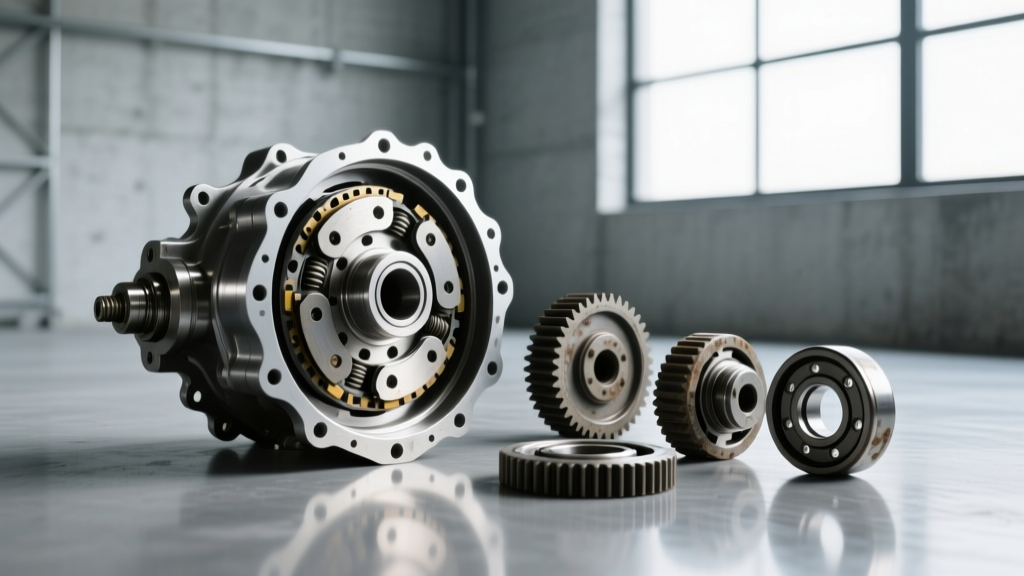
Clutch-type differentials utilize a series of alternating friction and steel separator plates clamped together by heavy-duty S-springs or coil-spring preload mechanisms. When torque bias is required, the side gears push outward against the thrust blocks, increasing the clamping force on the friction discs. Over time, the friction material wears, and the S-springs lose their nominal preload. This results in the infamous 'LSD chatter'—a stick-slip phenomenon where the clutch packs rapidly engage and disengage during low-speed cornering.
2. Helical Gear LSDs (e.g., Eaton Truetrac, Torsen)
Helical units operate entirely on gear geometry, utilizing worm and spur gear meshes to create torque bias without the need for friction modifiers or clutch packs. Because there are no friction discs to wear out, helical LSDs are largely maintenance-free regarding internal clutches. However, they still rely on precise carrier bearing preload to maintain proper gear mesh; if the carrier bearings fail, the helical gears will bind and destroy the differential case.
The Failure Cascade: How LSD Chatter Destroys Bearings
Why does a worn clutch pack lead to bearing failure? The answer lies in harmonic vibration and fluid film displacement. When a clutch-type LSD experiences stick-slip chatter, it generates high-frequency torsional vibrations. These vibrations travel directly through the differential case and into the carrier bearings (typically tapered roller bearings like the Timken LM501346 series).
Tapered roller bearings rely on a microscopically thin hydrodynamic film of 75W-90 gear oil to separate the steel rollers from the bearing race. High-frequency chatter causes microscopic impacts that puncture this fluid film, leading to metal-on-metal contact. This manifests as spalling (pitting) on the bearing cups and cones. Once spalling begins, the carrier loses its rigid lateral support. The ring and pinion gear mesh is compromised, accelerating wear on the pinion bearings and ultimately leading to catastrophic gear tooth shearing. Therefore, the cost to replace rear differential bearings is often a direct tax paid for ignoring LSD friction modifier maintenance.
Breaking Down the Cost to Replace Rear Differential Bearings
When an LSD-equipped axle requires a bearing overhaul, the job is inherently more complex than servicing an open differential. The carrier must be entirely disassembled to inspect the clutch packs, measure the S-spring preload, and replace the thrust washers. Below is a detailed breakdown of the cost to replace rear differential bearings on a standard 8.8-inch Ford or GM 10-bolt (8.5-inch) LSD axle in 2026.
| Component / Service | Part Numbers (Example) | Estimated Parts Cost | Labor Hours | Notes & Edge Cases |
|---|---|---|---|---|
| Carrier Bearing Kit | Timken LM501346 / LM102949 | $45 - $75 | Included in R&R | Requires hydraulic press; freeze carrier case for easier installation. |
| Pinion Bearing Kit | Timken HM89443 (Inner) / M86649 (Outer) | $50 - $85 | 1.5 - 2.0 | Must replace crush sleeve and pinion seal simultaneously. |
| LSD Clutch & Shim Kit | Eaton 19590-0100 (GM 8.5) | $160 - $240 | 1.0 | Mandatory if chatter is present or S-springs are collapsed. |
| Seals, Crush Sleeve, Hardware | OEM Pinion Seal, Ring Gear Bolts | $30 - $50 | 0.5 | Always use new ring gear bolts with red threadlocker. |
| Shop Labor (Full Rebuild) | N/A | N/A | 4.0 - 6.0 | At $130-$160/hr, labor dominates the final invoice. |
| Total Estimated Cost | Complete LSD Overhaul | $285 - $450 | 5.5 - 8.5 | Total Invoice: $850 to $1,600+ |
Note: If the spalling from the failed bearings has scored the ring and pinion gears, the cost will easily double, requiring a full gear setup and pattern verification.
Preventative Maintenance: Fluid and Friction Modifiers
The most effective way to avoid the steep cost to replace rear differential bearings is strict adherence to LSD-specific maintenance protocols. The friction modifier is not merely an additive; it is a vital chemical component that alters the shear characteristics of the gear oil, allowing the clutch packs to slip smoothly before engaging.
Friction Modifier Specifications
- General Motors: Requires GM EOS (Limited Slip Additive), part number 1052358, or equivalent synthetic modifier.
- Ford Motorcraft: Requires XL-3 Friction Modifier Additive. Standard 75W-140 synthetic alone will cause immediate Auburn or Eaton clutch chatter.
- Aftermarket Alternatives: Lubegard Limited Slip (Part #70902) or Red Line ShockProof Heavy (for high-load off-road applications, though it alters standard GL-5 friction dynamics).
"Never assume a 'Limited Slip Compatible' gear oil contains sufficient friction modifier for high-mileage clutch packs. OEM formulations degrade after 30,000 miles. Always add a dedicated 4oz to 8oz bottle of friction modifier during every fluid exchange to maintain the precise coefficient of friction required by the S-springs." - Eaton Drivetrain Technical Bulletins
The 30,000-Mile Fluid Exchange Protocol
- Warm the Axle: Drive the vehicle for 15 minutes to bring the 75W-90 or 75W-140 fluid to operating temperature, suspending metallic particulates.
- Extract and Inspect: Remove the differential cover (or use a fluid evacuator, though dropping the cover is preferred to inspect the magnet). Fine gray paste is normal; metallic flakes indicate bearing or gear degradation.
- Flush: Spray the carrier and clutch packs with brake cleaner to remove degraded friction modifier sludge that clogs the S-spring windows.
- Refill and Test: Fill to the bottom of the fill hole with GL-5 synthetic gear oil, add the friction modifier, and immediately perform five figure-eight turns in a parking lot to circulate the modifier into the clutch pack pores.
Critical Torque Specs for LSD Reassembly
If you are undertaking the bearing replacement yourself, precision is non-negotiable. Improper torque will destroy the new bearings within 500 miles. Always consult the specific factory service manual, but reference these baseline specifications for common V8 rear axles:
- Ring Gear to Case Bolts (GM 10-Bolt / Ford 8.8): 70 to 85 lb-ft. Crucial: Clean all bolt holes with a tap, apply medium-strength threadlocker (Loctite 243), and torque in a star pattern. Never reuse stretch-style ring gear bolts.
- Carrier Bearing Preload: Achieved via shims or adjuster nuts. Target 0.005 to 0.008 inches of lateral case deflection before securing the bearing caps.
- Pinion Nut (Crush Sleeve Axles): Do not use a standard torque value. You must torque the pinion nut incrementally while measuring rotational drag with an inch-pound beam torque wrench. Target 15 to 25 in-lbs of rotational preload on used bearings, or 25 to 35 in-lbs on new bearings.
Summary: Protecting the Drivetrain Investment
The limited slip differential is a masterpiece of mechanical traction control, but it demands respect. The internal friction that grants you grip out of a corner is the same friction that will degrade your clutch packs and send destructive harmonics into your carrier bearings. By utilizing the correct friction modifiers, adhering to strict 30,000-mile fluid intervals, and listening for the early warning signs of low-speed chatter, you can entirely avoid the exorbitant cost to replace rear differential bearings. Treat your LSD's fluid chemistry as seriously as your engine's oil pressure, and the axle will deliver decades of reliable, chatter-free traction.