The Physics of Clutch-Type LSD Operation
Limited slip differentials (LSDs) bridge the critical traction gap between open differentials and full locking lockers. While open differentials route torque to the path of least resistance—often leaving one wheel spinning uselessly on ice or mud—clutch-type LSDs utilize internal friction to bias torque across both axle shafts. Understanding this operation is the first step in proper differential maintenance.
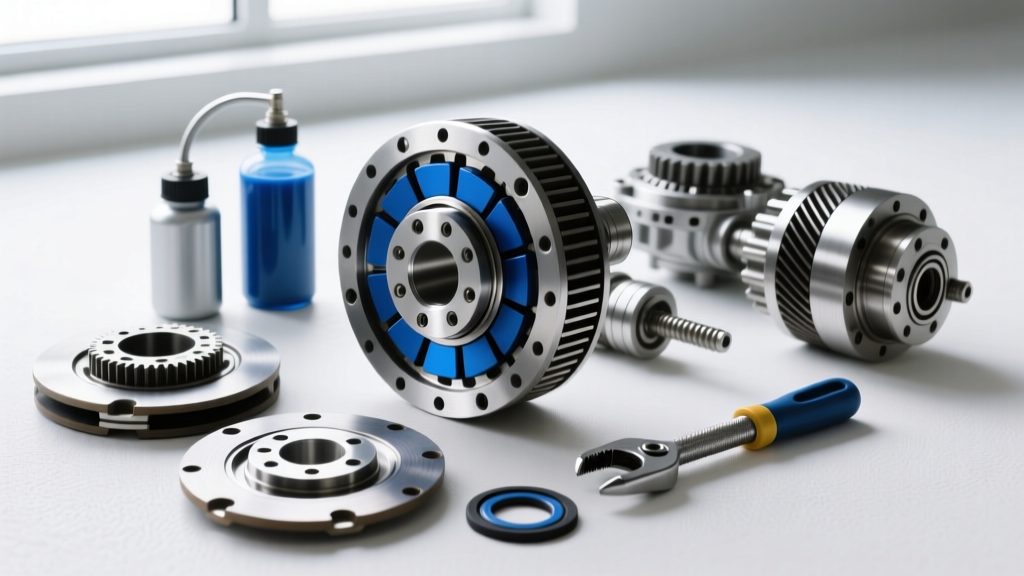
In a standard clutch-pack LSD, such as the ubiquitous Eaton Posi-Trac found in GM 10-bolt and Ford 8.8 axles, a series of alternating steel and friction discs are splined to the side gears and the differential case. Preload springs (often S-shaped or C-shaped coil springs) apply a baseline clamping force to these packs. When one wheel loses traction and attempts to spin faster than the other, the internal thrust rings wedge apart, multiplying the clamping force on the friction discs. This mechanical multiplication locks the side gears to the case, transferring torque to the wheel with grip.
Alternative designs, like the Auburn Gear cone-type LSD, replace flat clutch plates with conical friction surfaces. Cone clutches offer a vastly larger surface area and smoother engagement but are highly sensitive to fluid contamination and improper friction modifiers. Regardless of the design, the physical wear of these friction surfaces dictates the lifespan and performance of the unit, making fluid maintenance non-negotiable.
Fluid Dynamics and the Critical Role of Friction Modifiers
The gear oil inside an LSD housing serves three purposes: lubricating the hypoid ring and pinion gears, cooling the assembly, and managing the friction coefficient of the clutch packs. Hypoid gears require extreme pressure (EP) additives, universally designated by the API GL-5 rating, to prevent microwelding of the gear teeth under high shear loads.
However, standard GL-5 gear oil creates a 'stick-slip' effect on LSD clutch plates, resulting in violent chassis shudder and chatter during low-speed cornering. To counteract this, a limited-slip friction modifier (FM) is required. These modifiers are typically long-chain organic esters that bond to the porous surface of the friction material (whether paper, Kevlar, or carbon-fiber), creating a microscopic boundary layer that allows the clutches to slip smoothly before locking.
- Viscosity Selection: For standard street and light-towing applications, a full synthetic 75W-90 GL-5 is ideal for its cold-flow properties and shear stability. For heavy towing, off-road crawling, or high-horsepower applications, a 75W-140 synthetic provides a thicker protective film at elevated sump temperatures.
- Additive Dosage: Most axles require 4 to 6 ounces of FM additive per 2.5 quarts of gear oil. Over-applying the modifier will cause excessive clutch slip and premature wear, while under-applying will cause chatter. Always follow the OEM specification, such as Motorcraft XL-3 for Ford axles or GM EOS (Part #12377916) for Chevrolet applications.
According to the Valvoline Global technical data sheets, modern synthetic gear oils labeled 'LS' or 'Limited Slip' often contain a baseline dose of friction modifier, but field testing proves that a dedicated top-off additive is frequently still required to perfectly tune the clutch breakaway torque.
Diagnosing Axle Seal Failure and Contamination Risks
The most common point of failure in any drivetrain is the axle shaft seal. When these seals degrade, gear oil migrates outward, contaminating the brake shoes or rotors, leading to catastrophic braking failure. Conversely, when seals fail inward, they allow water, mud, and road debris to enter the differential sump.
Water ingress is fatal to LSD clutch packs. Moisture emulsifies the gear oil, destroying the boundary layer created by the friction modifier and causing the clutch plates to rust and weld together. If you pull the differential fill plug and the fluid resembles a milky chocolate emulsion, immediate teardown and clutch pack replacement is required. If the fluid is merely low due to a slow weep, seal replacement is your immediate priority.
Executing the Extraction: Differential Seal Puller Techniques
When it is time to replace a leaking axle seal, amateur mechanics often reach for a flathead screwdriver or a pry bar. This is a critical mistake. The seal bore in the axle tube or the differential carrier is machined to exact tolerances. Prying against the soft aluminum or thin-walled steel bore will score the metal, creating a permanent pathway for leaks that no new seal can fix.
The correct tool for this operation is a dedicated differential seal puller. Tools like the OTC 4544 or the Lisle 34550 axle seal puller are engineered specifically for this task. These tools feature a slender, hooked extraction finger that slides past the rubber lip of the seal to catch the rigid inner metal casing.
Step-by-Step Seal Extraction
- Preparation: Drain the differential fluid and remove the axle shaft. Clean the bore with brake cleaner to remove sludge that might obscure the seal edge.
- Tool Insertion: Insert the hook of the differential seal puller into the bore. Slide it past the inner lip of the seal until you feel the hook drop behind the metal casing of the seal.
- Engagement: Rotate the tool 90 degrees to lock the hook behind the metal casing. Ensure the tool's fulcrum pad is resting squarely against the flat face of the axle tube or carrier, never against a machined bearing surface.
- Extraction: Apply steady, even leverage. For stubborn, corroded seals, attach a slide hammer to the puller's threaded shaft. A sharp, controlled impact from the slide hammer will break the corrosion bond without damaging the bore.
Using a proper differential seal puller not only preserves the integrity of the housing but reduces extraction time from a frustrating 30 minutes to roughly 45 seconds. For a comprehensive look on tool applications, the OTC Tools catalog provides exact dimensional clearances for their puller hooks across various axle splines.
Installation, Reassembly, and Torque Specifications
Once the old seal is removed, clean the bore thoroughly. Coat the outer metal casing of the new seal with a thin layer of RTV silicone or bearing retainer compound to prevent outer-case spinning. Use a correctly sized seal driver or a large deep-well socket to tap the seal into place. The seal must be driven in perfectly square; a cocked seal will tear its inner lip upon axle insertion.
Before reinstalling the axle shaft, coat the splines and the inner lip of the new seal with fresh gear oil to prevent dry-start tearing. When torquing the carrier and housing components, precision is vital to maintaining gear mesh and bearing preload.
Reference Table: Common LSD Axle Specifications
| Axle Model | LSD Type | Fluid Capacity | Carrier Cap Torque | Cover Bolt Torque |
|---|---|---|---|---|
| Ford 8.8-inch | Clutch Pack (Carbon) | 2.0 - 2.5 Quarts | 85 - 95 lb-ft | 28 - 38 lb-ft |
| GM 10-Bolt (8.5/8.6) | Eaton Posi-Trac | 2.0 - 2.2 Quarts | 60 - 70 lb-ft | 25 - 30 lb-ft |
| Dana 44 (Standard) | Trac-Loc (Clutch) | 2.0 - 2.4 Quarts | 60 - 80 lb-ft | 30 - 40 lb-ft |
| Chrysler 8.75 | Sure-Grip (Cone/Clutch) | 2.25 Quarts | 85 - 100 lb-ft | 30 - 35 lb-ft |
Note: Always consult the specific OEM service manual for your exact year and model, as fastener metallurgy and torque yields can vary. For deeper Dana axle specifications, the Spicer Parts technical library remains the definitive engineering resource.
The Figure-8 Break-In Procedure
If you have rebuilt the LSD, replaced the clutch packs, or simply performed a full fluid and additive flush to cure chatter, a proper break-in procedure is mandatory. The friction modifiers need mechanical action to bond to the clutch surfaces, and the clutches need to bed into their mating steels.
Find a damp, empty parking lot. Drive the vehicle in a tight figure-eight pattern at 10 to 15 mph. Perform 10 to 15 continuous figure-eight turns. This forces the outer and inner wheels to rotate at different speeds, intentionally slipping the clutch packs under load and evenly distributing the friction modifier across the entire surface area of the discs. Skip this step, and you risk localized hot-spotting, glazing, and the return of low-speed cornering chatter within the first 500 miles.
Real-World Maintenance Cost Breakdown
Proactive LSD maintenance is vastly cheaper than a full differential rebuild. Here is what you can expect to spend on a standard axle service:
- Synthetic 75W-90 GL-5 Gear Oil (3 Quarts): $35 - $55
- OEM Friction Modifier Additive: $8 - $15
- Axle Shaft Seals (Pair): $15 - $30
- Differential Cover Gasket / RTV: $5 - $12
- Quality Differential Seal Puller Tool: $25 - $45 (One-time investment)
Total DIY service cost generally falls between $88 and $157, compared to the $600 to $1,200 a shop will charge for labor and markup. By mastering the use of a differential seal puller and understanding the chemical necessity of friction modifiers, you ensure your limited slip differential operates smoothly, quietly, and reliably for hundreds of thousands of miles.