When executing a modern engine swap, selecting the correct high performance clutch is the single most critical drivetrain decision you will make. A common pitfall in the hot rod, restomod, and track-car community is relying on manufacturer horsepower ratings without understanding the underlying torque capacity, friction material dynamics, and model-specific installation tolerances. As of 2026, the aftermarket has largely standardized around modular twin-disc and triple-disc setups, but marketing fluff often obscures the real-world physics of clamping load and slip recovery.
This guide dissects clutch horsepower ratings through the lens of the two most popular swap platforms today: the GM LS/LT series mated to the Tremec T56 Magnum, and the Ford 5.0L Coyote mated to the MT-82 or TR-6060. We will cover exact part numbers, critical torque specifications, and the model-specific repair nuances that separate a reliable drivetrain from a stranded project car.
The Marketing Myth of Horsepower Ratings
Clutch manufacturers frequently advertise their kits using peak 'horsepower' numbers—such as 'Rated for 1,000 HP.' From an engineering standpoint, this is a flawed metric. Clutches do not hold horsepower; they hold torque. A naturally aspirated 700-horsepower engine produces vastly different torque curves than a 700-horsepower turbocharged engine with instant low-end spool. Furthermore, a 1,000 HP rating is often calculated based on ideal traction conditions and static clamping force, ignoring dynamic slip recovery and thermal fade.
When selecting a high performance clutch, you must translate your engine's rear-wheel torque output into required clamping force. The formula relies on the coefficient of friction of the disc material, the number of friction surfaces, and the effective radius of the clutch disc. For example, a twin-disc 7.25-inch racing clutch utilizes four friction surfaces but has a smaller effective radius than a 9.5-inch street twin, drastically altering the pedal effort required to achieve the same torque capacity.
Model-Specific Breakdown: GM LS/LT & T56 Magnum
The GM LS platform remains the undisputed king of V8 swaps. When pairing an LS3, LSA, or boosted LSX block with a Tremec T56 Magnum, the input shaft and pilot bearing depth are the primary failure points if ignored.
Input Shaft Spline Matching
The T56 Magnum utilizes a 1.125-inch x 26-spline input shaft. Many enthusiasts mistakenly purchase clutches designed for the older T56 or TKO transmissions, which feature a 1.125-inch x 10-spline shaft. Always verify the spline count. For a street-driven, 600-800 lb-ft torque application, the McLeod RST (Street Twin) kit (Part # 752105) is the industry benchmark. It features organic/ceramic hybrid friction material, offering a manageable pedal effort of roughly 450 lbs while maintaining excellent thermal stability.
| Clutch Kit (LS/T56 Magnum) | Target Application | Rating (lb-ft) | Pedal Effort | Friction Material |
|---|---|---|---|---|
| McLeod RST (752105) | Street/Strip (NA & Mild Boost) | 800 lb-ft | ~450 lbs | Organic/Ceramic |
| ACT Xtreme Twin (LS023X) | Aggressive Street/Track | 950 lb-ft | ~600 lbs | Sintered/Ceramic |
| Tilton OT-II (7.25) | Dedicated Race/Time Attack | 1,200+ lb-ft | ~800+ lbs | Carbon/Sintered Iron |
Critical Install Specs for the T56 Magnum
The most common repair failure in LS-T56 swaps is pilot bearing destruction. The LS block crank flange is shallower than the traditional Gen I Small Block. If you use a standard pilot bearing, the T56 Magnum input shaft will bottom out in the crank, pushing the transmission forward and destroying the input shaft bearings.
- Pilot Bearing Solution: Use a deep pilot bearing adapter or a specific extended pilot bearing (e.g., SKF 6203 or the McLeod adapter sleeve) to ensure the input shaft is supported without bottoming out.
- Flywheel Torque: When using ARP flywheel bolts (Part # 234-2503), the standard torque sequence is 74 lb-ft followed by an additional 30 degrees of rotation. Always use ARP Ultra-Torque lubricant on the threads and under the bolt head.
- Bellhousing Alignment: The T56 Magnum is highly sensitive to misalignment. You must use a Mitutoyo dial indicator to check Total Indicator Runout (TIR). The absolute maximum allowable TIR is 0.005 inches. If it exceeds this, install offset dowel pins (available in 0.007, 0.014, and 0.021-inch offsets) to correct the bellhousing bore.
Model-Specific Breakdown: Ford Coyote & MT-82 / TR-6060
The Ford 5.0L Coyote engine has become the premier alternative to the LS, particularly for those seeking high-revving, quad-cam performance. However, mating a Gen 2 or Gen 3 Coyote to a manual transmission introduces unique clutch rating and installation challenges.
Transmission Spline Variations
Unlike the GM ecosystem, Ford swappers must navigate two completely different input shaft configurations depending on the transmission. The factory MT-82 uses a 23-spline input shaft, while the aftermarket Tremec TR-6060 and Magnum-F use a 26-spline shaft. The McLeod Street Twin for Coyote (Part # 752109) is specifically engineered for the 23-spline MT-82 and utilizes a dedicated low-profile flywheel to accommodate the Coyote's unique rear crank flange and block dowel geometry.
Flywheel Step Heights and Runout Limits
When repairing or upgrading a Coyote manual drivetrain, flywheel step height is non-negotiable. The step height is the distance between the friction surface of the flywheel and the mounting surface of the pressure plate. If the step height is incorrect, the pressure plate diaphragm will operate outside its optimal mechanical range, leading to premature release bearing failure and erratic clamping force.
- Measurement: Use a precision straight edge and feeler gauge. Most twin-disc setups require a step height between 0.010 and 0.030 inches, but you must verify the exact specification provided by the clutch manufacturer for your specific part number.
- Block Dowels: Ford engine blocks are notorious for loose or misaligned dowel pins. Before installing the bellhousing, verify the dowel pins are fully seated and check runout. According to Tremec's official installation guidelines, exceeding 0.005 inches of TIR will void the transmission warranty and cause severe gear rattle.
- Flywheel Fasteners: OEM Ford flywheel bolts are Torque-To-Yield (TTY) and must be discarded after one use. Replace them with reusable ARP hardware (Part # 254-2803) torqued to 85 lb-ft using a calibrated torque wrench.
Material Science: Choosing the Right Friction Disc
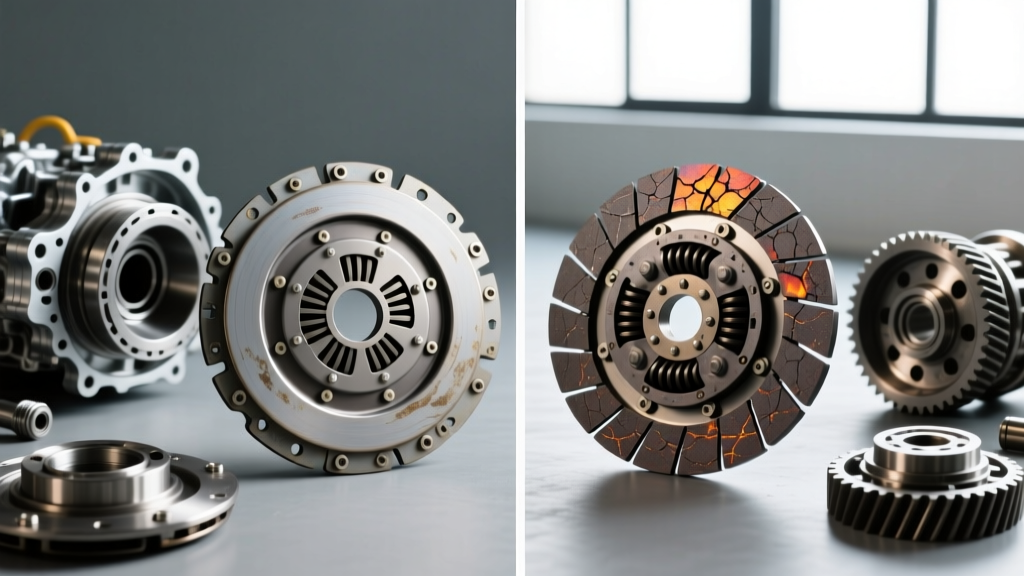
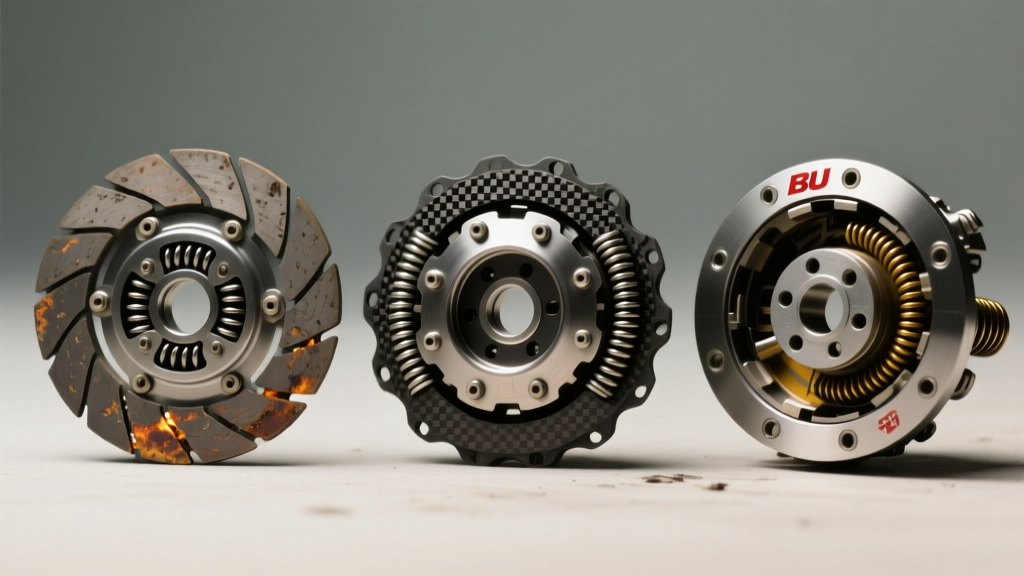
Understanding friction materials is essential when interpreting a high performance clutch rating guide. A clutch rated for 1,000 HP using sintered iron will drive entirely differently than one rated for 1,000 HP using carbon-carbon composites.
Organic and Kevlar Composites
Best for daily-driven restomods and street cars. Organic discs provide smooth, progressive engagement and excellent thermal recovery up to 400°F. They are forgiving on cast-iron flywheels but will glaze and slip if subjected to repeated hard launches or excessive slipping in stop-and-go traffic.
Ceramic and Cerametallic
The standard for high-horsepower street/strip cars (600-1,000 HP). Ceramic pucks offer a higher coefficient of friction and can withstand temperatures exceeding 800°F. The trade-off is aggressive engagement, which can cause drivetrain shock and low-speed chatter, especially in lightweight chassis builds.
Sintered Iron and Carbon-Carbon
Reserved for dedicated racing applications. Sintered iron operates on an 'on/off' switch principle, offering massive torque capacity but zero streetability. Carbon-carbon (like those from Tilton or AP Racing) provides incredible heat resistance and lightweight rotational mass, but requires a specific bedding-in procedure and operates optimally only at high temperatures. For deeper technical specifications on friction coefficients, refer to the engineering whitepapers published by McLeod Racing.
Summary Checklist for the Drivetrain Builder
Before you bolt up your transmission and lower the vehicle, run through this model-specific verification checklist to ensure your high performance clutch is installed to factory and aftermarket tolerances:
- Verify input shaft spline count matches the clutch hub (10, 23, or 26-spline).
- Confirm pilot bearing depth and ensure the input shaft is not bottoming out in the crank.
- Measure flywheel step height with a straight edge and feeler gauge.
- Dial-indicate the bellhousing to ensure TIR is under 0.005 inches.
- Torque flywheel and pressure plate bolts using the correct sequence and lubricant (never use Loctite on ARP flywheel bolts unless explicitly instructed).
- Adjust the clutch cable or hydraulic master cylinder pushrod to ensure 0.100 to 0.150 inches of free play at the release bearing to prevent premature wear.
By prioritizing torque capacity, friction dynamics, and precise model-specific measurements over marketing horsepower numbers, you will build a drivetrain capable of handling the rigors of both the street and the strip. For further reading on high-strength fasteners and torque specifications, consult the ARP Fasteners technical catalog to ensure your rotating assembly remains secure under extreme load.