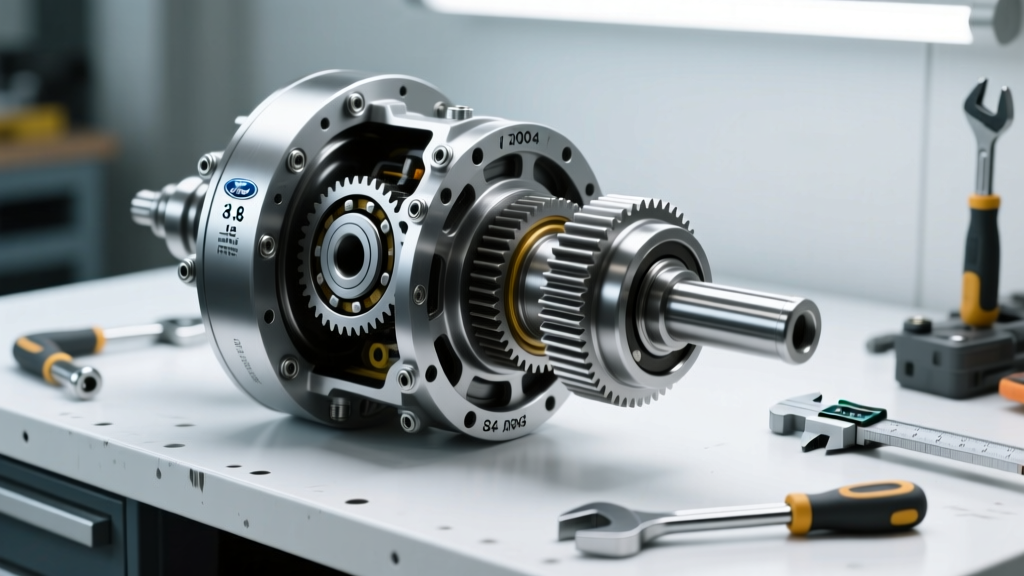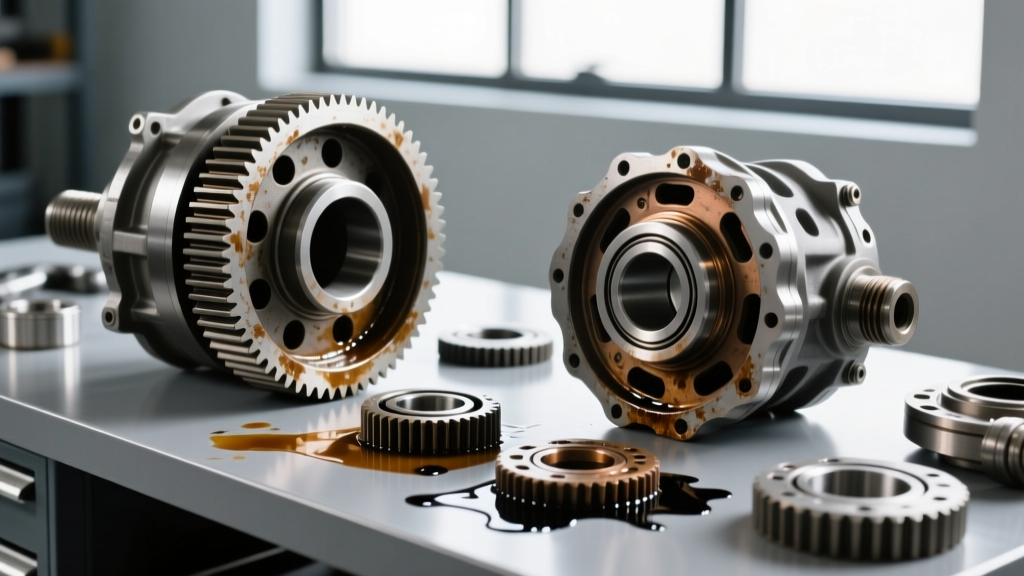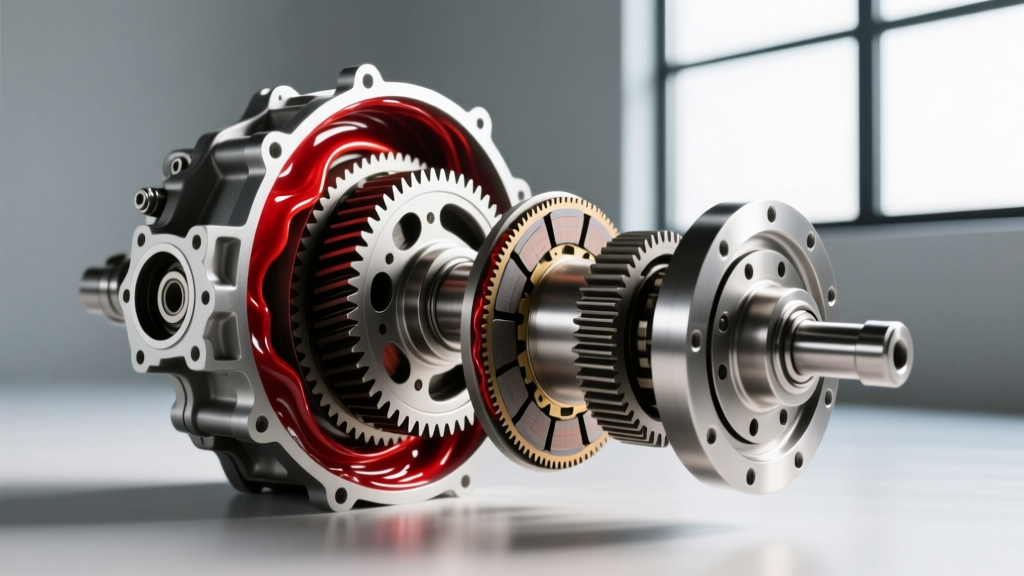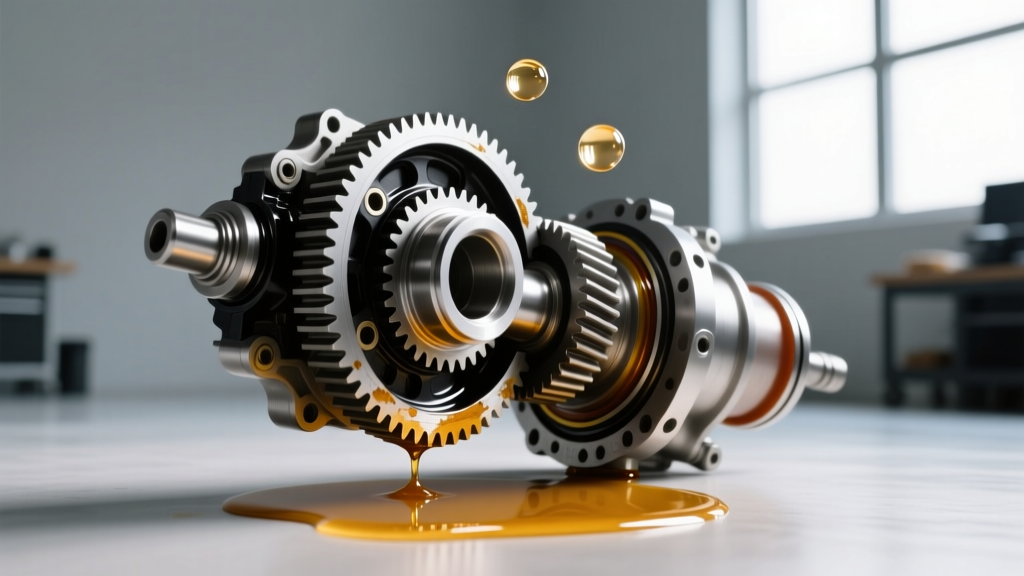
The Financial Impact: Recognizing the Signs of Low Differential Fluid
When drivers ignore the early signs of low differential fluid, they are unknowingly signing a blank check for catastrophic drivetrain failure. A whining rear axle at highway speeds, a rhythmic clunking during deceleration, or severe chatter during tight cornering are not just auditory nuisances; they are mechanical distress signals. In 2026, the cost of replacing a ruined ring and pinion gearset—such as a Yukon Gear 4.10 ratio set for a Ford 8.8-inch axle—easily exceeds $350 for parts alone. Add in a Timken master rebuild kit ($180) and 4.5 hours of dealership labor at current average rates of $175 per hour, and a simple fluid neglect issue balloons into a $1,300+ repair bill.
Understanding the root cause requires a deep dive into differential gear oil specifications. The differential operates under extreme shear stress and sliding friction, particularly on the hypoid gear teeth of the ring and pinion. When fluid levels drop below the submersion line of the pinion gear, the lack of hydrodynamic lubrication leads to localized welding, pitting, and eventual tooth shearing. This cost analysis breaks down exactly what specifications you need, the chemistry behind the fluids, and the true price of maintenance versus replacement.
Differential Gear Oil Specifications: Decoding Viscosity and API Ratings
Not all gear oils are created equal, and selecting the wrong specification can be just as costly as running dry. The American Petroleum Institute (API) classifies gear oils primarily into GL-4 and GL-5 categories. According to the American Petroleum Institute (API), GL-5 fluids contain high levels of sulfur-phosphorus extreme pressure (EP) additives designed specifically for the severe sliding friction of hypoid differentials. However, using GL-5 in a differential containing yellow metals (like bronze thrust washers found in some older or specialized axles) can cause severe sulfur-induced corrosion.
Viscosity is the second critical cost-driver. While SAE 75W-90 is the standard for most passenger SUVs and light trucks, heavy towing or high-horsepower applications demand the thicker shear-stability of SAE 75W-140. Synthetic formulations, like those detailed by Red Line Synthetic Oil, utilize polyol ester base stocks that resist thermal breakdown far better than conventional petroleum oils, maintaining film strength even when differential temperatures exceed 250°F under heavy load.
2026 Gear Oil Specification & Cost Comparison Matrix
| Fluid Type & Brand | Viscosity | API Rating | Avg. Cost (Per Qt) | Best Application & Notes |
|---|---|---|---|---|
| Mobil 1 Synthetic Gear Lube | 75W-90 | GL-5 | $12.50 | Standard daily drivers, light SUVs. Excellent baseline protection. |
| Amsoil Severe Gear | 75W-140 | GL-5 | $18.95 | Heavy towing (3/4-ton trucks), high-heat environments. Requires larger fill volume cost. |
| Red Line Heavyweight | 75W-140 | GL-5 | $21.50 | Off-road crawling, competition, high-shock load axles (Dana 60). |
| Castrol Syntrans | 75W-90 | GL-4 | $14.00 | Transaxles and diffs with yellow metals. Lacks GL-5 EP additives. |
The Hidden Cost of Limited-Slip Friction Modifiers
A massive variable in differential service costs is the limited-slip differential (LSD). If your vehicle is equipped with a clutch-type LSD (such as the Ford 8.8 Trac-Lok or Dana Trac-Lok), standard GL-5 gear oil is not enough. The clutch packs require a specific friction modifier to prevent aggressive engagement, which manifests as a violent shuddering or 'chatter' during low-speed turns. Ignoring this symptom and continuing to drive will glaze and destroy the carbon-fiber or steel clutch packs, necessitating a $400+ teardown and rebuild.
Friction modifiers are relatively inexpensive but vital. Motorcraft XL-3 (Part # C6AZ-19546-A) costs roughly $10 per 4oz bottle, while ACDelco's GM equivalent (Part # 100461435) hovers around $12. The general specification requires adding 4oz of modifier per axle, though fine-tuning for chatter may require up to 8oz. Conversely, if your vehicle utilizes a helical gear LSD (like the Torsen or Detroit Truetrac) or a locking differential (like the Eaton E-Locker), do not add friction modifiers. These units rely on gear geometry or mechanical dogs, and adding modifier fluid will reduce the locking bias, effectively ruining the performance capability of the differential.
Axle Service Cost Breakdown: DIY vs. Dealership (2026 Pricing)
To truly understand the cost analysis of differential maintenance, we must compare dealership service menus against the DIY approach. Dealerships often overcharge by utilizing 'bulk' fluid pricing markups and charging 1.5 hours of labor for a job that takes 45 minutes. For precise torque specifications and fluid capacities, technicians frequently reference Dana Spicer engineering manuals or OEM service databases.
| Axle Model | Fluid Capacity | Drain/Fill Torque | Cover Bolt Torque | DIY Cost (Fluids + Mod) | Dealership Cost (Est.) |
|---|---|---|---|---|---|
| Ford 8.8 (Super 8.8) | 2.0 - 2.5 Qts | 33 lb-ft (Plug) | 25 lb-ft (Cover) | $35 - $55 | $180 - $240 |
| Dana 44 (JK/JL Wrangler) | 2.0 Qts | 25 lb-ft (Plug) | 30 lb-ft (Cover) | $40 - $60 | $190 - $260 |
| GM 9.5 / 10-Bolt | 2.75 Qts | 24 lb-ft (Plug) | 25 lb-ft (Cover) | $45 - $65 | $200 - $280 |
| BMW ZF Rear (E90/F30) | 1.0 - 1.2 Liters | 60 Nm (44 lb-ft) | N/A (Sealed/Plug) | $25 - $45 | $250 - $350 |
Step-by-Step Cost-Effective Replacement Protocol
To maximize your maintenance budget and eliminate the signs of low differential fluid permanently, follow this precise, cost-effective protocol:
- Pre-Warm the Axle: Drive the vehicle for 15 minutes to bring the gear oil up to operating temperature. Warm fluid flows faster and suspends metallic particulates, ensuring a more complete drain and saving you time.
- Break the Fill Plug FIRST: Never drain the differential before confirming the fill plug can be removed. If the fill plug is seized or stripped, you will be left with a dry axle and a costly tow to the shop.
- Inspect for Shear Debris: Most drain plugs are magnetic. A fine, glitter-like paste is normal wear. However, if you find metal shards larger than a grain of rice, the ring and pinion is already suffering from catastrophic spalling, and fluid changes will no longer save the unit.
- Use a Fluid Transfer Pump: A $15 manual transfer pump is vastly superior to the 'squeeze bottle' method. It ensures you reach the exact fill level, which is universally defined as the bottom edge of the fill plug hole.
- Torque to Spec: Over-torquing the fill plug on an aluminum differential housing (common in modern F-150s and Silverados) will strip the threads, requiring a $150 helicoil repair or a complete housing replacement. Always use a calibrated torque wrench.
Final Verdict on Maintenance Economics
Spotting the signs of low differential fluid—such as whining, seepage around the axle seals, or differential cover sweating—should trigger an immediate service response. By understanding differential gear oil specifications, selecting the correct API GL-5 synthetic, and applying the right friction modifiers for your specific LSD, you can execute a complete axle service for under $70 in your driveway. This minor investment effectively insulates you from the thousands of dollars in labor and hard parts associated with hypoid gear failure.