Upgrading to a Locking Differential: The Traction Paradigm
When building a dedicated off-road rig, a rock crawler, or a high-horsepower drag car, an open differential is the weakest link in your drivetrain. Upgrading to a locking differential ensures that 100% of the engine's torque is distributed equally to both wheels, eliminating the dreaded one-wheel peel and maximizing traction in zero-grip environments. However, upgrading your carrier is only half the battle. The internal mechanics of a locker generate different shear forces and heat profiles than standard limited-slip differentials (LSDs). Consequently, the protocol for changing differential fluid in a locker-equipped axle requires strict adherence to specific viscosity grades, additive packages, and service intervals to prevent catastrophic gear or bearing failure.
Breaking Down Locking Differential Types for Performance Builds
Selecting the right locker depends heavily on your vehicle's primary use case. The market is dominated by three primary architectures, each with distinct mechanical behaviors and fluid requirements.
1. Automatic Mechanical Lockers (Detroit & Spartan)
Automatic lockers, such as the legendary Eaton Detroit Locker (e.g., part number 225SL16C for the Dana 44) or the budget-friendly Spartan Locker, utilize a ratcheting gear mechanism. They lock automatically under load and unlock during turns to allow for wheel speed differentiation. Because they rely on heavy-duty dog clutches and gear-driven engagement rather than friction clutches, they are incredibly robust but notoriously harsh on the street. Pricing typically ranges from $650 to $850 for the carrier alone.
2. Selectable Air Lockers (ARB)
For drivers who need open-differential manners on the street and 100% lockup on the trail, selectable air lockers are the gold standard. The ARB Air Locker (such as the RD116 for Dana 44 axles) uses an onboard air compressor to push a pneumatic piston, engaging a heavy-duty lock collar. Because the locking mechanism is only engaged on demand, internal wear is minimal. Expect to invest between $900 and $1,100 for the carrier, plus an additional $300+ for the compressor kit and air lines.
3. Selectable Electric Lockers (Eaton E-Locker)
The Eaton E-Locker uses an electromagnetic coil to actuate the locking pins. While highly convenient (requiring only a 12V switch), E-Lockers are uniquely sensitive to the fluid environment. Metallic debris suspended in the gear oil can cling to the electromagnet, causing short circuits or preventing the locking collar from fully disengaging. Priced between $800 and $1,050, they are excellent for overlanding and moderate trail use.
The Fluid Strategy: Why Lockers Change the Rules
The most common mistake enthusiasts make when changing differential fluid after a locker upgrade is carrying over the additive logic from their previous limited-slip setup.
The Friction Modifier Myth
Limited-slip differentials (like the Auburn or Trac-Lok) utilize clutch packs that require a specialized friction modifier (e.g., GM 88900338 or Ford XL-3) to prevent chatter and binding during tight turns. Locking differentials DO NOT use friction modifiers. Adding a friction modifier to a Detroit or Spartan locker will coat the dog clutches, causing them to slip during the lock/unlock transition, leading to rapid metal-on-metal wear and eventual failure. When servicing a locker, you must use a straight GL-5 gear oil with zero friction modifiers.
Viscosity Selection: 75W-90 vs. 75W-140
Your tire size and driving style dictate your viscosity. For daily drivers with tires under 33 inches, a high-quality synthetic 75W-90 GL-5 (like Red Line 75W90 NS) provides excellent cold-weather flow and adequate protection. However, if you are running 35-inch or larger tires, towing heavy loads, or doing low-speed technical rock crawling, the ring and pinion gears generate immense localized heat. In these scenarios, stepping up to a 75W-140 synthetic, such as AMSOIL Severe Gear 75W-140, is mandatory to maintain a protective hydrodynamic film across the gear teeth and carrier bearings.
Step-by-Step: Changing Differential Fluid on a Locker-Equipped Axle
Proper maintenance ensures your $1,000 investment survives the punishment of the trail. Follow this exact procedure when changing differential fluid on a locker-equipped axle:
- Preparation and Drain: Run the vehicle for 15 minutes to warm the gear oil, reducing its viscosity. Place a drain pan under the differential and remove the fill plug first (to ensure you can refill it later). Remove the cover bolts, leaving the top two bolts slightly threaded to hold the cover while the fluid drains.
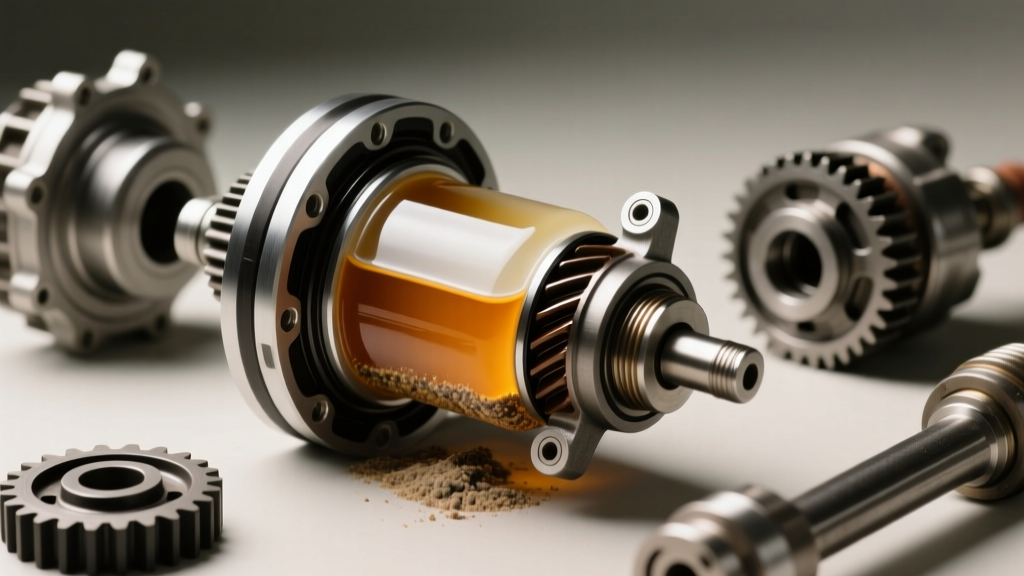
- Magnetic Plug Cleaning: This is critical for E-Lockers and ARB units. Inspect the magnetic drain plug or the magnet inside the differential pan. Fine, paste-like metallic dust is normal gear wear. However, if you find large metal shards or chunks of the locking collar, the differential must be torn down and inspected.
- RTV Application: Scrape the mating surfaces clean. Do not use cheap gaskets. Apply a continuous 3mm bead of Permatex Ultra Black RTV silicone. Allow it to skin over for 10 minutes before mating the cover to the housing.
- Torque Specifications: Reinstall the cover bolts hand-tight, then torque them in a crisscross pattern. For a Dana 44 or Dana 60, torque the cover bolts to 25-30 lb-ft. For a Ford 8.8-inch, torque to 25-35 lb-ft. Over-torquing will distort the bearing caps and cause premature bearing failure.
- Fill and Seal: Pump the 75W-90 or 75W-140 GL-5 fluid into the fill hole until it reaches the bottom of the threads. Reinstall the fill plug and torque to 25-30 lb-ft.
Locker Selection & Fluid Specification Matrix
Use the table below as a quick-reference guide to match your differential upgrade with the correct fluid strategy and maintenance interval.
| Locker Type | Best Application | Required Fluid Spec | Friction Modifier? | Service Interval |
|---|---|---|---|---|
| Detroit / Spartan (Auto) | Rock Crawling, Drag Racing | 75W-140 GL-5 Synthetic | NO | Every 15,000 miles / Post-Break-in |
| ARB Air Locker | Overlanding, Daily/Trail | 75W-90 or 75W-140 GL-5 | NO | Every 30,000 miles |
| Eaton E-Locker | Light Trail, Snow/Ice | 75W-90 GL-5 Synthetic | NO | Every 20,000 miles (Magnet Check) |
| Standard Clutch LSD | Street Performance, Towing | 75W-90 GL-5 | YES | Every 30,000 miles |
Final Thoughts on Drivetrain Longevity
Upgrading to a locking differential fundamentally transforms your vehicle's capability, but it also shifts the burden of stress directly onto your ring and pinion gears and carrier bearings. By understanding the mechanical differences between automatic and selectable lockers, and by strictly adhering to the correct protocols when changing differential fluid—specifically avoiding friction modifiers and selecting the right viscosity for your tire size—you will ensure your axle assembly delivers reliable, traction-maximizing performance for years to come. Always perform a 500-mile break-in fluid change after installing a new locker and gear set to remove initial manufacturing metal shavings.