The Axle Architecture: Open vs. Limited Slip in the TJ
The Jeep TJ Wrangler (1997-2006) remains one of the most capable and highly modified off-road platforms ever produced. At the heart of its drivetrain are the front Dana 30 and rear Dana 35c or Dana 44 axles. When it comes to drivetrain maintenance, selecting the correct Jeep TJ differential fluid is not a one-size-fits-all scenario. The fundamental choice between an open differential and a limited-slip differential (LSD) drastically alters the chemical requirements, additive packages, and maintenance intervals of your axle assemblies.
Open Differential Dynamics
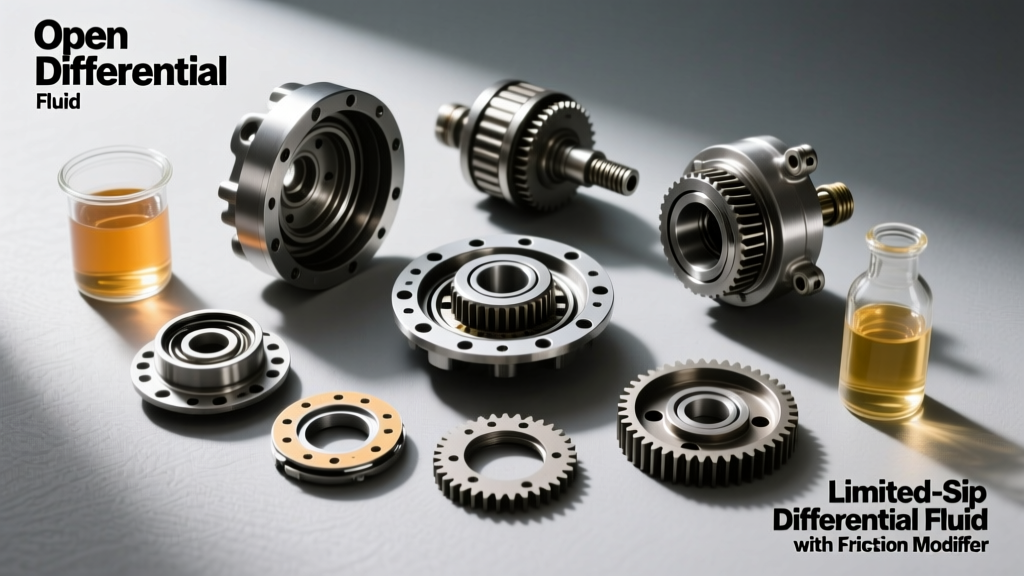
An open differential is the simplest and most robust design. It utilizes a set of spider gears to allow the left and right wheels to rotate at different speeds, which is essential for cornering on pavement. However, torque follows the path of least resistance. If your left rear tire is on solid rock and your right rear tire is in mud, 100% of the rotational force will be sent to the spinning mud tire, leaving you stranded. Open differentials do not require specialized friction modifiers, making their fluid maintenance straightforward and cost-effective. They are the preferred starting point for hardcore off-roaders who plan to eventually install a full locking differential (like an ARB Air Locker or Eaton E-Locker) and want to avoid the premature wear associated with clutch-type LSDs.
Limited Slip (Trac-Lok) Performance & Trade-offs
The factory optional limited-slip differential for the TJ was the clutch-based Trac-Lok, available primarily in the Dana 35 and Dana 44 rear axles. Inside a Trac-Lok, a series of alternating friction and steel clutch packs are compressed by preload springs against the side gears. When one wheel begins to slip, the clutch packs bind, transferring torque to the wheel with traction. While excellent for snow, ice, and light trail use, clutch-type LSDs generate immense internal shear forces and heat. This mechanical reality is exactly why your fluid choice becomes a critical point of failure or success.
Why Differential Type Dictates Your Fluid Chemistry
Both open and limited-slip differentials in the TJ utilize hypoid ring and pinion gears. The sliding, wiping action of hypoid gears requires extreme pressure (EP) additives to prevent metal-on-metal welding and pitting. Therefore, an API GL-5 rating is strictly mandatory. Never use GL-4 fluid in a TJ axle; it lacks the sulfur-phosphorus EP additives required to protect hypoid gear sets under load.
The Viscosity Debate: 75W-90 Synthetic vs. 80W-90 Conventional
For a bone-stock or freshly rebuilt TJ axle, a full synthetic 75W-90 GL-5 gear oil (such as AMSOIL Severe Gear or Red Line 75W90) is the gold standard. Synthetics offer superior thermal stability, resisting the extreme heat generated when crawling slowly in 4-Low. However, there is a massive caveat for older TJs: synthetic molecules are smaller and more uniform, and synthetic fluids contain aggressive detergents. If your 20-year-old TJ has original, hardened axle seals or slightly pitted seal seating surfaces, switching to synthetic can induce weeping and leaks. In these high-mileage scenarios, a high-quality conventional 80W-90 GL-5 is often the smarter, leak-free choice.
The Friction Modifier Imperative for LSDs
If your TJ is equipped with a clutch-type Trac-Lok, standard GL-5 gear oil is only half the equation. You must add a limited-slip friction modifier (Part # Mopar 4318060AD or Lubegard 70902). Without this additive, the clutch packs will grab and release violently, causing a phenomenon known as 'chatter' during low-speed turns. This chatter will rapidly glaze and destroy the $200+ clutch packs inside your differential. Gear-type LSDs (like the Eaton Detroit TrueTrac) do not use clutch packs and therefore do not require friction modifiers.
Fluid Capacities and Torque Specifications Matrix
Precision during a differential service prevents catastrophic leaks and gear starvation. Below is the definitive matrix for Jeep TJ axle servicing, sourced from Quadratec's TJ technical archives and Dana Incorporated's aftermarket service manuals.
| Axle Model | Diff Type | Fluid Capacity | Cover Bolt Torque | Modifier Required? |
|---|---|---|---|---|
| Front Dana 30 | Open | 2.5 Pints (1.2L) | 25 ft-lbs | No |
| Rear Dana 35c | Open | 3.5 Pints (1.7L) | 30 ft-lbs | No |
| Rear Dana 35c | Trac-Lok LSD | 3.5 Pints (1.7L) | 30 ft-lbs | Yes (4 oz) |
| Rear Dana 44 | Open / Locker | 4.0 Pints (1.9L) | 30 ft-lbs | No |
| Rear Dana 44 | Trac-Lok LSD | 4.0 Pints (1.9L) | 30 ft-lbs | Yes (4 oz) |
2026 Buyer’s Guide: Top Gear Oils for TJ Axles
Based on current tribological testing and long-term field reports from the off-road community, here are the top fluid recommendations for your Jeep TJ differential fluid service.
- AMSOIL Severe Gear 75W-90 (SVG): The premium choice for heavily modified TJs running 35-inch tires or larger. Its high film strength protects ring and pinion teeth under extreme shock loads. Expect to pay around $22-$26 per quart.
- Red Line 75W90 GL-5: Contains a robust polyol ester base that clings to gear surfaces, providing excellent startup protection. It naturally contains some friction modifiers, but a dedicated additive is still recommended for Trac-Lok axles. Priced at $20-$24 per quart.
- Valvoline High Performance 80W-90 (VV952): The best conventional option for high-mileage TJs with suspect axle seals. It provides excellent GL-5 protection without the aggressive detergents that cause older seals to weep. Highly affordable at $8-$10 per quart.
- Lubegard 70902 Limited Slip Friction Modifier: The universal alternative to the increasingly hard-to-find Mopar additive. A 4 oz bottle costs roughly $8 and effectively eliminates Trac-Lok chatter.
Step-by-Step Service Protocol & Edge Cases
Servicing a TJ differential is a rite of passage, but doing it incorrectly leads to ruined gear sets. Follow this professional protocol:
1. The Drain and Inspection
Unlike engine oil pans, TJ differentials do not have drain plugs (unless an aftermarket cover is installed). You must remove the entire differential cover. Place a catch pan directly beneath the axle. Loosen the 3/8-inch, 12-point cover bolts in a crisscross pattern. Expert Tip: Leave the top two bolts loosely threaded to act as a hinge, preventing the heavy, oil-filled cover from dropping into your pan and splashing gear oil everywhere.
2. Diagnosing Wear via the Magnet
Once the cover is off, inspect the magnetic drain plug or the magnetic spot inside the cover. A fine, metallic paste is normal wear for a 100,000-mile axle. However, if you find distinct metal flakes, chips, or needle bearing fragments, your differential requires an immediate teardown and rebuild. Do not simply refill and ignore it.
3. Gasket Selection: RTV vs. Reusable
While black or grey RTV silicone is the traditional sealing method, it requires a 24-hour curing time before filling with oil, and over-torquing can squeeze RTV into the gear mesh, blocking oil passages. For a modern, foolproof seal, invest in a LubeLocker reusable elastomer gasket (Part # 921035 for Dana 35, 921044 for Dana 44). These cost around $35, seal instantly, and allow you to fill the axle and drive away immediately.
4. The Refill and Modifier Sequence
If your axle requires a friction modifier, always pour the 4 oz modifier into the empty differential housing before adding the gear oil. If you add the thick gear oil first, the modifier will sit in the fill tube and fail to mix with the sump fluid. Use a fluid transfer pump to fill the axle until the oil level reaches the exact bottom edge of the fill hole. Reinstall the fill plug and torque to 25 ft-lbs.
Mechanic's Warning: If you have a Trac-Lok LSD and still experience chatter after adding the modifier and driving in figure-eights for 15 minutes, your clutch packs are likely glazed or worn beyond the preload spring's compensation range. Fluid chemistry cannot fix mechanical wear; a clutch pack replacement kit (approx. $120 for parts) will be required.
Conclusion: Matching Fluid to Function
Choosing the right Jeep TJ differential fluid requires understanding both your driving habits and your specific axle hardware. Open differentials thrive on high-quality, cost-effective GL-5 gear oils, while Trac-Lok limited slips demand strict adherence to friction modifier protocols to prevent catastrophic chatter and wear. By matching your fluid viscosity to the condition of your axle seals and adhering strictly to Dana's torque specifications, you can ensure your TJ's drivetrain survives everything from daily highway commuting to punishing trail abuse.