Diagnosing Dana 44 Differential Leaks on the Jeep Wrangler JK
The 2007-2018 Jeep Wrangler JK equipped with the Dana 44 rear axle is a cornerstone of the off-road community. However, high mileage, extreme suspension articulation, and oversized tires place immense stress on the axle seals. When gear oil begins to weep, immediate diagnosis and repair are critical. Running a differential low on fluid leads to catastrophic ring and pinion failure, while gear oil contaminating the rear brake shoes creates a severe safety hazard.
Before unbolting any components, you must accurately identify the leak source. Gravity and axle rotation often disguise the true origin of the seepage. Clean the entire center section and axle tubes with brake cleaner, then drive the vehicle for 10 miles. Inspect the axle using a bright LED light to trace the fluid to its highest point.
Pinion Seal vs. Axle Seal vs. Cover Gasket
- Pinion Seal Leak: Fluid accumulates on the front face of the differential center section, dripping onto the exhaust or skid plate. This is caused by a worn rubber lip on the pinion seal or a grooved companion flange (yoke).
- Axle Shaft Seal Leak: Fluid migrates down the axle tube and pools inside the brake backing plate. On the Dana 44, this often results in contaminated brake pads and shoes. If left unchecked, the gear oil will wash out the grease in the outer wheel bearing, leading to bearing seizure.
- Cover Gasket Leak: Fluid seeps directly from the mating surface of the differential cover. This is typically due to over-torqued bolts warping the stamped steel cover, or a degraded RTV silicone bead.
Required Tools, Parts, and Fluid Specifications
Executing a proper repair on the JK Dana 44 requires specific tools and high-quality replacement components. Do not reuse the pinion nut, as it is a prevailing-torque lock nut designed for single use. Below is the definitive parts list for a complete leak repair and fluid service.
| Component | Part Number | Est. Cost (2026) | Qty Required |
|---|---|---|---|
| Mobil 1 Synthetic Gear Lube 75W-90 | 111516 | $14.50 / qt | 2 |
| Mopar Friction Modifier (Trac-Lok) | 4318060AD | $11.00 | 1 (4 oz) |
| Spicer Pinion Seal (Dana 44) | 48645 | $18.50 | 1 |
| Spicer Axle Shaft Seal (Dana 44) | 10479 | $12.00 | 2 |
| Mopar Pinion Nut & Washer Kit | 68085878AA | $24.00 | 1 |
Step-by-Step Pinion Seal Replacement Procedure
Replacing the pinion seal is a precision task. The Dana 44 utilizes a crush sleeve to set the pinion bearing preload. If you over-torque the pinion nut during reassembly, you will over-crush the sleeve, requiring a complete differential teardown to replace it. According to Dana Incorporated service guidelines, measuring rotational torque is the only safe method for seal replacement without a full rebuild.
1. Measure Breakaway Torque
With the vehicle safely supported on jack stands and the rear wheels removed, use an inch-pound torque wrench on the pinion nut. Record the rotational torque required to turn the pinion shaft (typically between 15 and 25 inch-pounds for used bearings). This is your target preload for reassembly.
2. Yoke Removal and Seal Extraction
Use a paint pen to mark the alignment of the yoke, pinion shaft, and nut. Remove the pinion nut using a 1/2-inch drive impact wrench and a 1-5/16-inch (or 32mm) socket. Pull the yoke using a dedicated 3-jaw puller—never hammer the yoke, as this will shatter the pinion bearing. Pry out the old seal with a seal puller, being careful not to gouge the aluminum or cast-iron bore.
3. Installation and Torque Verification
Lubricate the new Spicer seal lip with fresh gear oil and tap it flush into the bore using a seal driver. Reinstall the yoke, aligning your paint marks. Hand-thread the new Mopar pinion nut. Tighten the nut using a torque wrench, checking the rotational torque every 10 ft-lbs. Your final torque must fall within the factory specification of 160 to 205 ft-lbs, AND the rotational torque must match your initial breakaway measurement. If you hit 205 ft-lbs before reaching the correct rotational preload, stop immediately; the crush sleeve must be replaced.
Axle Shaft Seal Replacement: The Dana 44 Advantage
Many amateur mechanics confuse the Dana 44 with the weaker Dana 35. The Dana 35 uses internal C-clips to retain the axle shafts, requiring the differential cover to be removed to access the cross-pin. The Dana 44, however, uses a press-fit bearing and an external 4-bolt retainer plate. This makes axle seal replacement significantly easier.
Remove the rear brake caliper and rotor. Unbolt the four 9/16-inch retainer plate nuts securing the axle shaft flange to the axle tube (torque spec: 35 ft-lbs). Pull the axle shaft straight out. Pry the old seal from the axle tube. When installing the new Spicer seal, use a specialized axle seal driver or a deep well socket that matches the outer diameter of the seal. Drive it in until it seats firmly against the internal shoulder. Reinstall the axle shaft, ensuring the splines do not damage the new seal lip, and torque the retainer nuts to 35 ft-lbs.
Refilling with Mobil 1 Differential Fluid
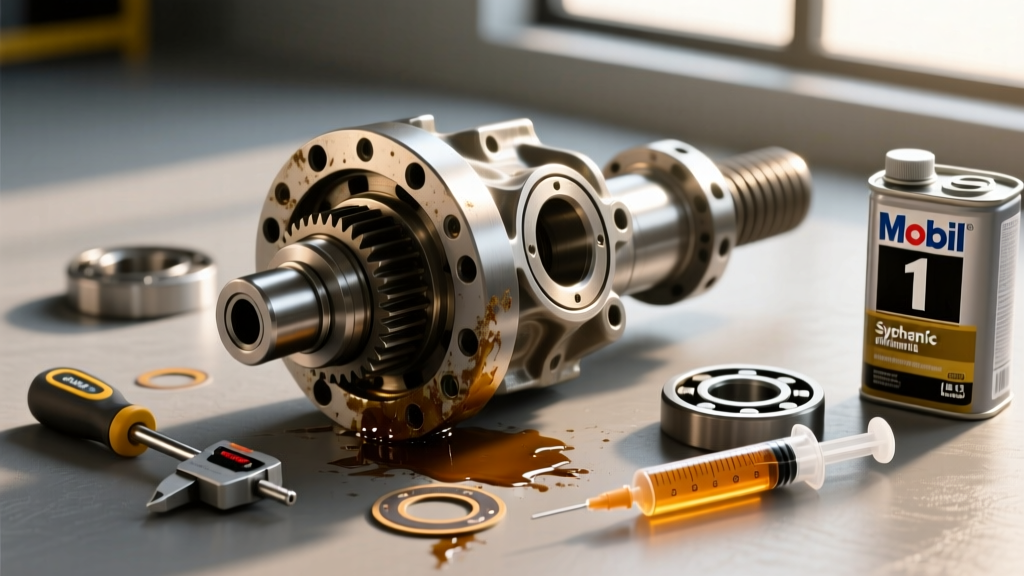
Once all seals are replaced and the cover is resealed (using a new gasket or high-temp RTV, torquing the cover bolts to 25 ft-lbs), it is time to refill the housing. For the Jeep JK Dana 44, we exclusively recommend Mobil 1 Synthetic Gear Lube 75W-90. This full-synthetic formulation offers superior shear stability and extreme pressure (EP) protection, which is vital when running larger-than-stock tires that increase leverage and heat generation on the ring and pinion gears.
The Trac-Lok Limited Slip Additive Requirement
If your JK is equipped with the factory Trac-Lok limited-slip differential (LSD), fluid selection requires an extra step. While Mobil 1 75W-90 contains a baseline friction modifier, Chrysler's Trac-Lok clutch packs require a higher concentration to prevent low-speed binding and chatter during tight turns. You must add exactly 4 ounces (118 ml) of Mopar Friction Modifier (Part # 4318060AD) before filling the rest of the housing with the Mobil 1 gear oil.
Expert Tip: The Dana 44 rear differential fluid capacity is nominally 4.0 pints (1.9 liters). However, always use the fill-hole as your ultimate gauge. The fluid level is correct when it is exactly level with the bottom edge of the fill hole threads. If you have installed an aftermarket deep-sump cover, you will need additional fluid, but the fill-hole rule remains the absolute standard for proper lubrication of the pinion bearings.
Post-Repair Bedding and Testing
After filling, reinstall the fill plug and torque it to 25 ft-lbs. Drive the vehicle in a series of slow, tight figure-eights in an empty parking lot. This forces the Trac-Lok clutch packs to slip and absorb the friction modifier, eliminating any potential cornering chatter. Finally, re-inspect the pinion and axle seals after 50 miles of driving to ensure the repair is completely sealed and the differential is operating at optimal thermal efficiency. For sourcing OEM Mopar components and upgraded axle hardware, trusted distributors like Quadratec remain invaluable resources for Jeep specialists.