The 2019 F-150 Rear Axle Ecosystem: Why Fluid Choice Matters
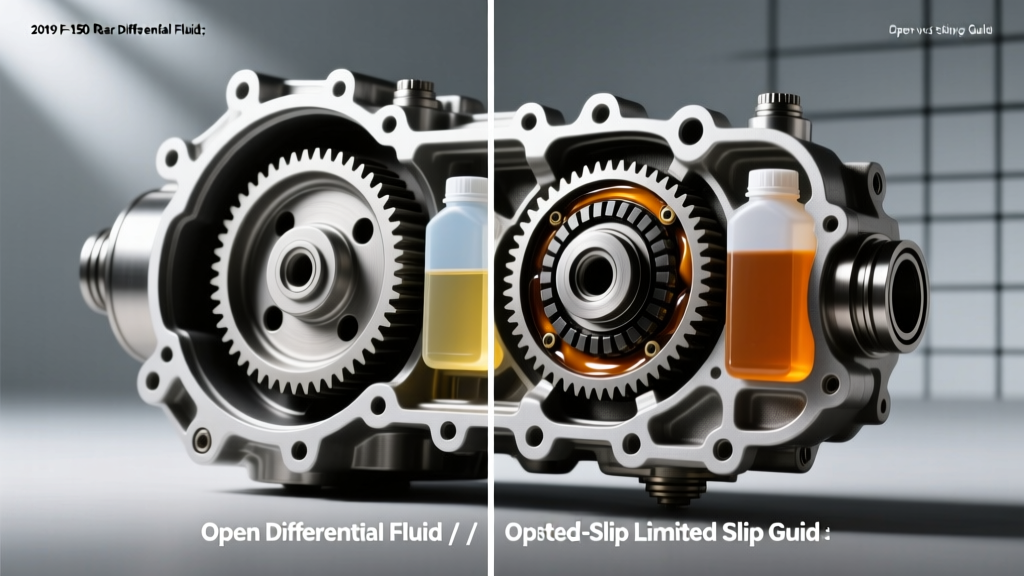
When maintaining a half-ton pickup, the rear axle is the unsung hero of the drivetrain. Whether you are towing a 6,000-pound travel trailer or navigating slippery job sites, the ring and pinion gears in your rear differential generate immense heat and shear forces. For owners searching for the correct 2019 F-150 rear differential fluid, the answer is not a simple one-size-fits-all scenario. The exact fluid specification, viscosity, and additive package you need are entirely dictated by the type of differential installed at the factory: Open, Limited Slip (LSD), or Electronic Locking (E-Locker).
As we evaluate the aftermarket and OEM landscape in 2026, synthetic gear oils have evolved significantly, offering better thermal stability for EcoBoost models equipped with the max tow package. However, using the wrong additive package—specifically friction modifiers—can lead to clutch pack chatter, premature wear, or thousands of dollars in rebuild costs. This guide breaks down the mechanical differences between the F-150's rear differential options and provides a precise buyer's guide for your next service interval.
Open vs. Limited Slip vs. E-Locker: The Mechanical Reality
To select the correct fluid, you must first identify what is inside your axle housing. Ford offered three primary rear differential configurations for the 2019 F-150, typically housed within the 8.8-inch, 9.75-inch, or heavy-duty 10.5-inch axle assemblies.
1. The Open Differential
The open differential is the baseline setup found on many XLT and base XL models. It utilizes a standard spider gear set that allows the left and right axles to rotate at different speeds during cornering. Because there are no friction clutches or locking mechanisms inside the carrier, an open differential only requires a high-quality synthetic gear oil to lubricate the ring, pinion, and spider gears. No friction modifier is needed or recommended.
2. The Clutch-Type Limited Slip Differential (LSD)
Often found in Lariat and King Ranch trims equipped with the Trailer Tow Package, the traditional clutch-type LSD uses a series of alternating steel and friction clutch packs. Under normal driving, it acts like an open diff. When one wheel loses traction, the clutch packs bind to transfer torque to the wheel with grip. This is where fluid chemistry becomes critical. The clutch packs require a specific Friction Modifier (FM) additive to prevent the plates from grabbing and releasing abruptly, which manifests as a low-speed "chatter" or vibration when turning.
3. The Electronic Locking Differential (E-Locker)
Common on FX4 Off-Road packages and Lariat+ trims, the E-Locker is fundamentally different from a clutch-type LSD. It utilizes a mechanical dog-clutch mechanism that physically locks the axles together when engaged via the dash switch. Because there are no slipping friction clutches inside the carrier, the E-Locker does not require friction modifier. Adding FM to an E-Locker is a common mistake that dilutes the gear oil's protective properties without providing any mechanical benefit.
2019 F-150 Axle Specifications & Fluid Matrix
Below is the definitive matrix for 2019 F-150 rear axle service. Always verify your specific axle ratio and size via the door jamb sticker (AXLE code) before purchasing fluid.
| Axle Size | Common Diff Types | Base Fluid Viscosity | Fluid Capacity | Friction Modifier Required? |
|---|---|---|---|---|
| 8.8-inch | Open, LSD | SAE 75W-90 or 75W-140 | 2.5 - 2.7 Pints | Yes (LSD Only) |
| 9.75-inch | Open, LSD, E-Locker | SAE 75W-140 (Towing/HD) | 3.3 - 3.5 Pints | Yes (LSD Only) |
| 10.5-inch | E-Locker, Open | SAE 75W-140 | 3.7 Pints | No |
2026 Buyer's Guide: Top Rear Differential Fluids
When shopping for your 2019 F-150 rear differential fluid, you must decide between OEM Motorcraft fluids and premium aftermarket synthetics. Current 2026 pricing for full-synthetic 75W-140 gear oils ranges from $16 to $28 per quart.
OEM Choice: Motorcraft SAE 75W-140 Synthetic Rear Axle Lubricant
Part Number: XY-75W140-QL
Best For: Warranty compliance, daily driving, and standard towing.
Motorcraft's 75W-140 is the factory fill for most 9.75-inch and 10.5-inch axles equipped with the tow package. It provides excellent shear stability. If you have a clutch-type LSD, you must purchase Motorcraft XL-3 Friction Modifier (Part # XL-3) separately, as the OEM fluid does not come pre-mixed with it. Expect to pay around $18 per quart at the dealer or via RockAuto's Ford catalog.
Premium Aftermarket: AMSOIL Severe Gear 75W-140
Product Code: SVO
Best For: Heavy towing, off-road use, and extended drain intervals.
AMSOIL Severe Gear is widely considered the gold standard for heavy-duty truck axles. It features a higher baseline viscosity index and superior extreme-pressure (EP) additives compared to standard synthetics. According to AMSOIL's official product data, this fluid resists thermal runaway when towing near the F-150's max GCWR. Like the Motorcraft fluid, it requires the addition of a separate friction modifier (AMSOIL Slip Lock) if your truck is equipped with a clutch-type LSD.
Convenience Pick: Royal Purple Max-Gear 75W-140
Part Number: 01514
Best For: DIYers who want to skip the friction modifier step.
Royal Purple Max-Gear is uniquely formulated to be compatible with both open and limited-slip differentials straight out of the bottle. It contains the necessary friction modifiers pre-blended into the synthetic base. While purists argue that dialing in a separate FM additive is better for fine-tuning clutch chatter, Royal Purple's pre-mixed formula works flawlessly for 95% of F-150 LSD applications, saving you time and the cost of a separate additive bottle.
Service Intervals, Torque Specs, and DIY Costs
Ford officially labels the rear differential fluid as "filled for life" under normal driving conditions. However, if your 2019 F-150 falls under the "Severe Duty" cycle—which includes frequent towing, driving in dusty conditions, or extensive idling—the recommended service interval drops to every 150,000 miles or 5 years. Most drivetrain experts recommend a baseline fluid swap at 60,000 miles to remove manufacturing metal shavings and water condensation.
Crucial Torque Specifications
The 2019 F-150 utilizes a stamped steel or aluminum differential cover sealed with either a pre-cut rubber gasket or a bead of RTV silicone. Over-tightening the cover bolts will warp the flange, leading to persistent leaks.
- 8.8-inch & 9.75-inch Cover Bolts: 25 lb-ft (34 Nm)
- 10.5-inch Cover Bolts: 30 lb-ft (41 Nm)
- Fill Plug (if equipped on 10.5-inch): 22 lb-ft (30 Nm)
Expert Diagnostic Tip: If you drain your 2019 F-150's differential and the fluid smells heavily of sulfur and resembles a metallic milkshake, water has breached the axle seal or vent tube. Before refilling with new 75W-140, flush the housing with a cheap quart of conventional 80W-90 and a solvent to displace the moisture, then drain and fill with your premium synthetic.
Estimated 2026 DIY Service Costs
Servicing the rear differential at a Ford dealership typically costs between $160 and $240, largely due to labor markup and shop supplies. By performing the service in your driveway, you can expect to spend roughly $65 to $90. This includes three quarts of full-synthetic 75W-140 ($55), one bottle of Friction Modifier if required ($10), and a new rubber cover gasket or tube of high-temp RTV silicone ($8). Always use a hand pump to transfer the thick 75W-140 fluid from the bottle into the axle fill hole, and ensure the fill plug is removed before you drain the fluid to avoid getting stranded with an empty axle.
Final Verdict
Selecting the correct 2019 F-150 rear differential fluid is an exercise in matching chemistry to mechanical hardware. If you have an open diff or an E-Locker, stick to a high-quality straight synthetic like Motorcraft or AMSOIL Severe Gear. If you are running a traditional clutch-type LSD, do not forget the friction modifier, or opt for a pre-blended fluid like Royal Purple Max-Gear to eliminate drivetrain chatter and ensure your clutches engage smoothly for years to come.