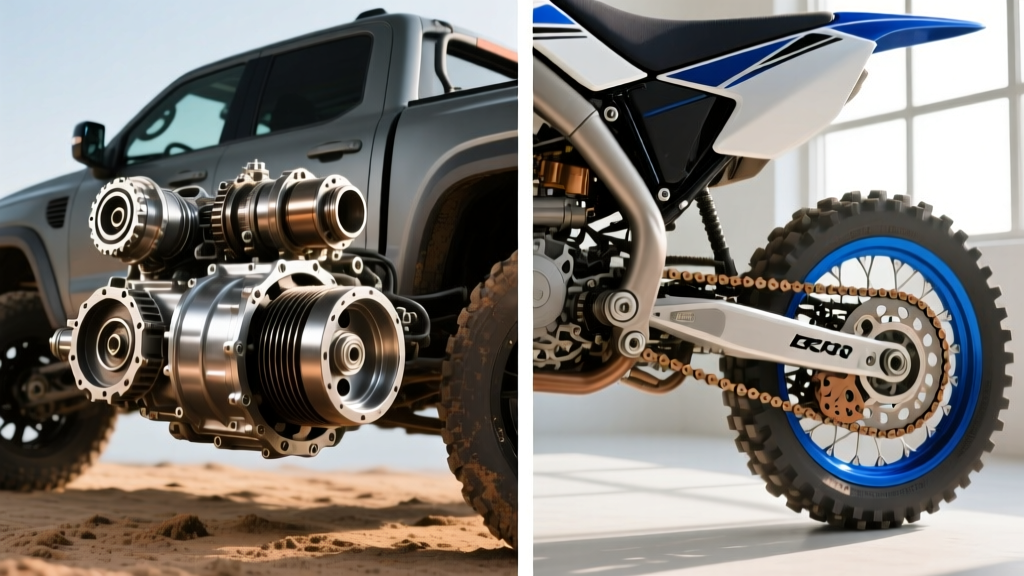
The Paradigm Shift: Dirt Bike Drivetrain vs. Heavy-Duty SUV
When off-road enthusiasts transition from two wheels to four, the mechanical leap is staggering. A typical dirt bike drivetrain is a masterpiece of lightweight, high-RPM efficiency. It relies on a 520 or 530 O-ring chain, a hardened steel countershaft sprocket, and a rear hub damper to manage roughly 50 to 80 horsepower and 40 lb-ft of torque across a 250-pound chassis. Maintenance is measured in hours of runtime, and component swaps take minutes with basic hand tools.
In stark contrast, the modern truck and SUV drivetrain is an exercise in extreme torsional management. Moving a 5,500-pound vehicle off-road requires multiplying engine torque through a transfer case and distributing it via massive hardened-steel gears, U-joints, and axle shafts. With the advent of high-output turbo-diesels and the instant low-end torque delivery of 2026 hybrid and EV truck platforms, the stress placed on truck and SUV drivetrain components has never been higher. Understanding the architecture of these heavy-duty systems is critical for survival on the trail.
| Metric | Dirt Bike (450cc Motocross) | Heavy-Duty SUV (3/4-Ton 4WD) |
|---|---|---|
| Primary Power Transfer | 520 O-Ring Chain & Sprockets | NP261HD / BW4406 Transfer Case Chain |
| Peak Torque Handled | ~45 lb-ft (at countershaft) | 1,000+ lb-ft (at rear output shaft) |
| Lubrication Method | External (Chain Lube) | Sealed Bath (e.g., AutoTrak II / 75W-90) |
| Service Interval | 5-15 Hours (Clean/Lube) | 30,000 - 50,000 Miles (Fluid Flush) |
Transfer Cases: The Heart of the SUV 4WD System
The transfer case is the central distribution hub for any 4WD SUV or truck. Unlike the exposed, easily adjustable chain on a dirt bike, a truck transfer case houses a massive Morse-type silent chain operating in a sealed, pressurized fluid bath. Take the ubiquitous GM NP261HD (RPO NQH) found behind the 6L80 and 10L80 transmissions. This magnesium-cased unit utilizes a 2.5-inch wide chain to route torque to the front and rear driveshafts.
Expert Best Practice: Chain stretch is the primary killer of modern transfer cases. As the chain elongates under heavy towing or rock-crawling loads, it begins to ride on the aluminum case housing, leading to catastrophic fluid loss and case destruction. To prevent this, upgrade to a billet aluminum rear case half (such as those from Midwest Transmission Center) and strictly adhere to fluid specifications.
- Fluid Specification: GM AutoTrak II (P/N 88900333) or equivalent full-synthetic transfer case fluid.
- Capacity: Exactly 2.0 quarts. Overfilling causes aeration and overheating.
- Rear Output Shaft Nut Torque: 148 lb-ft. Always stake the nut or apply high-strength threadlocker.
- Encoder Motor: The NQH uses a 4-position encoder motor. If you experience a flashing 4WD warning light, check the transfer case control module ground wire behind the left kick panel before replacing the motor.
For Ford Super Duty applications utilizing the BorgWarner 4406 transfer case, the internal oil pump is driven by the mainshaft. If you flat-tow your SUV with the rear wheels on the ground without putting the transfer case in Neutral, you will starve the internal bearings and burn up the unit within 50 miles.
Axles and Differentials: Dana 60 vs. Corporate 10.5
While a dirt bike transfers power directly to a single rear hub via a cush-drive, an SUV must split torque laterally through a differential and out through axle shafts. The Dana 60 front axle remains the gold standard for heavy-duty off-road SUVs, featuring a massive 9.75-inch ring gear and 35-spline inner axle shafts.
The most common failure point in a built Dana 60 is not the gearset itself, but the ring gear bolts shearing under shock loads (such as dropping the clutch on a steep rock ledge). OEM ring gear bolts are often borderline for extreme use.
Ring Gear Fastener Upgrade Protocol
According to ARP Fasteners, upgrading to high-tensile aftermarket hardware is mandatory for any SUV running 37-inch tires or larger. Use ARP P/N 141-001 (7/16"-20 Left-Hand Thread).
- Clean all threaded holes in the differential carrier with a 7/16"-20 LH tap and brake cleaner.
- Apply a single drop of Red Loctite 271 to the threads.
- Torque the ring gear bolts in a crisscross pattern to exactly 65 lb-ft. Do not exceed this, as over-torquing can distort the ring gear and cause premature wear patterns.
For the rear axle, the GM Corporate 10.5-inch (14-bolt) is a workhorse. When upgrading to a Detroit Locker or ARB Air Locker, ensure the carrier bearing preload is set using a dial indicator. A common mistake is setting the backlash to the OEM spec of 0.006"-0.010" when running aftermarket cut gears; most aftermarket 4.10 or 4.56 ratio gearsets require a tighter backlash of 0.008"-0.012" to prevent tooth chipping.
Driveshafts, U-Joints, and CV Joints
The driveshaft connects the transfer case to the axles, absorbing suspension articulation. While a dirt bike chain simply flexes, a truck driveshaft requires universal joints (U-joints) or constant velocity (CV) joints to operate at angles up to 25 degrees without binding.
Upgrading from a 1350-series to a 1410-series driveshaft is a standard modification for lifted SUVs. According to Spicer Parts engineering data, the difference in torsional yield strength is massive:
- Spicer 1350 (P/N 5-178X): 3.625" cap-to-cap. Cross diameter: 1.188". Yield strength: ~2,200 lb-ft.
- Spicer 1410 (P/N 5-280X): 4.188" cap-to-cap. Cross diameter: 1.188" (wider trunnions). Yield strength: ~3,200 lb-ft.
Expert Warning on Lift Kits: Installing a 4-inch suspension lift on an SUV without addressing driveline geometry will destroy U-joints in thousands of miles. The transfer case output shaft and the pinion yoke must remain within 3 degrees of parallel. If the pinion angle is too low, you must install degree shims between the leaf springs and the axle perches, or use a CV-style driveshaft with a double-cardan joint at the transfer case end to cancel out the operating angles.
2026 Maintenance Matrix: Fluids and Torque Specs
Maintaining a heavy-duty SUV drivetrain requires adherence to strict intervals and specifications. Modern synthetic fluids offer superior shear stability, but off-road contamination (water ingress through axle breathers) remains a critical threat. Below is the definitive maintenance matrix for heavy-duty truck and SUV platforms.
| Component | Fluid / Lubricant | Capacity | Service Interval | Critical Torque Spec |
|---|---|---|---|---|
| Transfer Case (NP261HD) | AutoTrak II (Synthetic) | 2.0 Quarts | 50,000 Miles | Drain/Fill Plug: 18 lb-ft |
| Front Diff (Dana 60) | 75W-90 GL-5 Synthetic | 3.5 Pints | 30,000 Miles | Cover Bolts: 30 lb-ft |
| Rear Diff (Corp 10.5) | 75W-90 GL-5 + Modifier | 4.0 Quarts | 30,000 Miles | Pinion Nut (Crush Sleeve): 250+ lb-ft (to preload) |
| Wheel Bearings (Unit Bearing) | Sealed / Pre-packed | N/A | Replace at play >0.005" | Hub-to-Knuckle Bolts: 130 lb-ft |
| Driveshaft Slip Yoke | Moly EP-2 Grease | N/A | Every Oil Change | Strap Bolts (1350): 25 lb-ft |
The Water Ingress Threat
Unlike a dirt bike drivetrain which is entirely exposed and easily washed, SUV axles feature sealed breather tubes. When an axle housing is submerged in cold water (such as a river crossing), the hot air inside rapidly contracts, creating a vacuum. If the breather tube is not extended high into the engine bay, water will be sucked past the axle seals, emulsifying the gear oil into a milky sludge. This sludge offers zero boundary lubrication, leading to rapid scoring of the carrier bearings and pinion gear teeth. Extending axle breathers using 1/4" polyurethane tubing and a remote filter is a mandatory $50 modification before any deep water crossings.
Ultimately, while the dirt bike drivetrain rewards frequent, hands-on adjustments and lightweight agility, the truck and SUV drivetrain demands brute-force engineering, precise torque management, and rigorous fluid hygiene. Mastering these heavy-duty components ensures your rig survives the harshest environments on the planet.