The Anatomy of Jeep Driveshaft Vibrations
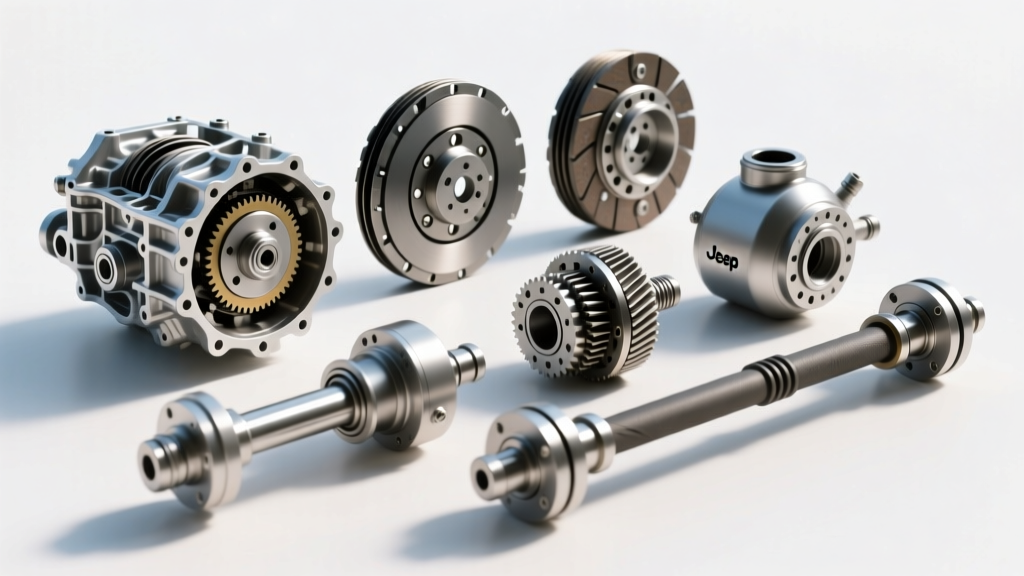
Jeep Wranglers and Gladiators are engineered for extreme off-road articulation, but this capability often comes at the cost of on-road driveline refinement. Whether you are driving a stock JL Rubicon or a lifted JK with 37-inch tires, driveline vibrations are one of the most common complaints among owners. These vibrations are rarely random; they are the direct result of compromised geometry, worn universal joints, or imbalanced tubes. When diagnosing these issues, understanding the precise interaction between your transfer case, axles, and jeep drivetrain components is critical to implementing a permanent fix rather than a temporary band-aid.
Modern Jeep platforms utilize advanced transfer cases like the NV241OR (Rock-Trac) and NV271 (Super Command-Trac), paired with Dana 30, Dana 44, or Dana 60 axles. While robust, the factory driveshafts are designed for specific pinion angles. The moment you install a suspension lift, alter the ride height, or wear out a centering ball in a CV joint, the operating angles shift outside their engineered tolerances, resulting in harmonic vibrations that can ultimately destroy differential bearings and transfer case output seals.
Diagnostic Framework: Isolating the Vibration Source
Before purchasing replacement parts, you must accurately diagnose the vibration type. Driveshaft vibrations generally fall into two distinct categories: first-order and second-order.
First-Order Vibrations (Imbalance or Runout)
A first-order vibration occurs exactly once per revolution of the driveshaft. It typically manifests as a high-frequency hum or shake that peaks between 50 and 65 mph and remains consistent regardless of whether you are accelerating or coasting.
- Common Causes: Missing balance weights, a bent driveshaft tube from rock strikes, or mud/debris packed inside the shaft tube.
- Diagnostic Test: Perform a coast-down test. Bring the vehicle to 70 mph, shift into neutral, and shut off the engine (if safe to do so) or simply let off the throttle. If the vibration persists identically while coasting, the shaft is physically out of balance or bent.
Second-Order Vibrations (Operating Angle Issues)
Second-order vibrations occur twice per shaft revolution. They are caused by improper U-joint or CV joint operating angles. This vibration usually peaks at lower speeds (25 to 45 mph) and is highly load-sensitive—it will often disappear when you let off the throttle and reappear under acceleration.
- Common Causes: Excessive pinion angle post-lift, worn U-joint caps, or a failing double-cardan centering ball.
- Diagnostic Test: Use an adjustable control arm or a temporary shim to alter the rear pinion angle by 2 to 3 degrees. If the vibration changes or disappears, your issue is strictly geometric, requiring either adjustable control arms to reset the pinion or a custom-length CV driveshaft.
Buyer's Guide: Comparing Replacement Jeep Drivetrain Components
Once you have isolated the issue to worn components or an inadequate factory shaft for your lifted setup, selecting the right replacement is paramount. The aftermarket for jeep drivetrain components is vast, ranging from cheap import U-joints to bespoke, high-clearance shafts. Below is our 2026 comparison matrix of the most reliable solutions on the market.
| Component Type | Brand / Part Number | Application / Series | Max Operating Angle | 2026 Est. Price |
|---|---|---|---|---|
| U-Joint (OEM Replacement) | Spicer 5-760X | 1310 Series (JK/JL Front) | 3-5 Degrees | $45 - $55 |
| U-Joint (Heavy Duty) | Spicer 5-1350X | 1350 Series (Upgraded) | 3-5 Degrees | $80 - $95 |
| Complete CV Shaft | Tom Wood's Custom CV | 1350 Series Double-Cardan | Up to 15 Degrees | $650 - $850 |
| Complete OEM Shaft | Mopar Aluminum OEM | 1310 Series (Stock JL) | 3 Degrees | $450 - $600 |
| Slip Yoke Eliminator (SYE) | Advance Adapters Ultra-Range | NP231 / NP241 Transfer Cases | N/A (Geometry Fix) | $280 - $350 |
The 1310 vs. 1350 Series Debate
Factory Jeep Wranglers typically utilize 1310-series U-joints at the transfer case and axle yokes. While adequate for 33-inch tires and mild trails, 1310 joints are the weakest link when running 35-inch or larger tires with sticky mud-terrain compounds. Upgrading to a 1350-series U-joint (like the Spicer 5-1350X) increases the cross-sectional area of the trunnion and bearing caps by roughly 25%, drastically improving torsional strength.
Expert Warning: Do not simply install 1350 U-joints into factory 1310 cast yokes using 'combo' or 'conversion' joints. The 1310 cast yoke ears will flex and snap under high-torque binding situations. A proper upgrade requires welding or replacing the axle and transfer case yokes to accept full 1350 strap kits.
Geometry Rules: Standard U-Joints vs. Double-Cardan CV Joints
A frequent mistake made by novice Jeep builders is misunderstanding the geometric requirements of different joint types. Installing the wrong shaft style for your pinion angle will guarantee immediate vibration and premature joint failure.
Standard Two-Joint Driveshafts (Single Cardan)
Standard driveshafts rely on two single U-joints. For these to operate smoothly without second-order vibrations, the yokes at both ends (transfer case output and axle pinion) must be parallel. They must point in the exact same direction, effectively canceling out the acceleration and deceleration phases of the joint's rotation. If your lift kit rotates the axle pinion upward, the yokes are no longer parallel, and vibration ensues.
Double-Cardan CV Driveshafts
When lifting a Jeep more than 3 inches, the pinion angle changes so drastically that a standard shaft can no longer function. This requires a Slip Yoke Eliminator (SYE) and a double-cardan CV shaft. A CV shaft concentrates all the angular deflection at the transfer case end using a centering ball mechanism.
- The Golden Rule of CV Shafts: The axle pinion yoke must point directly at the transfer case output yoke. The ideal operating angle at the pinion should be between 1 and 2 degrees (to ensure the needle bearings rotate and do not brinell the cap). If the pinion points above or below the transfer case, the CV joint will vibrate and the centering ball will overheat and fail.
Precision Torque Specifications & Clearances
When replacing jeep drivetrain components, adhering to factory and aftermarket torque specifications is non-negotiable. An under-torqued U-joint strap bolt will back out and destroy the yoke; an over-torqued bolt will stretch and snap under axle articulation.
| Fastener / Component | Thread Size | Torque Specification | Notes / Best Practices |
|---|---|---|---|
| 1310 U-Joint Strap Bolts | M8 x 1.25 | 19 lb-ft | Apply medium threadlocker (Blue 242). Replace if stretched. |
| 1350 U-Joint Strap Bolts | 5/16'-24 UNF | 25 - 30 lb-ft | Ensure straps are seated flush; do not overtighten. |
| Transfer Case Output Yoke Nut (NP231/NP241) | 1-1/8' or 1-1/4' | 110 - 150 lb-ft | ALWAYS use a new stover (prevailing torque) nut. Do not reuse. |
| Dana 44 Pinion Nut | 1/2'-20 UNF | 250 lb-ft (Minimum) | Requires crush sleeve or solid spacer setup. Check rotational drag. |
| CV Centering Ball Retainer | Varies | Snug + 1/4 Turn | Pack with high-temp moly grease. Do not overtighten or binding occurs. |
Slip Yoke Eliminator (SYE) and Tail Housing Wear
For older JKs and TJs utilizing the NP231 or early NP241 transfer cases, the factory slip yoke design is a major liability. The slip yoke rides on a bushing inside the transfer case tail housing. Over time, especially with lifted suspensions that force the driveshaft to plunge in and out at steep angles, this bushing wallows out. The result is a leaking rear output seal and a clunking sensation when shifting from Park to Reverse.
If you are diagnosing a vibration accompanied by a rear transfer case leak or driveline clunk, inspect the slip yoke for lateral play. If you can wiggle the yoke more than 0.015 inches radially, the tail housing bore is compromised. Installing a heavy-duty SYE kit replaces the slip yoke with a fixed output yoke, moving the slip spline to the driveshaft itself via a heavy-duty stub shaft. This not only eliminates tail housing wear but provides the necessary clearance to run a longer, flatter CV driveshaft, permanently solving steep-angle vibrations.
Final Verdict & Sourcing Strategy
Diagnosing driveshaft vibrations requires a methodical approach: separate first-order imbalance from second-order angle issues, and measure your pinion geometry before ordering parts. For stock or mildly lifted Jeeps, replacing worn U-joints with greasable Spicer 5-760X units and ensuring proper strap torque will restore factory smoothness. For heavily modified rigs running 35-inch tires and 4+ inches of lift, abandoning the factory aluminum shaft in favor of a custom 1350-series double-cardan CV shaft and an SYE kit is the only reliable path to a vibration-free driveline. Always source your components from authorized drivetrain distributors to avoid counterfeit bearings, and never compromise on fastener torque specs when reassembling the driveline.