Navigating the Mercedes-Benz Drivetrain Warranty Landscape
When it comes to German engineering, the drivetrain of a Mercedes-Benz is a masterpiece of mechanical and electronic integration. Whether you are piloting a rear-wheel-drive C-Class with the 9G-Tronic (725.0) transmission or an E-Class equipped with the 4MATIC all-wheel-drive system, the complexity of these components is staggering. However, this complexity means that out-of-warranty repairs can easily exceed $4,000 to $8,000. Understanding the exact parameters of your Mercedes drivetrain warranty is not just a matter of reading the fine print; it requires a technical understanding of what the manufacturer considers a 'covered hard part' versus an 'excluded wear item.'
This step-by-step guide will walk you through the exact process of verifying your coverage, diagnosing common drivetrain failures, and successfully navigating the dealership claim process in 2026 and beyond. We will reference specific transmission models, torque specifications, and real-world pricing to ensure you are fully equipped to protect your investment.
Step 1: Identify Your Specific Mercedes Warranty Tier
Before you can file a claim or demand a repair, you must know exactly which warranty umbrella your vehicle falls under. Mercedes-Benz structures its factory coverage into distinct tiers, and the definition of 'drivetrain' shifts slightly depending on your contract. According to the Mercedes-Benz USA Warranty Portal, the primary tiers include:
| Warranty Tier | Coverage Limit | Drivetrain Scope |
|---|---|---|
| New Vehicle Limited Warranty | 4 Years / 50,000 Miles | Bumper-to-bumper, including all drivetrain internals, electronics, and seals. |
| Certified Pre-Owned (CPO) | Adds 1 Year / Unlimited Miles | Covers engine and transmission internals, but excludes certain external driveline sensors. |
| Extended Limited Warranty (ELW) - Powertrain | Up to 7 Years / 100,000 Miles | Strictly covers internal lubricated parts of the transmission, differentials, and transfer case. |
| ELW - Gold / Platinum | Up to 7 Years / 100,000 Miles | Expands coverage to include transmission control units, conductor plates, and 4MATIC actuators. |
Pro Tip: If you purchased a third-party extended warranty instead of a factory Mercedes-Benz ELW, scrutinize the contract for the 'We Pay' list. Many third-party providers explicitly exclude the electro-hydraulic control units (conductor plates) found in the 7G-Tronic and 9G-Tronic transmissions, classifying them as 'electronics' rather than 'drivetrain.'
Step 2: Delineate Drivetrain vs. Powertrain Coverage
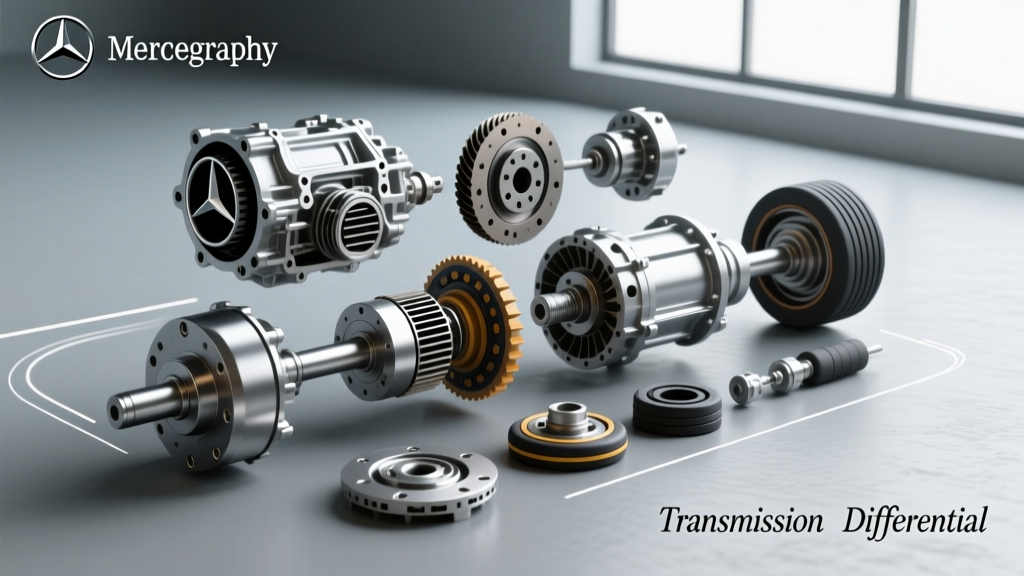
A common pitfall for Mercedes owners is confusing the powertrain with the drivetrain. While the engine is the heart of the powertrain, the drivetrain encompasses everything that transfers that power to the wheels. Under a standard Mercedes drivetrain warranty, the following components are typically covered if they fail due to a manufacturing defect:
Covered Drivetrain Components
- Transmission Internals: Planetary gear sets, clutch packs, torque converters, and the mechatronic valve body (on Gold/Platinum ELW tiers).
- 4MATIC Transfer Case: The internal multi-disc clutch pack and planetary gearset integrated into the rear of the transmission housing.
- Differentials: Front and rear differential ring and pinion gears, bearings, and electronic locking mechanisms (e.g., AMG Performance 4MATIC+ rear axle clutches).
- Propeller Shafts & CV Axles: The metal shafts, constant velocity (CV) joints, and inner/outer axle boots (if torn due to defect, not road debris).
Excluded Wear and Tear Items
Dealerships will frequently deny claims by categorizing the failed part as a 'wear item.' Be aware that the following are almost never covered under any Mercedes drivetrain warranty:
- Flex Discs (Guibo): The rubber vibration dampener between the transmission output flange and the driveshaft. Even if it shatters at 30,000 miles, it is considered routine maintenance.
- Engine and Transmission Mounts: Hydraulic and rubber mounts that absorb drivetrain torsion.
- Fluids and Filters: ATF 134.15 (for 9G-Tronic) and differential gear oils are excluded unless a covered hard-part failure contaminated them.
- Driveshaft Center Support Bearings: The rubber-isolated bearing that supports the two-piece propeller shaft.
Step 3: Diagnose Common Failures Before Claiming
Walking into a dealership blind is a recipe for a denied claim or an unnecessary diagnostic fee. Before scheduling a warranty appointment, you should perform preliminary diagnostics or have an independent Mercedes specialist pull the fault codes using an XENTRY or high-end aftermarket scanner.
The 722.9 Conductor Plate Failure
The 7-speed 722.9 transmission is notorious for speed sensor failures located on the conductor plate (Part Number A 220 270 26 61). If your vehicle throws DTC P0717 (Input/Turbine Speed Sensor Circuit No Signal) or P0722 (Output Speed Sensor Circuit No Signal), the transmission will enter 'limp home' mode, locking you in second gear. While the part itself costs around $450, the labor and required SCN coding push the dealer repair bill to $1,400. If you have a Gold ELW, this is a covered drivetrain electronic component. If you have a basic Powertrain ELW, expect a fight.
4MATIC Transfer Case Shudder
In 4MATIC models, the transfer case relies on a specific friction modifier in the fluid. If the fluid degrades, the multi-disc clutch pack will chatter during tight, low-speed turns. This is often misdiagnosed by inexperienced technicians as a failing front differential or worn CV axles. If the transfer case is neglected, the clutch pack will physically score the steel drums, resulting in a $3,800 transfer case replacement. Documenting this shudder early and demanding a fluid flush under the New Vehicle Limited Warranty can save the mechanical hard parts.
Step 4: The Dealership Claim Process (Actionable Steps)
Filing a Mercedes drivetrain warranty claim requires precise communication. Service advisors are not technicians; they are translators. How you write the Repair Order (RO) dictates how the technician approaches the car.
- Draft the Complaint Accurately: Never write 'Needs transmission service.' Instead, write: 'Vehicle exhibits harsh 2-3 upshifts and a high-pitched whine from the undercarriage at 45 MPH. Suspect 9G-Tronic valve body or torque converter clutch failure.'
- Request a Teardown Authorization: The dealership must submit a 'teardown' request to Mercedes-Benz Warranty Administration. This allows them to remove the transmission pan and inspect the valve body and clutch material for metallic debris.
- Verify Fluid Specifications: Ensure the dealer is using the exact OEM fluid. The 9G-Tronic (725.0) requires MB 236.17 specification fluid (Shell 9-Speed ATF). The dry fill capacity is 10.0 liters, while a standard service fill is approximately 6.0 liters. Using incorrect fluid will instantly void your warranty claim.
- Confirm Torque Specs on Reassembly: If your driveshaft is removed for a transmission R&R, ensure the technician follows factory torque specs. The flex disc to transmission output flange M10x1.5 bolts must be torqued to 45 Nm plus a 90-degree turn. The propeller shaft center bearing support M8 bolts require exactly 20 Nm. Improper torque leads to driveline vibrations that the dealer may later blame on 'aftermarket modifications.'
Step 5: Navigating Claim Denials and Goodwill Assistance
If your claim is denied, the most common reason cited is 'lack of maintenance' or 'external contamination.' Mercedes-Benz does not explicitly mandate a transmission fluid change interval for 'normal' driving in the USA for many of their newer models, labeling the ATF as 'lifetime.' However, warranty administrators will use the presence of burnt fluid or excessive clutch material in the pan as proof of abuse.
Expert Insight: If your drivetrain warranty claim is denied due to 'fluid degradation,' request a sample of the drained ATF and send it to an independent lab like Blackstone Laboratories. If the lab report shows normal wear metals and no evidence of overheating, you can submit this report to Mercedes-Benz Customer Assistance to force a reversal of the denial or secure 'Goodwill' assistance, which can cover 50% to 100% of the repair despite the technical denial.
Furthermore, always check the NHTSA Recalls Database and Mercedes Technical Service Bulletins (TSBs). If a known manufacturing defect exists for your specific transmission serial number range, the dealership is legally obligated to perform the repair regardless of your warranty status, as outlined by the Federal Trade Commission (FTC) guidelines on manufacturer defects and implied warranties of merchantability.
Real-World Cost Analysis: Out-of-Pocket vs. Warranty
To illustrate the financial importance of understanding your Mercedes drivetrain warranty coverage, review the current 2026 dealer pricing for common drivetrain failures. These estimates include OEM parts, factory-specified fluids, and dealership labor rates averaging $220 per hour.
| Drivetrain Component | Example Part Number | Out-of-Pocket Cost | Warranty Cost |
|---|---|---|---|
| 9G-Tronic (725.0) Valve Body | A 222 270 08 00 | $3,200 - $4,100 | $0 (Deductible may apply) |
| 4MATIC Transfer Case Assembly | A 204 270 04 00 | $4,500 - $5,800 | $0 (Deductible may apply) |
| Rear Differential (AMG LSD) | A 213 350 18 00 | $3,800 - $4,500 | $0 (Deductible may apply) |
| Driveshaft Flex Disc (Guibo) | A 220 410 16 15 | $450 - $650 | Not Covered (Wear Item) |
| Transmission Conductor Plate | A 220 270 26 61 | $1,200 - $1,600 | $0 (Requires Gold/Platinum ELW) |
Final Thoughts on Drivetrain Protection
Your Mercedes-Benz drivetrain is a highly calibrated system where mechanical tolerances and electronic controls operate in perfect harmony. The key to successfully utilizing your Mercedes drivetrain warranty lies in proactive documentation, precise terminology when speaking with service advisors, and a firm understanding of the boundary between 'hard internal parts' and 'wear items.' By following this step-by-step framework, you ensure that when the 4MATIC system or the 9G-Tronic transmission inevitably requires attention, the financial burden remains squarely on the manufacturer, not in your bank account.