The Phantom Failures: Understanding Intermittent Clutch Issues
Constant clutch failures are easy to diagnose. A completely worn friction disc slips under any load, and a shattered pressure plate refuses to engage. However, the most frustrating and dangerous issues for drivers and technicians alike are the intermittent signs of clutch problems. These phantom failures occur only under specific thermal conditions, RPM ranges, or driving durations, often leaving mechanics scratching their heads during a standard cold-weather shop test.
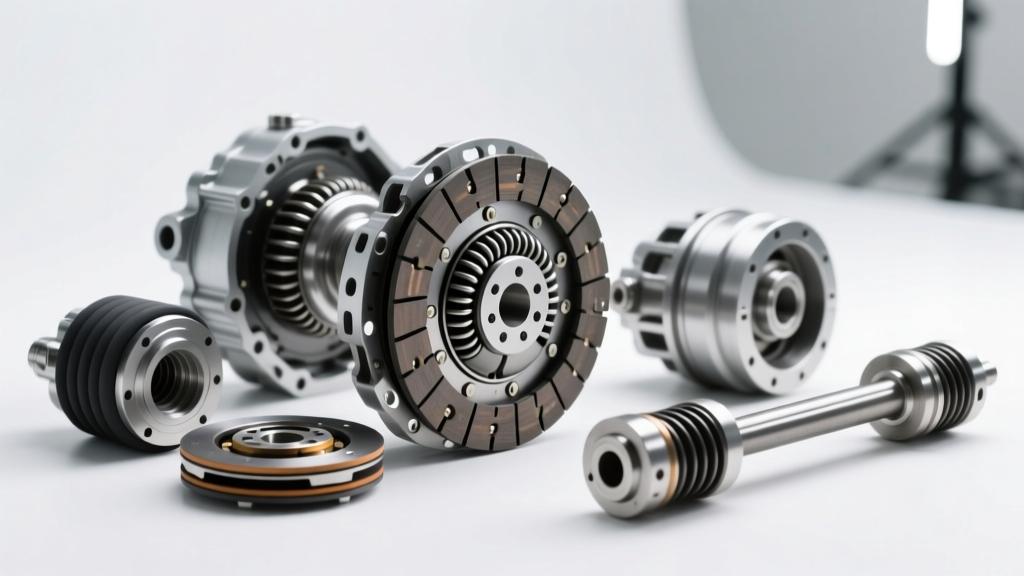
As of 2026, with the manual transmission largely relegated to performance and niche utility vehicles, the complexity of clutch actuation and dampening has increased. Modern dual-mass flywheels (DMFs), concentric slave cylinders (CSCs), and high-pressure DOT 5.1 hydraulic systems introduce variable failure modes that do not present consistently. Diagnosing these intermittent faults requires moving beyond basic visual inspections and understanding the thermodynamics and rotational physics of the drivetrain.
Temperature-Dependent Pedal Sponginess: The Hydraulic Bypass
One of the most common intermittent signs of clutch problems is a pedal that feels firm and offers a precise bite point in the morning, but slowly sinks to the floorboard after 45 minutes of stop-and-go traffic. This is rarely air in the lines; air causes a consistently spongy pedal regardless of temperature.
The Culprit: Clutch Master Cylinder (CMC) Internal Bypass
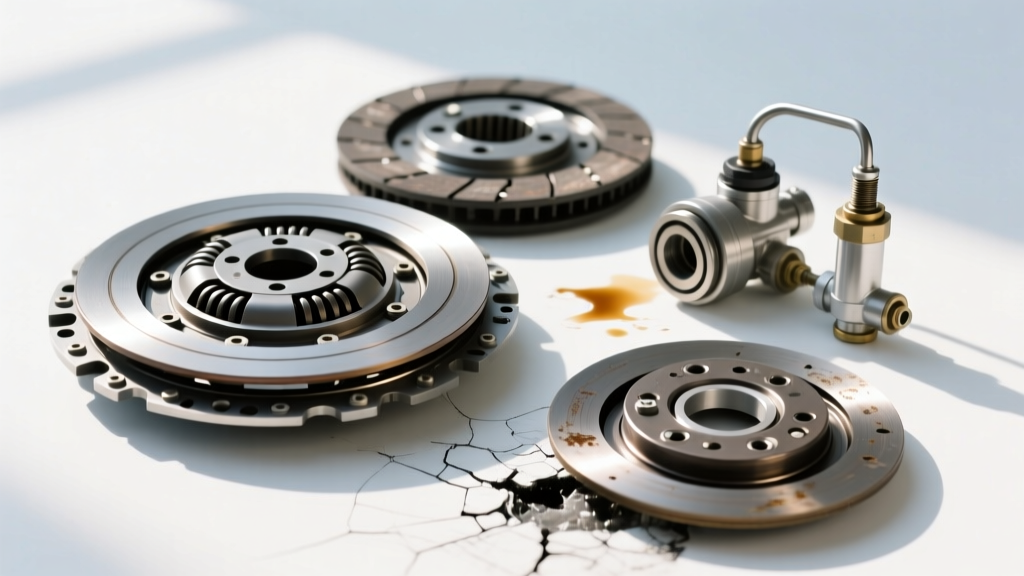
When the engine bay reaches peak operating temperatures (often exceeding 210°F near the firewall), the hydraulic fluid expands. If the internal rubber piston cup inside the CMC has hardened or developed microscopic scoring on the cylinder bore, the fluid bypasses the seal under high pressure. The fluid simply flows back into the reservoir instead of pushing the slave cylinder. Once the car cools down, the rubber seal contracts slightly, regaining its ability to hold pressure.
- Fluid Spec Check: Standard DOT 4 fluid has a dry boiling point of 446°F (230°C). If your fluid is dark and hygroscopic (water-contaminated), its wet boiling point drops below 311°F (155°C), leading to localized vapor lock in the slave cylinder lines routed near the exhaust.
- Part Sourcing: For European applications, OEM-equivalent ATE or Sachs CMC units (e.g., ATE 24.2526-0022.3) feature updated EPDM seals that resist thermal degradation far better than cheap aftermarket white-box alternatives.
RPM-Specific Chatter: Dual-Mass Flywheel Degradation
If your vehicle shudders violently, but only between 1,600 and 2,200 RPM under heavy throttle in 4th or 5th gear, you are witnessing torsional resonance failure. This is a highly specific intermittent symptom pointing directly to the Dual-Mass Flywheel (DMF).
Internal Spring Sag and Arc Play
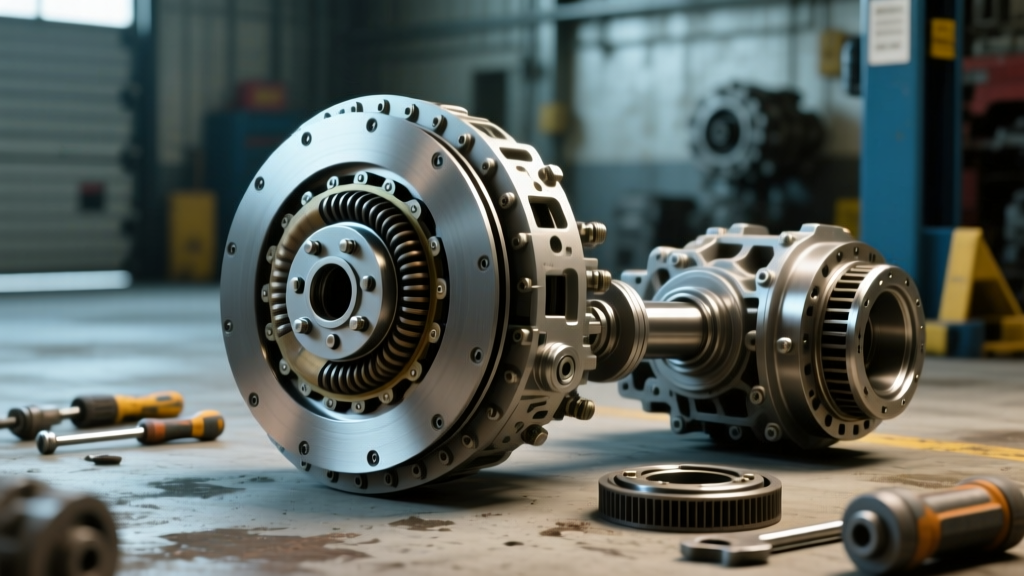
DMFs utilize a complex series of planetary gears and heavy-duty torsional springs to absorb engine harmonics before they reach the transmission input shaft. Over time, these internal springs lose their tension. At low RPMs, the springs are not compressed enough to rattle. At high RPMs, centrifugal force locks the DMF mass together. But in that critical mid-range torque band, the weakened springs allow the primary and secondary flywheel masses to slam back and forth, creating a severe, intermittent chatter.
According to technical bulletins from LuK Aftermarket, a DMF exhibiting more than 60 degrees of free-play arc rotation, or showing visible heat checking (blueing) on the friction surface, must be replaced. Attempting to resurface a DMF is impossible due to its internal sealed damping mechanisms.
Inconsistent Bite Point: Throwout Bearing Binding
Another erratic symptom is a clutch that disengages smoothly 90% of the time, but occasionally 'grabs' or lurches when releasing the pedal from a dead stop. This is typically caused by the throwout bearing (TOB) or release collar binding on the transmission input shaft sleeve.
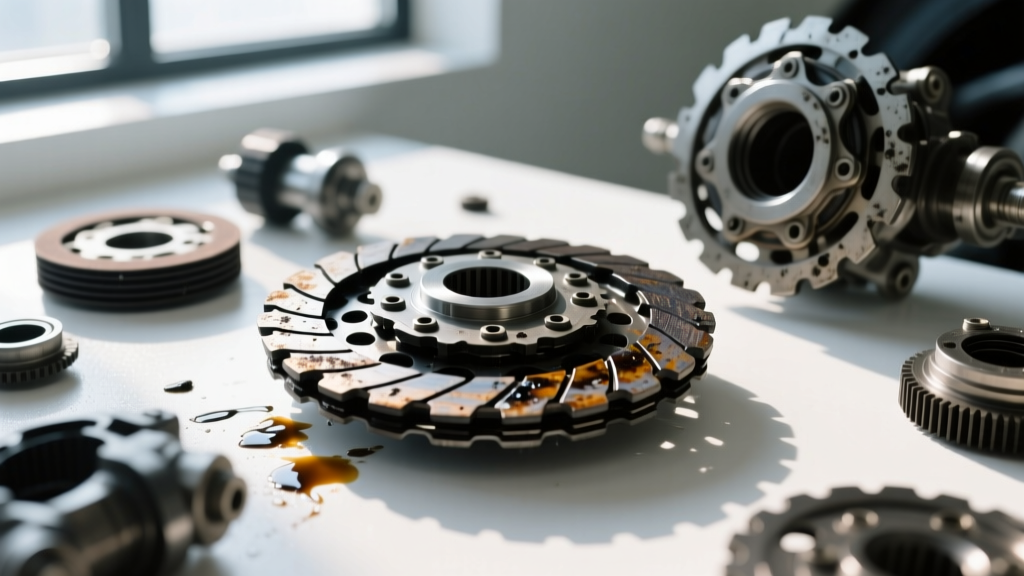
The input shaft sleeve requires a very specific, high-temperature molybdenum disulfide (moly) grease. If a previous mechanic over-applied standard lithium grease, or if dust from the friction disc mixes with the lubricant, it forms an abrasive paste. The TOB will slide smoothly when cold, but as friction heat builds up during repeated shifting, the paste thickens and causes the bearing to hang up on the sleeve. The clutch fork then releases the TOB abruptly rather than smoothly, causing the lurch.
Diagnostic Matrix: Isolating the Intermittent Fault
Use the following matrix to correlate the specific operating condition with the probable mechanical failure. This framework eliminates guesswork and prevents unnecessary transmission pulls.
| Symptom Profile | Operating Condition | Primary Suspect | Verification Test |
|---|---|---|---|
| Pedal drops to floor | Stop-and-go traffic (hot) | CMC Internal Bypass | Pump-and-Hold Test (Hold pedal down with a broomstick for 10 mins; if it creeps up, CMC is bypassing) |
| Low-frequency shudder | 1,600 - 2,200 RPM under load | Dual-Mass Flywheel (DMF) | Lug Test in 4th gear at 1,200 RPM; listen for metallic clatter from the bellhousing |
| Harsh, erratic disengagement | Cold mornings / High mileage | TOB Binding on Input Sleeve | Remove inspection cover; observe TOB return speed and check for grease/dust paste buildup |
| Inconsistent bite point | Varies with ambient temp | Aerated Fluid / Worn Pivot | Bench bleed CMC and measure clutch fork pivot ball wear (max 0.020 inch deviation) |
Step-by-Step Troubleshooting for the DIY Mechanic
Before ordering a $600 clutch kit, perform these three non-invasive tests to pinpoint the intermittent signs of clutch problems.
1. The Thermal CMC Stress Test
Wait until the vehicle is fully warmed up after a hard drive. Have an assistant press the clutch pedal to the floor and hold it there. Place your hand on the clutch hard-line (the metal tube exiting the CMC). If the line pulses or you feel fluid flowing backward toward the reservoir while the pedal is held static, the internal seal is bypassing. Replace the CMC and flush with fresh DOT 5.1 fluid.
2. The DMF 'Lug' and 'Start-Up' Test
Start the engine and immediately turn it off. Listen closely to the bellhousing. A failing DMF will produce a distinct, metallic 'clunk-clunk-clunk' that echoes for 2 to 3 seconds after the engine dies, as the internal masses rebound without engine dampening. Next, put the car in 4th gear at 15 MPH and slowly release the clutch to lug the engine. Severe rattling confirms internal spring failure.
3. Pedal Freeplay and Pivot Ball Inspection
Measure the pedal freeplay at the top of the stroke. It should be exactly 0.5 to 1.0 inches (12-25mm) before you feel hydraulic resistance. If the freeplay constantly changes, inspect the clutch fork pivot ball inside the bellhousing (accessible via the slave cylinder hole on many Tremec and Getrag transmissions). A worn aluminum pivot ball will alter the clutch geometry dynamically as the housing heats and expands.
Repair Costs, Torque Specs, and Part Sourcing (2026 Market Rates)
When addressing intermittent issues, always replace the entire mating system. Reusing a worn pivot ball or old flywheel bolts will guarantee a rapid return of the symptoms.
- Hydraulic Overhaul: A high-quality ATE or FTE CMC and slave cylinder combo costs between $140 and $280. Labor to bleed and replace is typically 1.5 hours ($180-$250).
- DMF & Clutch Kit: A complete LuK RepSet (including DMF, pressure plate, disc, and TOB) for a modern performance car (e.g., BMW E92 M3 or Ford Mustang GT) ranges from $650 to $1,100. Labor for a RWD transmission pull averages $700 to $1,200.
- Crucial Torque Specifications: Never reuse flywheel bolts. They are Torque-To-Yield (TTY).
- GM LS (Gen III/IV) Flywheel Bolts: 74 lb-ft (100 Nm).
- Ford 5.0L Coyote Flywheel Bolts: 66 lb-ft + 90 degrees.
- BMW ZF S6-45 DMF to Crank: 105 Nm + 74 Nm + 140 degrees.
For detailed hydraulic bleeding procedures and specific torque sequences, always consult the ATE Brakes Technical Portal or your vehicle's OEM service manual. Recognizing these intermittent signs of clutch problems early saves the transmission input shaft from catastrophic harmonic damage and ensures your manual drivetrain performs exactly as engineered.