The Hidden Danger of the Quick-Lube Fluid Swap
When a vehicle arrives at the shop with harsh downshifts, torque converter shudder, or delayed engagements shortly after a service, the immediate suspect is often the fluid itself. While owners frequently ask how often should you change transmission fluid in a car, the far more critical question is what type of fluid was actually put in the pan. Misidentifying automatic transmission fluid (ATF) or continuously variable transmission fluid (CVTF) is one of the most common catalysts for catastrophic drivetrain failure in modern vehicles.
Modern transmissions are not merely hydraulic pumps; they are electro-hydraulic marvels relying on precise friction coefficients, specific viscosity indices, and tailored anti-wear additive packages. Putting a generic 'multi-vehicle' ATF into a highly calibrated unit like the ZF 8HP or a GM 10L90 will alter the clutch apply times by milliseconds, triggering adaptive learning faults and eventual mechanical burnout. In this diagnostic guide, we will break down how to identify unknown fluids, map specific shifting symptoms to the wrong fluid types, and establish definitive service intervals.
Visual and Olfactory Diagnostics: Identifying Unknown ATF
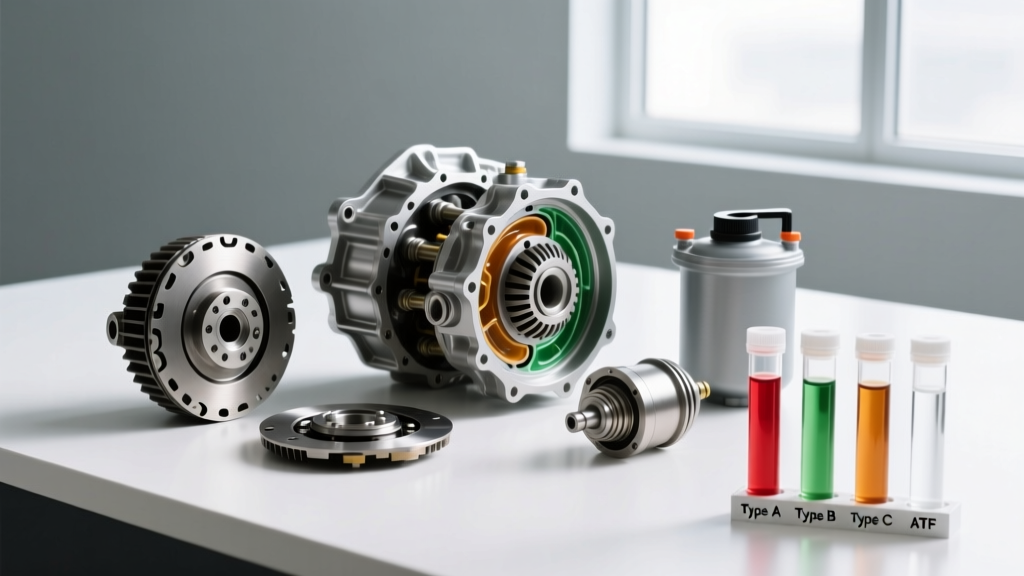
If you are troubleshooting a vehicle with an unknown service history, pulling the dipstick or dropping the inspection pan is your first diagnostic step. While color alone is not a definitive chemical analysis, combined with smell and viscosity, it provides a strong baseline for fluid identification.
| Fluid Spec / OEM | Typical Color (New) | Odor Profile | Viscosity & Tactile Feel |
|---|---|---|---|
| Dexron VI (GM) | Cherry Red | Mild, slightly sweet petroleum | Thin, low-viscosity (approx. 5.5 cSt at 100°C) |
| Mercon LV (Ford) | Bright Red | Sharp, distinct chemical/solvent | Slightly thicker than Dexron VI, slick feel |
| ATF+4 (Chrysler/Stellantis) | Deep Ruby Red | Strong synthetic ester smell | Medium viscosity, high friction modifier content |
| ZF Lifeguard 8 | Yellowish-Green / Amber | Faint, almost odorless synthetic | Very thin, engineered for high-shear stability |
| Nissan NS-3 (CVT) | Translucent Green | Earthy, heavy base oil scent | Thick, high-tack feel for steel belt grip |
| Honda DW-1 | Clear / Pale Amber | Light mineral oil | Extremely low viscosity for clutch-to-clutch shifts |
The Paper Towel Chromatography Test
When fluid has degraded, color becomes muddled. To identify the base chemistry, place three drops of the suspect fluid on a high-quality white paper towel and let it sit for 15 minutes. Dexron-based fluids will spread rapidly with a uniform red or brown halo. CVT fluids (like NS-3) tend to pool denser in the center with a slower wicking rate due to higher tackifier content. ZF Lifeguard fluids will often leave a distinct yellowish ring at the outer edge of the wick pattern as the specialized friction modifiers separate from the polyalphaolefin (PAO) base stock.
Symptom Mapping: What Happens When You Guess the Fluid Type?
Diagnosing a fluid-related issue requires matching the driver's complaint and OBD2 scan tool data to the specific transmission architecture. Here is how incorrect fluid manifests in three of the most common modern transmissions.
ZF 8HP (Chrysler 8-Speed, BMW, Audi, Jaguar)
The ZF 8HP series requires ZF LifeguardFluid 8 (Part # S671 090 312). This fluid is specifically engineered for the ZF's integrated mechatronic unit and its unique torque converter clutch (TCC) lock-up strategy.
- The Mistake: A shop tops off the ZF 8HP with a generic Dexron VI or 'Universal' ATF, noting that the bottle claims compatibility with 'most 8-speeds'.
- The Symptom: The driver reports a pronounced shudder during light-throttle 3-4 and 4-5 upshifts, and a harsh 'clunk' on 2-1 coast-down shifts. Scan data reveals erratic TCC slip RPMs (PID: TCC_SLIP) fluctuating between 40 and 150 RPM when it should be locked at 0-10 RPM.
- The Diagnosis: The friction modifiers in Dexron VI are designed for GM's clutch materials, not the ZF's paper-based friction rings. The incorrect fluid causes micro-slip, leading the Transmission Control Module (TCM) to aggressively increase line pressure to compensate, resulting in harsh garage shifts and eventual mechatronic sleeve wear.
GM 6L80 / 6L90 (Silverado, Corvette, Camaro)
These units require ACDelco Dexron VI (Part # 88865618). The 6L80 relies on a highly sensitive Transmission Electro-Hydraulic Control Module (TEHCM) mounted directly inside the fluid pan.
- The Mistake: Using an older, obsolete Dexron III or a high-viscosity 'heavy duty' ATF to 'stop a leak' or 'firm up shifts'.
- The Symptom: Delayed reverse engagement when hot, accompanied by a P0711 (Transmission Fluid Temperature Sensor Circuit Range/Performance) or P0741 (TCC Stuck Off) code.
- The Diagnosis: Dexron III is too thick at operating temperatures (approx. 7.0 cSt vs 5.5 cSt). The TEHCM solenoids are calibrated for the lower viscosity of Dexron VI. The thicker fluid starves the 3-5-R clutch apply circuits during rapid temperature spikes, causing localized overheating and varnishing of the TEHCM filter screen.
Jatco CVT8 / CVT-X (Nissan, Subaru, Mitsubishi)
These continuously variable transmissions require Nissan NS-3 or equivalent OEM CVTF. NS-3 is priced higher (often $45-$60 per gallon) due to its extreme-pressure additives designed to prevent the steel push-belt from slipping on the variable pulleys.
- The Mistake: Flushing the CVT with standard red ATF because the machine was already hooked up and the technician assumed 'fluid is fluid'.
- The Symptom: Immediate RPM flaring under acceleration, a loud whining noise from the pump, and a P0868 (Line Pressure Low) or P281E code. The vehicle enters limp mode within 50 miles.
- The Diagnosis: Standard ATF lacks the extreme shear-stability and tackifiers required for CVT pulley grip. The belt slips, scoring the pulley faces and sending microscopic metal debris directly into the step-motor and valve body, effectively destroying the transmission.
So, How Often Should You Change Transmission Fluid in a Car?
Now that we have established the catastrophic risks of using the wrong fluid, we must address the core maintenance question: how often should you change transmission fluid in a car? The automotive industry's shift toward 'Lifetime' fluid designations has caused widespread confusion and premature transmission failures.
According to engineering standards from ZF Aftermarket, 'Lifetime' does not mean the lifetime of the vehicle; it means the lifetime of the warranty period, or roughly 100,000 miles under ideal conditions. However, real-world driving involves thermal cycling, towing, and stop-and-go traffic, which rapidly depletes the fluid's oxidation inhibitors.
Definitive Service Intervals (Severe vs. Normal Duty)
- Standard Planetary Automatics (GM 6L80, Ford 6R80, Toyota A750): Drop the pan, replace the filter/screen, and refill every 60,000 miles. A full machine flush is generally unnecessary if the pan is dropped regularly.
- High-Gear Count Automatics (ZF 8HP, GM 10L90, Ford 10R80): Every 50,000 to 60,000 miles. These units operate at higher internal pressures and temperatures, breaking down the shear-stability of the fluid faster.
- CVTs (Nissan Jatco, Subaru Lineartronic): Every 30,000 to 50,000 miles. CVTs are highly sensitive to fluid degradation. The friction modifiers deplete rapidly, and metal shearing from the belt contaminates the fluid quickly.
- Heavy Duty / Towing (Ram Aisin, Ford TorqShift): Every 30,000 miles or 1,500 hours of PTO/towing operation.
For a comprehensive breakdown of specific fluid formulations and their chemical tolerances, technicians should consult the Castrol Transmission Fluid Technical Data Sheets to verify viscosity and friction modifier compatibility before performing any service.
Corrective Action: Drain, Fill, and Hardware Specs
If you have diagnosed that the wrong fluid was installed, a simple 'drain and fill' is rarely sufficient. The torque converter holds 40% to 60% of the total system capacity. You must perform a double drain-and-fill or a low-pressure dialysis flush using the correct OEM fluid to dilute the incorrect additive package below the 5% threshold where it can cause friction anomalies.
Critical Torque Specifications & Part Data
When dropping the pan to verify fluid type or perform the corrective service, adhering to OEM torque specs is vital to prevent pan warping, filter unseating, and cross-threading of soft aluminum cases.
- GM 6L80 / 6L90 Aluminum Pan: Torque pan bolts to 25 Nm (18 lb-ft) in a crisscross pattern. Do not exceed this, or the aluminum threads in the case will strip. Use ACDelco filter kit # 24236933.
- ZF 8HP Plastic Pan (Mechatronic Integrated): The plastic pan bolts are one-time-use stretch bolts. Torque to 10 Nm, then turn an additional 45 degrees. The filter is integrated into the plastic pan; you must replace the entire pan assembly (ZF Part # 2411 8 612 856, approx. $250-$350).
- ZF 8HP Mechatronic Sleeve Adapter: If removing the mechatronic unit to flush the valve body, the electrical sleeve locking tab must be seated perfectly, and the adapter ring torqued to 8 Nm (71 lb-in). Over-torquing will crack the plastic sleeve, causing a massive external fluid leak.
By combining precise fluid identification techniques with strict adherence to OEM intervals and torque specifications, you can eliminate 'mystery' shift complaints and ensure the longevity of modern, highly-calibrated drivetrains. Never assume fluid compatibility based on bottle marketing; always verify the exact OEM specification.