The Actuation Divide: Steel Wire vs. Fluid Pressure
For decades, manual transmission enthusiasts have debated the merits of cable-actuated versus hydraulic-actuated clutch systems. Whether you are restoring a classic Foxbody Mustang, maintaining a 1990s Honda Civic, or daily-driving a modern Subaru WRX, understanding how your clutch disengages the transmission is fundamental to drivetrain reliability. While both systems serve the exact same purpose—moving the release bearing against the pressure plate diaphragm springs—their mechanical execution, failure modes, and maintenance requirements are vastly different.
As we navigate the automotive landscape in 2026, hydraulic systems have largely won the OEM war due to packaging flexibility and consistent pedal feel. However, cable systems still hold a loyal following in budget motorsports and classic restomods. In this guide, we will break down the engineering differences, explore the realities of changing clutch master cylinder assemblies, and help you decide which system belongs in your project car.
How Cable Clutch Systems Work (and Why They Fail)
A cable clutch relies on a simple Bowden cable setup. When you depress the pedal, a steel wire pulls directly on the clutch fork or release arm. The cable is housed within a ribbed outer casing lined with PTFE (Teflon) or nylon to reduce friction.
Common Cable Failure Modes
- Cable Fraying and Snapping: Over time, the steel wire fatigues at the pedal pivot point or the clutch fork anchor. A snapped cable leaves you stranded instantly with zero warning.
- Housing Collapse: The outer plastic housing can compress under heavy pedal loads, especially if the cable routing has sharp bends. This results in a 'spongy' pedal feel that mimics air in a hydraulic line.
- Quadrant Wear: Vehicles like the 1980s-1990s Ford Mustangs use a plastic self-adjusting quadrant. These teeth strip under the load of heavy-duty pressure plates (like a Spec Stage 3+), causing the pedal to drop to the floor.
Expert Insight: Cable systems require physical routing space and are highly sensitive to engine movement. If your engine mounts are worn, the engine shifts under load, altering the cable tension and causing the clutch to slip or drag unexpectedly.
The Hydraulic Advantage: Pascal's Law in the Drivetrain
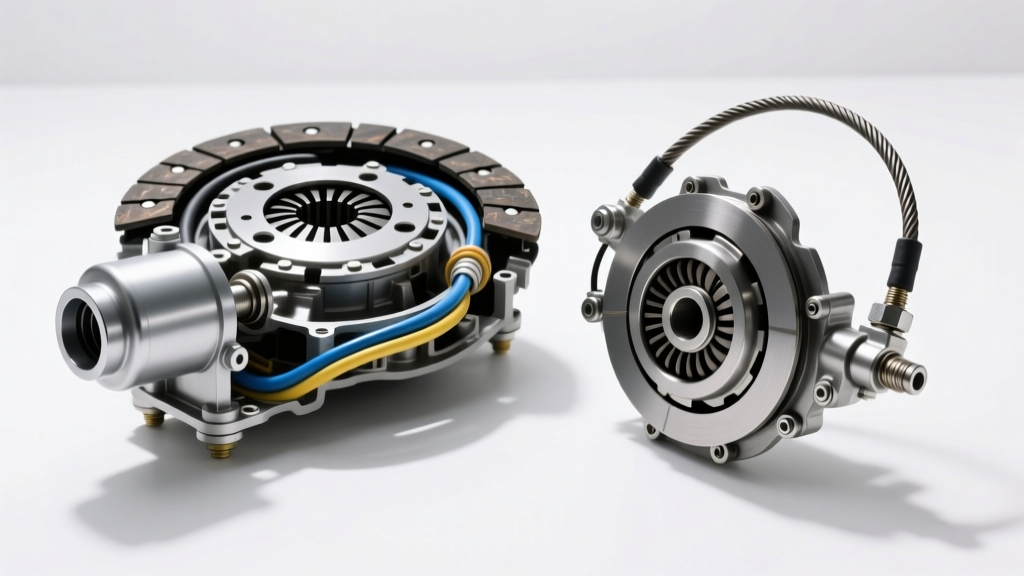
Hydraulic systems replace the physical wire with incompressible glycol-ether fluid (DOT 3, DOT 4, or DOT 5.1). Pressing the pedal pushes a piston inside the master cylinder, forcing fluid through a high-pressure line to a slave cylinder, which then actuates the clutch fork.
Bore Size Dynamics: 5/8" vs. 3/4"
The diameter of the master cylinder bore dictates your pedal effort and travel. According to fluid dynamics principles documented by ZF Sachs, a smaller bore (e.g., 5/8-inch or 15.87mm) requires less pedal effort but pushes less fluid volume, requiring a longer pedal stroke. Conversely, a larger bore (e.g., 3/4-inch or 19.05mm) pushes more volume for a shorter stroke but demands significantly more leg effort. Upgrading from a 5/8" to a 3/4" master cylinder is a common fix for vehicles with heavy aftermarket twin-disc clutches that suffer from incomplete disengagement.
System Comparison Matrix
| Feature | Cable Actuation | Hydraulic Actuation |
|---|---|---|
| Pedal Feel | Mechanical, prone to binding | Linear, consistent, easily tunable |
| Primary Failure Mode | Sudden snap or housing collapse | Gradual fluid leaks or seal bypass |
| Routing Flexibility | Poor (requires smooth, wide bends) | Excellent (hoses bend tightly) |
| Maintenance | Lubrication and cable adjustment | Fluid flushes and system bleeding |
| Avg. Replacement Cost | $30 - $90 (Cable only) | $45 - $180 (Master Cylinder) |
The Reality of Changing Clutch Master Cylinder Components
When the time comes for changing clutch master cylinder components, the job is often misunderstood by beginners. Unlike a cable swap, which usually just requires unhooking two ends, a hydraulic master cylinder replacement involves managing brake fluid, avoiding paint damage, and properly bleeding the system. Let's look at the exact steps and specifications for a common application, such as a GM S-10 or a BMW E46.
Preparation and Removal
First, protect your firewall and interior carpets. DOT 4 fluid is highly corrosive to automotive paint and will melt certain plastics. Use a fluid extraction syringe to empty the reservoir before unbolting. You will need a set of flare nut wrenches—typically 11mm or 12mm—to remove the hydraulic line fitting. Never use an open-end wrench on these soft brass or steel flare nuts, as rounding them off will force you to replace the entire hard line.
Inside the cabin, locate the pushrod connecting the pedal to the master cylinder. This is usually secured by a clevis pin and clip, or a single 13mm or 15mm nut. On the engine bay side, the master cylinder is held to the firewall by two nuts (usually 13mm or 15mm). The factory torque specification for these firewall mounting nuts is generally between 15 and 22 lb-ft (20-30 Nm). Over-torquing can crack the plastic reservoir or warp the aluminum mounting flange.
Bench Bleeding: The Step Beginners Skip
Before installing the new unit (such as a Dorman M640044 for GM trucks or a Sachs KF1402230519 for BMWs), you must bench bleed it. Clamp the master cylinder in a vise, fill the reservoir with fresh DOT 4 fluid, and use a blunt punch to slowly push the piston in and out until no air bubbles emerge from the output port. Skipping this step will trap a massive air pocket in the master cylinder that the slave cylinder bleeder valve simply cannot pull out.
Fluids, Bleeding, and Modern Standards
Once installed, the system must be bled. While the old 'pump-and-hold' two-person method works, modern DIYers should invest in a pressure bleeder. Using a tool like those offered by Motive Products, you can pressurize the master cylinder reservoir to 15 PSI. This forces fluid down through the slave cylinder without introducing micro-bubbles.
For high-performance applications, standard DOT 3 (dry boiling point 401°F) is inadequate. Upgrade to a high-quality DOT 4 (dry boiling point 446°F / 230°C) or DOT 5.1. Never use DOT 5 (silicone-based) in a clutch system; it does not absorb moisture, leading to localized pooling of water that will destroy internal rubber seals and cause the slave cylinder to seize.
The Conversion Question: Swapping Cable for Hydraulic
Many classic car owners opt to convert their mechanical or cable linkages to hydraulic. If you are restoring a 1960s muscle car, the original Z-bar mechanical linkage is heavy, binds under header heat, and requires constant adjustment. Companies offer complete bolt-in hydraulic conversion kits that include the pedal assembly, master cylinder, hard lines, and a hydraulic throwout bearing.
These kits typically range from $600 to $950 depending on the application. While the upfront cost is significantly higher than a $40 replacement cable, the elimination of pedal binding, the ability to easily swap engines without fabricating new linkages, and the vastly superior pedal modulation make the hydraulic conversion one of the highest-ROI upgrades you can perform on a vintage manual transmission vehicle.
Final Takeaway
Cable systems offer raw, mechanical simplicity and are incredibly cheap to replace, making them viable for budget track cars and basic commuters. However, hydraulic systems provide the consistent, tunable pedal feel required for modern driving and high-horsepower applications. By understanding the bore sizing, mastering the bench-bleeding process, and using the correct flare nut tools, maintaining a hydraulic system becomes a straightforward, rewarding DIY task rather than a dreaded chore.
For sourcing OEM replacement hydraulics at wholesale pricing, enthusiasts frequently cross-reference part numbers on platforms like RockAuto to ensure they are getting genuine FTE, Sachs, or Aisin components rather than low-quality white-box knockoffs.