The Evolution of Two-Wheel Transmissions: Manual vs. Auto
The motorcycle industry is undergoing a massive shift in drivetrain technology. While traditionalists still swear by the tactile feedback of a manual transmission, the rise of Honda's Dual Clutch Transmission (DCT), continuously variable transmissions (CVTs), and auto-clutch conversions has popularized the concept of motorcycles without a clutch. For riders who prefer to skip the left-hand lever entirely, maintenance revolves around complex mechatronic units and specialized hydraulic filters. However, for the vast majority of performance, commuter, and touring motorcycles on the road in 2026, the traditional hydraulic clutch system remains the standard.
As a preventive maintenance guide, understanding the nuances of hydraulic clutch diagnosis is critical. A failing hydraulic system doesn't just ruin your ride; it can strand you on the side of the highway or lead to catastrophic transmission damage if the clutch drags during shifts. This guide breaks down the exact symptoms, diagnostic procedures, and preventive maintenance protocols for manual hydraulic clutches, while contrasting them with the upkeep required for motorcycles without a clutch.
Core Symptoms of Hydraulic Clutch Degradation
Unlike cable-actuated systems that give gradual warning through increased lever effort, hydraulic systems can fail suddenly if preventive maintenance is ignored. Diagnosing the root cause requires isolating the issue to either the master cylinder, the hydraulic line, or the slave cylinder.
1. The Spongy Lever and Moisture Ingress
A spongy or soft clutch lever is the most common symptom of hydraulic degradation. This is almost always caused by two factors: air in the system or moisture contamination. Motorcycle hydraulic systems typically use DOT 4 or DOT 5.1 brake fluid, which is highly hygroscopic (water-absorbing). As moisture enters through the microscopic pores of rubber brake lines or the master cylinder reservoir diaphragm, the boiling point of the fluid drops. Under heavy use, the water boils, creating compressible vapor pockets that result in a spongy feel and incomplete clutch disengagement.
2. Clutch Drag and Slave Cylinder Retraction Failure
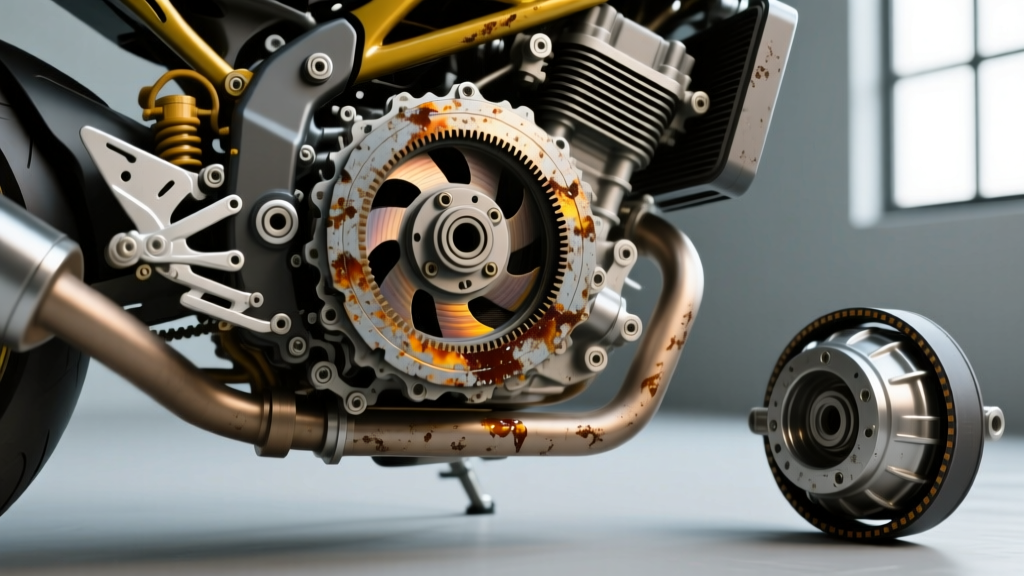
If your motorcycle creeps forward when the clutch lever is fully pulled in, or if you experience false neutrals and clunky downshifts, you are experiencing clutch drag. In a hydraulic system, this is rarely a warped friction plate issue. Instead, it points to a blocked master cylinder return port or a failing slave cylinder. When the internal seals of the slave cylinder degrade, they can swell or bind, preventing the piston from fully retracting. This keeps constant pressure on the clutch pushrod, meaning the clutch pack is never fully engaged, leading to rapid friction plate wear and overheating.
3. The Yamaha MT-09 / FJ-09 Slave Cylinder Epidemic
A real-world diagnostic example is the Yamaha MT-09 and Tracer 9 (FJ-09) platform. These bikes are notorious for premature slave cylinder failures, often occurring between 12,000 and 18,000 miles. The OEM unit utilizes a plastic pushrod guide and marginal internal seals that degrade rapidly under high engine bay temperatures. Diagnosis involves removing the slave cylinder (held on by two M6 bolts) and inspecting the pushrod for lateral play or scoring. The preventive fix is upgrading to an all-metal aftermarket billet slave cylinder (costing roughly $140-$180) to eliminate the plastic failure point entirely.
Preventive Maintenance: Fluids, Seals, and Hardware
Preventing hydraulic failure is vastly cheaper than replacing a burnt clutch pack. A strict preventive maintenance schedule relies on fluid testing and precise hardware torque specifications.
Fluid Selection and Moisture Testing
Never rely solely on the color of the fluid to determine its health. Dark fluid can simply be a result of normal dye breakdown or minor rubber hose degradation. Instead, use a digital brake fluid moisture tester or copper sulfate test strips. According to Motul's technical data for RBF 600, high-performance DOT 4 fluids offer a dry boiling point of 622°F (328°C) and a wet boiling point of 420°F (216°C). Once moisture content exceeds 3%, the wet boiling point plummets, and the fluid must be flushed immediately. For most street riders, a complete hydraulic flush every 12 to 18 months is the golden rule.
Master and Slave Cylinder Torque Specifications
When performing a flush or replacing a slave cylinder, adhering to precise torque specs is non-negotiable. Overtightening banjo bolts can strip the aluminum master cylinder threads or crush the hollow bolt, restricting fluid flow. Undertightening leads to slow weeping leaks that introduce air into the system.
- M10x1.25 Banjo Bolts (Hydraulic Lines): 22 Nm (16.2 lb-ft). Always use two new crush washers (one on each side of the banjo fitting).
- M6 Slave Cylinder Mounting Bolts: 10 Nm (7.4 lb-ft). Apply a drop of blue Loctite 243 to prevent vibration-induced backing out.
- M8 Master Cylinder Clamp Bolts: 24 Nm (17.7 lb-ft).
Maintenance Cost & Effort: Manual vs. Motorcycles Without a Clutch
Why do some riders gravitate toward motorcycles without a clutch? Often, it is to escape the maintenance and physical fatigue of manual transmissions. However, clutchless systems introduce their own complex preventive maintenance requirements. Below is a diagnostic and maintenance comparison for 2026.
| System Type | Primary Fluid / Medium | Service Interval | Avg. Dealer Cost | Common Failure Point |
|---|---|---|---|---|
| Manual Hydraulic Clutch | DOT 4 / DOT 5.1 Brake Fluid | Every 12-18 Months | $80 - $120 | Slave cylinder seals, rubber line swelling |
| Honda DCT (e.g., Africa Twin) | Engine Oil + DCT Hydraulic Filter | Filter every 24k miles | $180 - $250 | DCT filter clogging, mechatronic solenoid failure |
| Rekluse Auto-Clutch Conversion | Shared Engine Oil (Wet Clutch) | Check free-play every 1k miles | $60 - $90 (DIY adjust) | Expander assembly wear, drive basket notching |
| Manual Cable Clutch (Legacy) | Lithium Grease / Cable Lube | Every 5,000 Miles | $40 - $60 | Cable fraying at the lever perch |
As the data shows, while motorcycles without a clutch (like DCT-equipped models) eliminate the rider's left-hand fatigue, they require specialized filters (such as Honda Part # 25430-MJM-D01) and stricter engine oil shear monitoring, as the oil acts as both a lubricant and a hydraulic medium for the clutches. Conversely, a manual hydraulic system is incredibly robust provided the fluid is kept dry and the slave cylinder seals are monitored.
Step-by-Step Hydraulic Bleeding and Pressure Testing
If your diagnostic checks reveal a spongy lever after a fluid flush, you likely have trapped air in the ABS module (if equipped) or a high-point in the hydraulic line routing. Traditional pump-and-hold bleeding is often insufficient for modern motorcycles with complex line routing. Vacuum bleeding is the professional standard.
- Preparation: Wrap the master cylinder reservoir in shop towels. DOT fluid will strip motorcycle paint and melt plastic fairings within seconds.
- Extract Old Fluid: Use a fluid extractor syringe to remove the contaminated fluid from the reservoir. Refill with fresh, sealed DOT 4 or 5.1 fluid.
- Attach Vacuum Bleeder: Connect a vacuum bleeder (like the Motion Pro ProBleeder) to the slave cylinder bleeder nipple. Ensure the rubber cone seals tightly over the nipple to prevent false air ingestion.
- Pull Vacuum: Pump the vacuum bleeder to 20-25 inHg. Open the bleeder nipple a quarter turn.
- Monitor Flow: Watch the fluid travel through the clear tube. Do not close the nipple until you see a solid, bubble-free stream of fluid and the master cylinder reservoir is topped off. Never let the reservoir run dry, or you will restart the process.
- Seal and Test: Close the nipple to 10 Nm (7.4 lb-ft), release the vacuum, and test the lever feel. It should hit a hard, immovable hydraulic wall within 10mm of the grip.
When to Convert: The Auto-Clutch Alternative
For off-road and dual-sport riders who are tired of diagnosing hydraulic leaks after tip-overs, or those suffering from hand fatigue in stop-and-go traffic, converting to an auto-clutch system is a viable alternative. Companies like Rekluse Motor Sports offer centrifugal auto-clutch systems (like the Core EXP or TorqDrive) that retain the manual shifter but eliminate the need to pull the lever to prevent stalling. While these systems require meticulous engine oil maintenance and periodic free-play adjustments, they entirely remove the hydraulic master and slave cylinders from the equation, eliminating hydraulic-specific failure points.
Conclusion
Whether you are riding a traditional manual sportbike or exploring the world on one of the new motorcycles without a clutch, drivetrain maintenance is unavoidable. For hydraulic clutch systems, the path to reliability is paved with preventive care: annual fluid flushes, moisture testing, and proactive slave cylinder upgrades on known weak platforms. By understanding the exact torque specs, fluid properties, and diagnostic symptoms outlined above, you can ensure your transmission shifts flawlessly for tens of thousands of miles, keeping you on the road and out of the repair bay.