The Unique Role of Torque Converters in P2 Hybrid Architectures
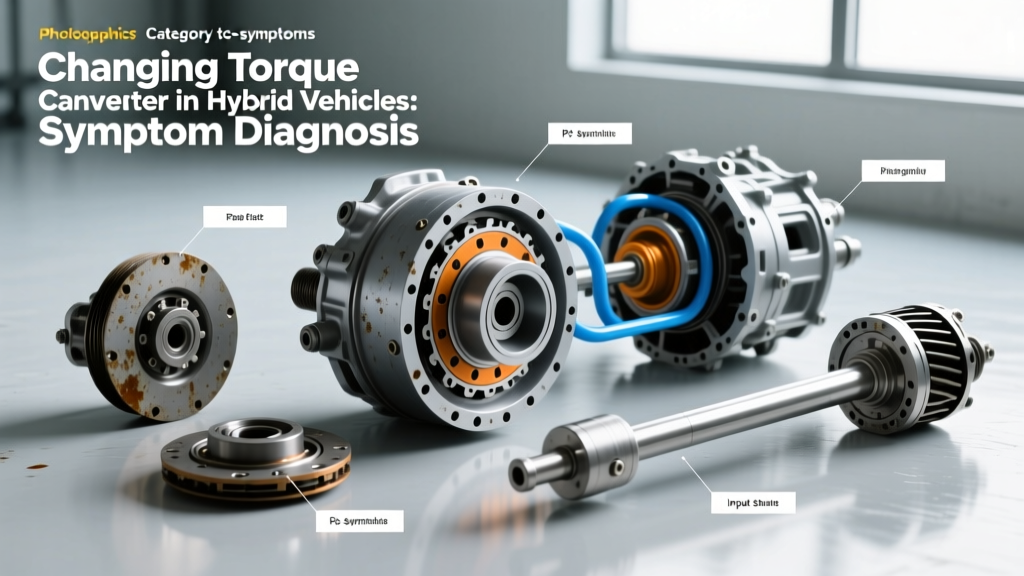
The integration of electric motors into traditional automatic transmissions has fundamentally changed how drivetrain technicians approach symptom diagnosis. In P2 hybrid architectures—where the electric motor is sandwiched between the internal combustion engine (ICE) and the transmission input shaft, such as in the ZF 8HP hybrid variants (e.g., 8HP75H) or the Hyundai/Kia 6F24 hybrid systems—the torque converter is subjected to extreme, dual-source torsional stress. Unlike a conventional vehicle where the torque converter only manages the ICE’s gradual torque curve, hybrid torque converters must instantly absorb the peak, zero-RPM torque delivery of the E-Motor while simultaneously managing the ICE’s power band.
When a customer complains of low-speed shudder, delayed EV-to-ICE handoffs, or harsh torque converter clutch (TCC) lockup, the root cause is rarely as simple as degraded friction material. Modern 2026 diagnostic routines require a deep understanding of combined system torque loads, fluid shear rates, and precise mathematical conversions to differentiate between a mechanical failure and a software calibration limit.
Why Torque Converter lb-ft to Nm Conversions Matter in Diagnostics
One of the most common pitfalls for transmission technicians working on hybrids is the discrepancy in torque measurement units. Automakers typically rate the internal combustion engine’s output in pound-feet (lb-ft), while the integrated electric motor’s peak torque is almost universally rated in Newton-meters (Nm).
When diagnosing P2 hybrid systems, technicians frequently face a data mismatch on their bi-directional scan tools. To accurately determine if the torque converter clutch (TCC) is slipping due to mechanical wear or simply being overwhelmed by combined system torque, you must perform a torque converter lb ft to Nm conversion to compare the total drivetrain load against the TCC's maximum friction capacity. If the E-Motor is delivering 160 Nm of instant torque while the ICE is contributing 220 lb-ft, the combined input shaft load must be calculated in a single metric to verify if it exceeds the TCC apply pressure limits programmed into the Transmission Control Module (TCM).
Standard Conversion Formula and TCC Slip Thresholds
The formula is straightforward: 1 lb-ft = 1.35582 Nm. Conversely, 1 Nm = 0.73756 lb-ft. Below is a quick-reference table for common hybrid TCC slip diagnostic thresholds when evaluating combined torque loads.
| ICE Torque (lb-ft) | E-Motor Torque (Nm) | Converted E-Motor (lb-ft) | Total Combined Load (lb-ft) | Total Combined Load (Nm) | TCC Status / Diagnostic Action |
|---|---|---|---|---|---|
| 150 | 100 | 73.8 | 223.8 | 303.4 | Normal Operation (Within standard TCC clamp load) |
| 250 | 160 | 118.0 | 368.0 | 498.9 | Approaching Limit (Monitor for micro-slip / shudder) |
| 300 | 250 | 184.4 | 484.4 | 656.7 | Overload (TCM will induce slip to protect clutch) |
Source: Adapted from SAE International Technical Papers on P2 Hybrid Drivetrain Torque Management.
Top 3 Hybrid Torque Converter Symptoms & Troubleshooting Steps
1. TCC Shudder Under Combined Electric-ICE Load
The Symptom: A rhythmic, low-frequency vibration (typically between 30-50 Hz) felt through the chassis during light acceleration when the vehicle transitions from pure EV mode to hybrid mode, specifically as the TCC attempts to lock up to maximize fuel efficiency.
The Diagnosis: In a hybrid, the E-Motor provides instant torque at 0 RPM. If the TCC friction material has experienced glazing due to thermal degradation, it cannot handle the sudden Nm spike when the ICE fires. Using a scan tool, graph the ‘TCC Slip Speed’ against ‘TCC Apply Pressure’ (measured in kPa or PSI). If you observe slip speed fluctuating by more than 25 RPM while apply pressure is maxed out at 1100+ kPa, the friction material is compromised.
The Fix: Before condemning the torque converter, perform a triple-flush using the exact OEM-specified hybrid fluid. For ZF 8HP hybrid applications, this is ZF LifeguardHybrid 2 (Part# S671 090 312). Standard ATF will cause immediate dielectric breakdown and friction modifier failure in the presence of the E-Motor’s electromagnetic field. If the shudder persists post-flush, the torsional damper springs inside the TC are likely fatigued, requiring a complete converter replacement.
2. Delayed EV-to-ICE Handoff (Torque Multiplication Failure)
The Symptom: A pronounced ‘rubber-band’ effect or sluggish acceleration when the driver demands heavy throttle from a stop, accompanied by high engine RPMs but poor vehicle speed accumulation.
The Diagnosis: This indicates a failure of the torque converter’s stator one-way clutch (OWC). In a hybrid, the heavy mass of the high-voltage battery pack requires immense torque multiplication to launch. If the stator OWC is slipping or seized, the converter acts as a fluid coupling rather than a torque multiplier. You can verify this by performing a stall-speed test (if permitted by the OEM hybrid safety protocols) or by analyzing the ‘Turbine Speed’ vs. ‘Impeller Speed’ data PIDs during a controlled launch. A variance of less than 15% under heavy load indicates a failed stator.
3. High-Voltage Interlock Loop (HVIL) False Codes from TC Vibration
The Symptom: The vehicle intermittently throws High-Voltage Interlock Loop (HVIL) or E-Motor Resolver fault codes, disabling the hybrid system and forcing the car into ICE-only limp mode, despite all high-voltage cables being securely seated.
The Diagnosis: This is a highly specific edge case in P2 hybrids where the E-Motor is integrated directly into the transmission bell housing. A severely imbalanced torque converter, or one with a failing pilot bearing, generates high-amplitude harmonic vibrations at specific RPMs (often around 2,200-2,500 RPM). This harmonic resonance physically disrupts the delicate magnetic alignment of the E-Motor’s rotor position sensors (resolvers). According to Automatic Transmission Rebuilders Association (ATRA) technical bulletins, always rule out drivetrain harmonic imbalance before replacing expensive high-voltage sensor harnesses.
Real-World Repair Costs and Fluid Specifications for 2026 Hybrids
Replacing a torque converter in a modern hybrid is significantly more expensive than in a conventional vehicle due to the integration of the E-Motor and the necessity of recalibrating the TCM. Below is a breakdown of expected costs and specifications for common hybrid platforms.
- ZF 8HP75H (BMW/Chrysler P2 Hybrids): Torque converter replacement costs range from $2,800 to $4,200 (parts and labor). Requires exact fluid: ZF LifeguardHybrid 2. Capacity: ~9.5 Liters for a dry fill. TCM adaptation reset via OEM software is mandatory.
- Hyundai/Kia 6F24 Hybrid: Torque converter and E-Motor assembly replacement often exceeds $4,500, as the E-Motor stator is frequently bolted directly to the converter housing. Requires SP-IV Hybrid fluid.
- Ford 10R80 Hybrid (P2 Architecture): Converter replacement averages $2,200 to $3,100. Requires Motorcraft MERCON ULV fluid. Note: The 10R80 uses a specialized multi-plate TCC that requires a specific bi-directional scanner routine to bleed the apply circuits post-repair.
For deeper technical specifications on hybrid transmission mechatronic units and valve body torque specs, technicians should consult the ZF Aftermarket portal or OEM-specific techinfo databases.
Summary Checklist for Hybrid Drivetrain Technicians
Before removing the transmission from a hybrid vehicle for a suspected torque converter failure, complete this diagnostic checklist:
- Calculate the Load: Perform your torque converter lb ft to Nm conversions to ensure the TCC isn't simply being commanded to slip by the TCM to protect the drivetrain during peak combined torque events.
- Verify Fluid Dielectric Integrity: Hybrid fluids are subjected to electromagnetic fields. Check for fluid degradation or incorrect fluid top-offs that alter the friction coefficient.
- Graph the Slip: Never rely on a single snapshot of TCC slip. Graph the data over a 10-second EV-to-ICE transition to identify micro-shudder events.
- Inspect Harmonic Resonance: Rule out torque converter imbalance causing E-Motor resolver faults before condemning high-voltage components.
- Perform TCM Adaptations: A new torque converter in a hybrid will shift poorly and shudder if the TCM’s learned TCC apply volume and pressure adaptations are not reset and relearned via a bi-directional scan tool.