The Shift to Software-Defined Hybrid Drivetrains
Unlike traditional automatic transmissions—such as the ZF 8HP or GM 6L80—that rely on complex hydraulic valve bodies, clutch packs, and torque converters, hybrid electric vehicles (HEVs and PHEVs) utilize fundamentally different architecture. Dedicated Hybrid Transmissions (DHTs) and electronic Continuously Variable Transmissions (eCVTs), like the Toyota P810 or Ford HF35, use a planetary gearset paired with two motor-generators (MG1 and MG2). The mechanical hardware is remarkably robust and simple; the true complexity, and the primary focus of modern preventive maintenance, lies in the drivetrain software.
The Hybrid Vehicle Control Module (HVCM) or Powertrain Control Module (PCM) acts as the nervous system of the drivetrain. It samples resolver sensors thousands of times per second to manage torque blending, regenerative braking, and thermal protection. As we navigate the 2026 automotive landscape, maintaining the physical components of a hybrid drivetrain is only half the battle. Ensuring the software is calibrated, updated, and receiving accurate sensor data is critical to preventing catastrophic inverter failures and limp-mode derating.
Firmware Flashing and TSB Compliance
Preventive maintenance for hybrid drivetrains begins in the digital realm. Manufacturers frequently release Technical Service Bulletins (TSBs) that require updates to the drivetrain software. These updates often refine the regenerative braking algorithms, adjust the lock-up clutch engagement in parallel-hybrid systems (like the Honda i-MMD or Chrysler eFlite), or alter the thermal management thresholds for the Intelligent Power Module (IPM).
Why Firmware Updates Prevent Hardware Failure
The IPM contains Insulated-Gate Bipolar Transistors (IGBTs) that switch high-voltage DC from the battery into three-phase AC for the motor-generators. Early iterations of hybrid drivetrain software sometimes allowed aggressive regenerative current spikes that degraded the IGBTs over time. By visiting a dealership or a certified hybrid specialist to check for open TSBs, you ensure the drivetrain software is applying the latest current-limiting maps.
- Toyota/Lexus: Use the Toyota TechInfo portal to verify if your specific VIN requires an HVCM reflash for inverter protection.
- Ford/Lincoln: Access Ford Motorcraft Service to check for FDRS (Ford Diagnostic and Repair System) software updates targeting the HF35 and HF45 transaxle control modules.
Inverter Coolant Loop: Where Software Meets Thermodynamics
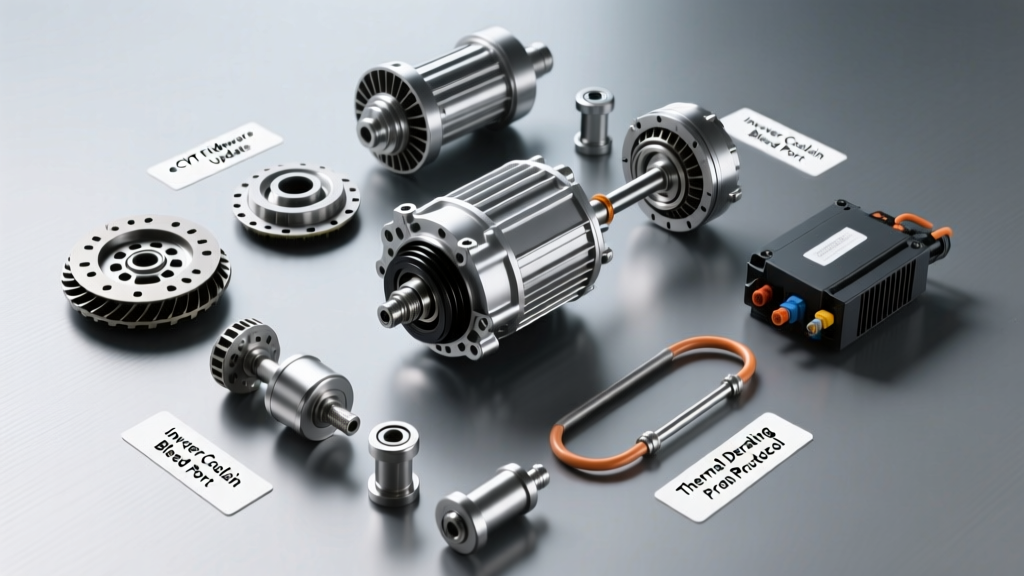
The drivetrain software constantly polls the inverter coolant temperature sensor. If the software detects that coolant flow is restricted or temperatures are rising, it will preemptively derate MG2 torque output to protect the power electronics. Therefore, maintaining the inverter coolant loop is a direct software-preservation task.
The Bleeding Procedure and Software Utilities
Most hybrid systems use a separate, low-voltage electric water pump to circulate coolant (typically Toyota Super Long Life Coolant or equivalent OAT antifreeze) through the inverter and transaxle cooling jackets. When performing a drain and fill (usually every 60,000 to 100,000 miles), you cannot simply squeeze the hoses to bleed the air.
Air pockets trapped in the inverter cooling jacket cause localized hot spots. The drivetrain software will detect these micro-thermal spikes and trigger a "Check Hybrid System" warning, often logging codes like P0A93 (Inverter Cooling System Performance). To prevent this, a bi-directional scan tool must be used to access the HVCM's active test menu and command the electric water pump to run at maximum RPM for 10-15 minutes while the coolant reservoir is topped off.
Expert Torque Spec Warning: When reinstalling the inverter coolant bleeder screws or transaxle coolant union bolts, be exceptionally careful. Many of these fittings thread directly into cast aluminum or composite housings. Torque to 1.5 Nm to 2.0 Nm (approx. 13-18 in-lbs). Overtightening will strip the threads, leading to high-voltage insulation faults if coolant leaks onto the HV cables.
Resolver Sensor Calibration and Air Gap Verification
Resolvers are rotary transformers that tell the drivetrain software the exact rotational position and speed of the MG1 and MG2 rotors. This data is non-negotiable; if the software loses track of the rotor position by even a few electrical degrees, it will miscalculate the stator magnetic field, resulting in violent torque shuddering or immediate high-voltage system shutdown.
Whenever a hybrid vehicle's 12V auxiliary battery is replaced, or if the HVCM loses power, the volatile memory storing the resolver offset values may be erased. Preventive maintenance dictates that a Resolver Offset Learning procedure must be performed via OEM-level software (like Techstream or FDRS) after any major electrical service. Furthermore, if the transaxle is removed or rebuilt, the physical air gap between the resolver stator and rotor must be measured with a feeler gauge (typically 0.5mm to 0.8mm) before the software calibration is executed.
eCVT Fluid Degradation and Software Thermal Mapping
While eCVTs do not have traditional friction clutch packs that wear out, the planetary gearset and motor-generator bearings still require specialized low-viscosity fluids. The drivetrain software uses fluid temperature sensors to map viscosity and adjust the regenerative braking torque limits accordingly. As fluid degrades, its dielectric properties and thermal transfer capabilities diminish, forcing the software to aggressively limit vehicle performance to prevent overheating.
| OEM / Transaxle | Fluid Specification | Capacity (Approx.) | Drain/Fill Torque | Software Thermal Derate Threshold |
|---|---|---|---|---|
| Toyota P810 (Prius Prime) | Toyota ATF WS (08886-80608) | 3.8 Liters | 39 Nm (29 lb-ft) | Derates MG2 at 115°C (239°F) |
| Ford HF35 (Escape Hybrid) | MERCON ULV (XT-12-QULV) | 5.5 Liters | 35 Nm (26 lb-ft) | Derates at 120°C (248°F) |
| Honda i-MMD (Accord Hybrid) | Honda HCF-2 (08200-HCF2) | 3.6 Liters | 44 Nm (32 lb-ft) | Derates at 110°C (230°F) |
Note: Always verify exact capacities and torque specifications via the OEM service portal for your specific model year, as mid-cycle manufacturing revisions can alter sump depths and fastener materials.
Diagnosing Software vs. Mechanical Drivetrain Faults
When a hybrid vehicle enters limp mode, the immediate assumption is often a failed motor-generator or a burnt inverter. However, seasoned hybrid technicians know that the drivetrain software is highly sensitive to peripheral sensor inputs. Before condemning a $4,000 transaxle assembly, technicians must analyze live PID (Parameter Identification) data.
Critical PIDs to Monitor
- MG1 / MG2 Torque Request vs. Actual Torque: A variance greater than 5-10 Nm under steady load indicates resolver drift or internal stator winding degradation.
- Inverter Coolant Flow Sensor (Hz or RPM): If the software commands the pump to 100% duty cycle but the flow sensor reads low, the software will instantly disable high-voltage output to save the IGBTs. The mechanical pump impeller may be cavitated, but the software reaction mimics a dead inverter.
- Battery Internal Resistance: The drivetrain software limits regenerative braking if the HV battery's internal resistance spikes due to aging or cold temperatures, often misdiagnosed by owners as a "broken transmission" due to the sudden loss of deceleration torque.
Cost Expectations for Hybrid Drivetrain Software Services
Proactive maintenance of the software and its dependent systems is vastly cheaper than reactive hardware replacement. Here is what you can expect to pay at a specialized hybrid repair facility or dealership:
- HVCM Firmware Reflash / TSB Update: $120 - $180 (Often covered if tied to an active emissions or safety recall).
- Inverter Coolant Flush & Software Bleed: $150 - $220 (Includes OEM coolant and bi-directional pump actuation).
- Resolver Offset Learning & Calibration: $90 - $130 (Usually performed in conjunction with a 12V battery replacement or HV system diagnostic).
- eCVT Fluid Drain & Fill: $180 - $250 (Highly dependent on fluid cost; MERCON ULV and HCF-2 are notably more expensive per quart than standard ATF WS).
Conclusion: Respecting the Digital Drivetrain
The era of judging a transmission's health solely by the color and smell of its fluid is over. In modern hybrid vehicles, the drivetrain software is the ultimate gatekeeper of performance and longevity. By adhering to strict firmware update schedules, utilizing bi-directional tools for proper coolant bleeding, and respecting the thermal limits mapped by the HVCM, you can easily push a hybrid eCVT past the 250,000-mile mark. For further reading on hybrid system safety and high-voltage protocols, consult the SAE International Standards database for the latest J2929 and J1766 safety guidelines.