The Thermodynamics of Hot Climate Transmission Cooling
When ambient air temperatures regularly exceed 100°F (38°C)—such as in the American Southwest, the Middle East, or Australian outback regions—passive air-to-fluid heat exchangers lose their thermodynamic advantage. The core principle of any heat exchanger is Delta T (ΔT), the temperature differential between the hot fluid and the cooling medium. If your transmission fluid is operating at 210°F and the ambient air baking your front bumper is 115°F, your ΔT is a mere 95°F. In stop-and-go traffic, airflow drops to zero, and passive stacked-plate or tube-and-fin coolers become heat sinks rather than heat rejectors.
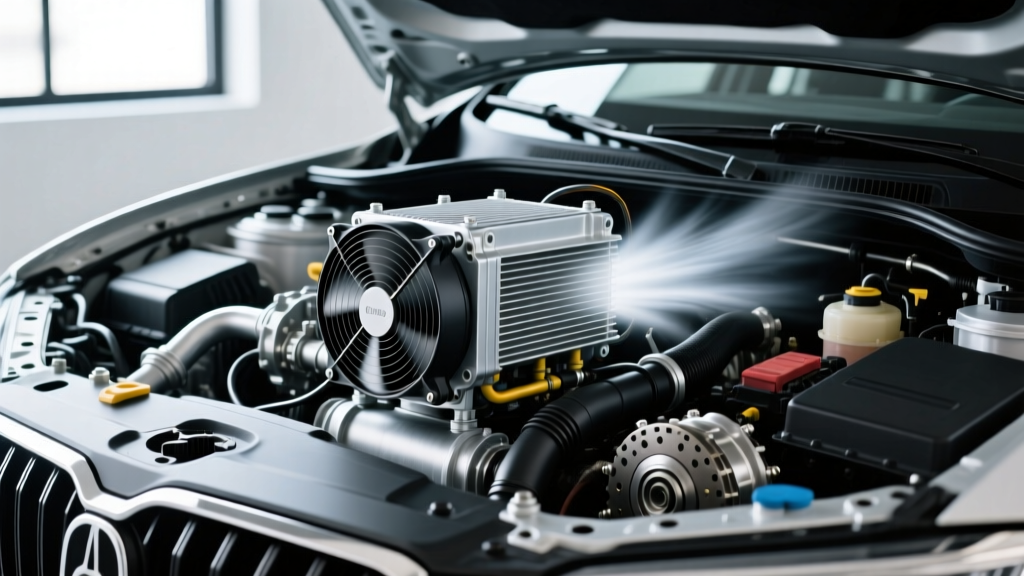
This is where a fan cooled transmission cooler transitions from an optional towing upgrade to an absolute drivetrain survival necessity. By forcing high-velocity ambient air across the cooler fins, an active fan setup maintains convective heat transfer even when the vehicle is stationary. According to data from the Automatic Transmission Rebuilders Association (ATRA), automatic transmission fluid (ATF) oxidation rates double for every 18°F (10°C) increase in temperature above the 200°F baseline. Running modern low-viscosity fluids like GM Dexron ULV or ZF LifeguardFluid 8 at sustained temperatures above 240°F leads to rapid shear degradation, varnish accumulation on valve body spool valves, and catastrophic clutch pack failure.
Selecting the Right Active Cooler (Sizing Matrix)
Not all active coolers are created equal. Slapping a generic 10-inch radiator fan onto a lightweight tube-and-fin cooler will not yield the BTU/hr rejection required for heavy-duty hot climate driving. You must match the Gross Vehicle Weight (GVW), the cooler's core volume, and the fan's Cubic Feet per Minute (CFM) rating.
| GVW Rating | Recommended Core Type | Fan CFM Requirement | Example Model / Setup | Est. Cost (USD) |
|---|---|---|---|---|
| Up to 10,000 lbs | Stacked-Plate (10-15 Row) | 800 - 1,000 CFM | Hayden Rapid-Cool w/ 10" Slim Fan | $160 - $210 |
| 10,000 - 16,000 lbs | Stacked-Plate (20-30 Row) | 1,200 - 1,500 CFM | Derale Hyper-Cool w/ 12" PWM Fan | $280 - $350 |
| 16,000 - 24,000 lbs | Heavy-Duty Tube & Fin | 2,000+ CFM (Dual Fans) | Mishimoto Heavy-Duty w/ Dual 12" Fans | $450 - $600 |
For severe hot climate applications, we highly recommend Derale Performance stacked-plate coolers paired with PWM (Pulse Width Modulation) fans. Stacked-plate designs offer roughly 30% more surface area and superior turbulent fluid mixing compared to tube-and-fin designs, which is critical when trying to pull heat out of the fluid quickly in high-ambient environments.
Advanced Routing: Bypassing the Radiator Loop
The factory routing on 90% of modern trucks and SUVs sends transmission fluid to the bottom tank of the engine radiator before looping out to an auxiliary front-mounted cooler. In a hot climate, your engine coolant can easily reach 225°F to 235°F under heavy load. Routing 210°F transmission fluid through a 230°F radiator tank results in heat transfer into the transmission, completely defeating the purpose of the cooling system.
The Standalone Bypass Loop Strategy
For dedicated hot-climate setups, expert builders utilize a standalone bypass loop. This involves blocking the factory radiator cooler ports and routing the transmission's pressure-out and return-in lines directly to the front-mounted fan cooled transmission cooler. This guarantees the fluid is only exposed to ambient air, never to engine coolant heat. However, this requires careful management of cold-start fluid viscosity, which brings us to transmission-specific thermal management.
GM 6L80 / 6L90 Thermal Bypass Valve Delete
If you are operating a GM vehicle equipped with the 6L80 or 6L90 transmission (found in Silverados, Tahoes, and Camaros), the factory transmission pan contains a thermal bypass valve. This valve restricts fluid flow to the cooler until the fluid reaches approximately 180°F, intending to help the transmission 'warm up' faster for emissions compliance. In a 110°F desert environment, this restriction causes massive heat spikes during initial heavy throttle pulls. Sonnax manufactures a thermal bypass valve shim kit (Part #15716-02K, approx. $25) that forces the valve open at all times, ensuring maximum, unrestricted flow to your auxiliary fan cooler from the moment you start the engine.
ZF 8HP Thermal Management Module (TMM) Considerations
The ZF 8HP transmission (used in Ram 1500s, Ford F-150s, and various European models) uses a complex Thermal Management Module (TMM) that routes fluid between the engine coolant and the transmission based on ECU logic. Bypassing the TMM entirely can trigger P0218 (Transmission Fluid Over Temperature) or P0711 sensor codes, throwing the ZF into limp mode. For ZF applications in hot climates, retain the TMM but install a high-capacity fan cooled transmission cooler on the auxiliary return loop, and use an OBD2 tuning suite (like HP Tuners) to lower the TCM's target temperature threshold from the factory 212°F down to 185°F.
Precision Installation and Hardware Specs
Vibration and heat cycles will destroy cheap rubber hoses and poorly crimped fittings. When plumbing a fan cooled transmission cooler, upgrade to PTFE (Teflon) lined, stainless steel braided hose.
- Hose Selection: Use -6 AN (3/8") for standard passenger vehicles and light trucks; use -8 AN (1/2") for heavy-duty diesels or vehicles exceeding 14,000 GVW.
- Fittings: Avoid push-lock fittings for the high-pressure side of the transmission loop. Use crimped Aeroquip or Earl's reusable socketless fittings.
- Torque Specifications: When threading AN-8 aluminum adapter fittings into the transmission case or cooler ports, apply a small amount of blue Loctite 565 (PTFE thread sealant) and torque to exactly 18-22 ft-lbs. Over-torquing aluminum cooler housings will warp the internal brazed plates, causing cross-contamination or external weeping.
- Isolation: Mount the cooler using the provided rubber isolation bushings. Never bolt the cooler directly to the chassis or core support without vibration dampening, as harmonic resonance will fatigue the brazed joints.
Automated Thermal Management: Wiring the Fan
Running a high-CFM fan continuously draws 15 to 25 amps, placing unnecessary strain on the alternator and creating excessive acoustic noise. The best practice is to wire the fan through a thermostatic PWM controller.
Expert Wiring Tip: Never wire a transmission cooler fan directly to an ignition-switched 12V source without a relay. The inrush current of a 10-inch slim fan can exceed 40 amps for a fraction of a second, which will melt standard 14 AWG wiring and blow a 15A fuse instantly.
Install a dedicated 40A automotive relay (Bosch style) wired directly to the battery positive terminal via an inline 50A Maxi-Fuse and 10 AWG primary power wire. Use a fluid-sensing thermostat probe inserted into the transmission return line via an inline weld-in bung or a specialized sandwich adapter. Set the PWM controller to ramp the fan speed from 0% to 100% between 175°F and 195°F. This ensures the fan only draws maximum amperage when the fluid is genuinely approaching the thermal danger zone, optimizing both electrical efficiency and component lifespan.
Summary of Hot Climate Best Practices
Surviving extreme ambient temperatures requires abandoning passive cooling paradigms. By selecting a high-capacity stacked-plate fan cooled transmission cooler, eliminating radiator heat-soak via a standalone bypass loop, addressing factory thermal restrictions (like the GM 6L80 bypass valve), and utilizing PTFE plumbing with PWM thermostatic controls, you can maintain ATF temperatures safely below 200°F regardless of the desert heat. Treat your transmission cooling system with the same engineering rigor as your engine's cooling system, and your drivetrain will easily exceed 200,000 miles in the harshest climates on earth.