The High-Mileage Reality of the Honda Element Real Time 4WD
As we navigate the 2026 automotive landscape, the Honda Element (2003–2011) has transitioned from a quirky compact crossover to a beloved, high-mileage workhorse. Many of these vehicles are now pushing well past 200,000 miles. While the K24 engine is famously bulletproof, the Real Time 4WD system—specifically the rear differential—requires meticulous, specialized care. The most common complaint brought to our drivetrain specialists is a distinct, low-pitch groaning or binding noise during tight, low-speed turns. In 90% of these cases, the culprit is degraded honda element rear differential fluid, but misdiagnosing this symptom can lead to unnecessary teardowns or catastrophic component failure.
Understanding the Dual Pump System (DPS) Architecture
To diagnose noise accurately, you must understand that the Element does not use a traditional open, limited-slip, or locking rear differential. Instead, it utilizes a hydraulically actuated Dual Pump System (DPS). The rear DPS unit contains two hydraulic pumps: one driven by the front wheels via the propeller shaft, and one driven by the rear wheels. When the front wheels slip and spin faster than the rear wheels, a pressure differential is created. This hydraulic pressure engages a wet clutch pack, locking the front and rear drivetrains together to send torque to the rear axle.
The specialized fluid inside this unit, Honda Dual Pump Fluid II (DPF-II), is not merely a lubricant; it is a vital hydraulic medium and friction modifier. When the fluid shears down and loses its friction-modifying properties over time, the wet clutch packs fail to engage smoothly. Instead of a seamless lockup, the clutches chatter and slip rapidly, transmitting a severe groaning vibration through the chassis that mimics a failing gear set.
Diagnostic Matrix: Is It the Fluid or the Hardware?
Before ordering replacement parts or scheduling a rebuild, use this diagnostic matrix to isolate the exact source of the noise. Driveline acoustics can be deceptive, and the Element's unibody construction easily transmits vibrations from the propeller shaft directly to the rear cabin.
| Symptom / Noise Type | Trigger Condition | Probable Diagnosis | Required Action |
|---|---|---|---|
| Low-pitch groan or moan | Tight, slow-speed turns (e.g., parking lots, full steering lock) | Wet clutch pack chatter due to degraded DPF-II friction modifiers | Perform Double Drain-and-Fill Procedure |
| High-pitch whine or howl | Constant highway speeds (55-75 mph), straight-line driving | Pinion bearing wear, ring gear lash issues, or internal pump cavitation | Differential teardown, bearing replacement, or unit swap |
| Rotational clunk or shudder | Hard acceleration from a dead stop or sudden deceleration | Worn propeller shaft U-joints, failing center support bearing, or diff mount tear | Inspect driveline U-joints and center bearing |
| Grinding or metallic crunch | Any time 4WD system engages on low-traction surfaces | Internal DPS relief valve failure or shattered clutch pack friction material | Replace rear differential assembly (Rebuild rarely cost-effective) |
The Fatal Mistake: Using Standard 75W-90 GL-5 Gear Oil
One of the most destructive errors we see in independent shops is the substitution of standard 75W-90 GL-5 hypoid gear oil in the Element's rear DPS unit. Traditional differentials rely on extreme pressure (EP) additives found in GL-5 oils to protect sliding gear teeth. However, the Honda DPS relies on specific wet-clutch friction modifiers. GL-5 gear oil will cause immediate, aggressive clutch chatter, permanently glazing the friction discs and potentially clogging the microscopic hydraulic relief valves inside the pump assembly. According to technical archives maintained by the Element Owners Club, flushing a DPS unit that has been contaminated with standard gear oil often requires multiple fluid changes just to restore baseline operation, and in severe cases, the clutch packs are ruined beyond repair.
The Mandatory Double Drain-and-Fill Procedure
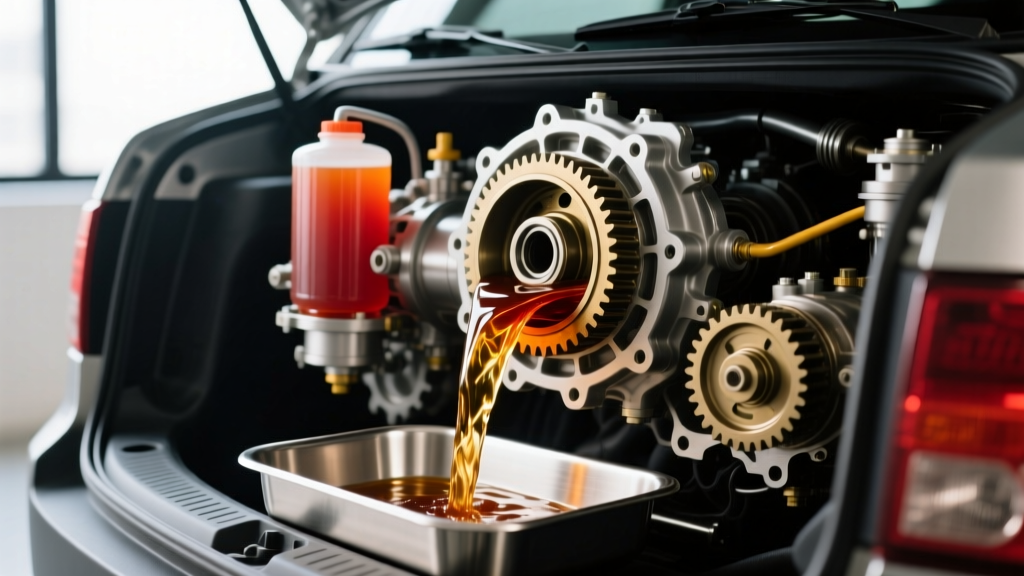
If your diagnosis points to clutch chatter, a single drain-and-fill will not solve the problem. The DPS unit retains a significant volume of old fluid inside the clutch galleries and hydraulic circuits. You must perform a 'Double D&F' to achieve the necessary fluid exchange. Below are the exact specifications and OEM part numbers required for the job.
Required Parts and Tooling
- Fluid: Honda Dual Pump Fluid II (DPF-II) - Part # 08200-9003 (You will need 3 quarts to safely complete a double flush).
- Crush Washers: 17mm Aluminum Crush Washers - Part # 94109-20000 (Qty: 4; never reuse the old washers).
- Capacity: 1.2 Liters (1.27 US Quarts) per fill.
- Torque Spec: 33 lb-ft (44 N·m) for both the 17mm drain and fill plugs.
- Tools: 17mm socket, 3/8-inch drive torque wrench, fluid transfer pump, drain pan.
Step-by-Step Execution
- Preparation: Ensure the vehicle is perfectly level on jack stands or a lift. An uneven stance will result in an under-filled or over-filled DPS unit, leading to pump cavitation or fluid aeration.
- First Drain: Remove the 17mm lower drain plug and allow the fluid to drain completely. Inspect the magnetic tip on the plug. A fine, glitter-like metallic paste is normal for high-mileage units; however, large metallic shards indicate internal bearing or gear failure.
- First Fill: Reinstall the drain plug with a new crush washer and torque to 33 lb-ft. Remove the upper 17mm fill plug. Pump in exactly 1.2 Liters of Honda DPF-II until it begins to weep from the fill hole. Reinstall the fill plug with a new washer and torque to 33 lb-ft.
- The Figure-8 Circulation: This is the most critical step. Drive the vehicle to an empty, paved parking lot. Perform continuous figure-8 maneuvers at 5 to 10 mph for at least 3 to 5 minutes. This forces the DPS hydraulic pumps to cycle, engaging the clutch packs and drawing the new fluid deep into the internal galleries while pushing the old fluid out into the main sump.
- Second Drain and Fill: Return to the shop, allow the vehicle to sit for 10 minutes so the fluid settles, and repeat the drain and fill process exactly as described above. This second cycle ensures over 90% of the degraded fluid is evacuated from the system.
When Fluid Changes Fail: Advanced Driveline Troubleshooting
If you have completed the double drain-and-fill procedure using genuine Honda DPF-II and the groaning persists, you must look outside the rear differential housing. The Element's driveline has two notorious secondary failure points that perfectly mimic internal differential noise.
Propeller Shaft Center Support Bearing
The two-piece propeller shaft connecting the front transfer case to the rear DPS unit is supported by a rubber-isolated center bearing. By 2026, the rubber dampener on almost all original-equipment Element propeller shafts has dry-rotted and collapsed. When this happens, the shaft drops slightly, altering the operating angle of the U-joints. This creates a binding sensation and a low-frequency groan during turns and acceleration. You can source replacement center bearings or complete aftermarket propeller shaft assemblies via catalogs like RockAuto. Inspect the bearing for visible cracking or play before condemning the rear differential.
Rear Differential Mount Bushings
The rear DPS unit is mounted to the subframe via thick rubber bushings. If these bushings are torn, the entire differential housing will physically shift and twist under torque load during cornering. This mechanical bind feels and sounds exactly like internal clutch chatter. Use a pry bar to check for excessive movement between the differential housing and the subframe bracket. Replacing these bushings requires dropping the rear subframe, but it is a necessary repair if the driveline geometry is compromised.
Final Expert Takeaways
Maintaining the Honda Element's Real Time 4WD system is entirely dependent on respecting the unique hydraulic requirements of the Dual Pump System. Never ignore a turning groan, and never compromise on fluid chemistry. By utilizing the double drain-and-fill method, adhering strictly to the 33 lb-ft torque specifications, and verifying the health of the propeller shaft center bearing, you can easily extend the life of the Element's rear drivetrain well past the 250,000-mile mark.