The Anatomy of Honda AWD Differential Noise
Honda and Acura have engineered some of the most sophisticated all-wheel-drive systems in the automotive industry, ranging from the hydraulic dual-pump Real Time AWD to the torque-vectoring SH-AWD (Super Handling All-Wheel Drive). However, these systems are exceptionally sensitive to fluid degradation, clutch pack wear, and improper lubrication chemistry. When a Honda differential begins to emit whines, groans, or clunks, it is rarely a random failure; it is a precise acoustic indicator of internal tribological breakdown or mechanical backlash deviation.
As an automotive drivetrain specialist, I frequently see misdiagnosed Honda rear differentials replaced prematurely because technicians fail to distinguish between clutch-pack chatter and bearing failure. Proper diagnosis requires an understanding of Honda's proprietary fluid requirements, precise acoustic isolation, and adherence to strict factory service tolerances.
Decoding the 'GLS41 Honda Differential Fluid' Myth
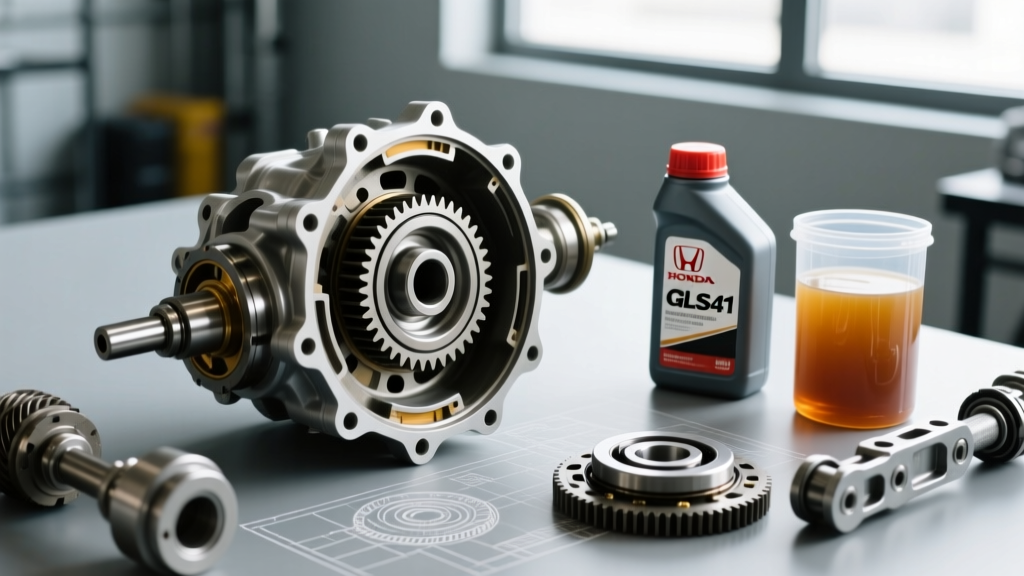
When browsing legacy enthusiast forums or scanning mislabeled aftermarket parts catalogs, you will occasionally encounter searches for gls41 honda differential fluid. This is a persistent industry misnomer—a conflation of API GL-4/GL-5 gear oil classifications and legacy Honda part numbers. It is critical to understand that Honda’s Real Time AWD, i-VTM4, and SH-AWD rear differentials do not use standard API GL-4 or GL-5 hypoid gear oils in their clutch-pack assemblies.
Standard GL-5 gear oils contain high levels of sulfur-phosphorus extreme pressure (EP) additives. While excellent for the hypoid ring and pinion gears, these additives will aggressively degrade the friction paper and cellulose linings used in Honda's internal clutch packs. Furthermore, the API gear oil classifications do not account for the specific dynamic friction coefficients required for Honda's dual-pump hydraulic systems. Using a generic GL-5 75W-90 in place of Honda's proprietary fluids will result in immediate low-speed groaning, clutch pack glazing, and eventual hydraulic pump cavitation. Always rely on Honda's exact OEM fluid specifications, which are heavily fortified with proprietary friction modifiers and shear-stable polymers.
Diagnostic Matrix: Identifying Honda Differential Noises
Accurate diagnosis requires isolating the noise based on vehicle speed, load state, and steering angle. Below is a diagnostic matrix tailored specifically for Honda and Acura AWD rear differentials.
| Acoustic Signature | Driving Condition | Probable Failure Point | Corrective Action |
|---|---|---|---|
| Low-Frequency Groan | Slow, tight turns (parking lots) | Clutch pack friction degradation; depleted friction modifiers. | Perform 3x drain-and-fill with OEM DPSF-II or SH-AWD fluid. |
| High-Frequency Whine | Deceleration (Coast Side) | Coast-side ring and pinion gear wear; excessive backlash. | Measure backlash; if >0.15mm, replace R&P gearset. |
| Deep Howl | Acceleration under load | Drive-side gear wear; low pinion bearing preload. | Adjust pinion bearing preload; inspect gear contact pattern. |
| Metallic Clunk | Shifting from Park to Reverse | Excessive spider gear backlash; worn propeller shaft CV joint. | Inspect propshaft U-joints/CVs; check differential side gears. |
| Rotational Growl | Constant speed (45-70 mph) | Carrier bearing or pinion bearing spalling/brinelling. | Replace bearings; verify crush sleeve torque. |
Step-by-Step Troubleshooting for Honda AWD Systems
The Figure-8 Test (Isolating Clutch Pack Chatter)
The most common complaint on Honda CR-V, HR-V, and Pilot models equipped with Real Time AWD or VTM-4 is a binding, groaning sensation from the rear axle during tight parking maneuvers. This is caused by the internal clutch packs locking up instead of slipping smoothly, often due to contaminated fluid or depleted friction modifiers.
To confirm this diagnosis, perform the Figure-8 test:
- Locate a dry, clean, and safe paved area.
- Turn the steering wheel to full lock.
- Drive the vehicle in a continuous figure-8 pattern at 5 to 10 mph.
- Perform 10 continuous repetitions. The heat generated will temporarily alter the fluid's viscosity and friction characteristics.
If the groaning and binding significantly decrease or disappear after the 10th repetition, the mechanical hard parts (gears and bearings) are intact. The issue is strictly fluid chemistry. A triple drain-and-fill using Honda Dual Pump Fluid II (DPSF-II) or the specific SH-AWD fluid will resolve the issue in 90% of cases. If the noise persists, the clutch friction material has physically delaminated, requiring a differential teardown.
Pinion and Carrier Bearing Isolation
Bearing noise is often misattributed to wheel bearings. To isolate a Honda rear differential pinion bearing, utilize a chassis ear or electronic stethoscope. Place the sensor on the differential housing near the pinion snout. Bearing noise will scale linearly with vehicle speed and will slightly change pitch during lateral load transfer (swerving left to right). According to SAE International tribology standards, once a tapered roller bearing begins to spall, the acoustic frequency shifts from a low rumble to a distinct, high-pitched growl. At this stage, immediate replacement is required to prevent metal shavings from entering the hydraulic clutch circuits.
Precision Service: Torque Specs and Fluid Capacities
When servicing Honda differentials, precision is non-negotiable. Over-torquing the fill or drain plugs can warp the aluminum housing, altering bearing preload and gear backlash. Below are the exact specifications for common Honda/Acura platforms.
| Vehicle Platform | AWD System | Required Fluid Spec | OEM Part Number | Capacity | Drain Plug Torque | Fill Plug Torque |
|---|---|---|---|---|---|---|
| Honda CR-V (2012-2024) | Real Time AWD | DPSF-II | 08200-9007 | 1.1 - 1.3 L | 39 lb-ft (53 Nm) | 32 lb-ft (44 Nm) |
| Honda Pilot (2016-2024) | i-VTM4 | i-VTM4 Fluid | 08200-9007* | 3.8 L | 39 lb-ft (53 Nm) | 32 lb-ft (44 Nm) |
| Acura RDX (2019-2024) | SH-AWD | SH-AWD Fluid | 08200-9003 | 2.8 - 3.0 L | 39 lb-ft (53 Nm) | 32 lb-ft (44 Nm) |
| Honda Ridgeline (2017-2024) | i-VTM4 | i-VTM4 Fluid | 08200-9007* | 3.8 L | 39 lb-ft (53 Nm) | 32 lb-ft (44 Nm) |
*Note: Always verify the exact part number via Honda Automotive Service Information, as Honda periodically updates fluid formulations and part numbers for newer i-VTM4 applications.
Always use an 18mm socket for the drain and fill plugs. Crucially, you must always remove the fill plug first. If you drain the differential and subsequently discover the fill plug is seized or stripped, you will be left with a disabled vehicle and a dry differential.
2026 Repair Economics: Rebuild vs. Replace
As of 2026, the economics of Honda differential repair have shifted due to rising labor rates and parts availability. A standard rear differential fluid flush service at an independent specialist typically ranges from $160 to $240, utilizing OEM fluids and new crush washers (Part # 90471-PX4-000).
If internal hard-part failure is diagnosed—such as a spalled pinion bearing or chipped ring gear—the decision to rebuild or replace becomes critical. Rebuilding a Honda Real Time AWD or SH-AWD differential requires specialized tools to measure pinion bearing preload (often requiring a specialized inch-pound torque wrench and custom holding fixtures). A professional rebuild, including OEM Timken or Koyo bearings, new crush sleeves, and Honda R&P gearsets, typically costs between $1,400 and $2,200.
Conversely, sourcing a low-mileage JDM or domestic salvage yard differential can cost between $450 and $800. However, installing a used unit carries the inherent risk of inheriting another vehicle's neglected fluid maintenance history. For daily-driven vehicles, especially those subjected to towing or harsh winter climates, a precision rebuild using OEM Honda components remains the most reliable long-term investment.
Final Expert Takeaways
Ignore internet myths regarding generic gear oils and legacy search terms. Honda's AWD differentials are marvels of hydraulic and mechanical engineering that demand exact fluid chemistry. By utilizing the Figure-8 test, adhering to strict torque specifications, and understanding the acoustic signatures of gear and bearing wear, you can accurately diagnose and resolve Honda differential noise, ensuring the longevity of the drivetrain for hundreds of thousands of miles.