When a Honda or Acura SUV begins to shudder, bind, or emit a low-frequency groan during tight, low-speed turns, many owners and general mechanics immediately suspect a catastrophic failure of the center differential or the transfer case. However, in the vast majority of cases, the root cause is not a shattered planetary gearset or a seized viscous coupling. Instead, the culprit is severely degraded Honda rear differential fluid. To accurately diagnose AWD driveline binding, you must first understand how Honda's unique all-wheel-drive architectures mimic traditional center differential behavior, and how fluid shear directly impacts torque transfer.
How Honda's 'Center Differential' Actually Works
Unlike Subaru's symmetrical AWD or Audi's Quattro systems, which utilize a traditional mechanical center differential (such as a Torsen or planetary gearset) to split torque between the front and rear axles, Honda employs entirely different architectures. Modern Honda vehicles primarily use the Real Time AWD system, while performance-oriented Acura models utilize Super Handling All-Wheel Drive (SH-AWD).
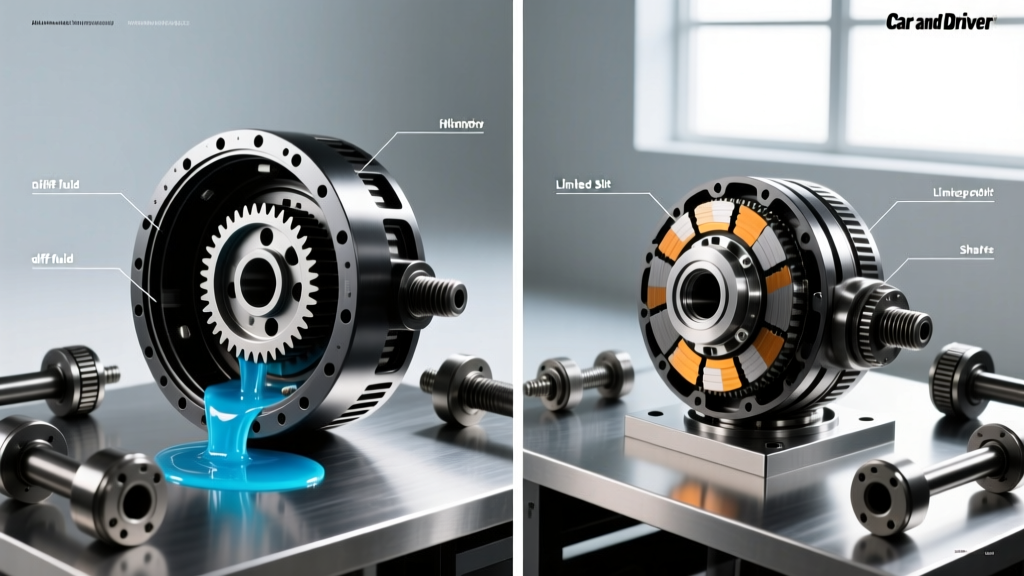
In the Real Time AWD system, there is no traditional center differential. Instead, a dual-pump hydraulic assembly acts as the center coupling. When the front wheels slip, a hydraulic pressure differential engages a multi-plate clutch pack, sending torque to the rear axle. SH-AWD takes this a step further by using direct electromagnetic clutch packs housed directly within the rear differential assembly to vector torque not just front-to-rear, but side-to-side. Because the rear differential housing contains both the final drive ring-and-pinion and the AWD clutch packs (or receives the hydraulic pressure to engage them), the condition of the Honda rear differential fluid dictates the entire AWD system's health. If the fluid loses its frictional modifiers, the clutches chatter, creating a binding sensation that perfectly mimics a locked or failing center differential.
The Figure-8 Diagnostic Test
Before tearing into the transfer case or ordering a replacement rear differential, you must perform the industry-standard Figure-8 diagnostic test. This isolates hydraulic clutch chatter from mechanical gear binding.
- Locate a dry, paved, open area free of traffic.
- Ensure the vehicle is at operating temperature (driven for at least 15 minutes).
- Turn the steering wheel to full lock (left or right).
- Drive the vehicle in a tight, continuous figure-8 pattern at roughly 5 to 10 mph.
- Pay close attention to feedback through the steering wheel and the rear floor pan.
Diagnosis: If you feel a rhythmic hopping, shuddering, or hear a distinct groaning from the rear of the vehicle during the tightest part of the turns, the AWD clutches are failing to slip smoothly. In 90% of Honda CR-V, Pilot, HR-V, and MDX models, this indicates that the friction modifiers in the differential fluid have broken down due to thermal cycling and shear. The clutches are momentarily locking and releasing, causing the axle hop.
Symptom Matrix: Fluid Degradation vs. Mechanical Failure
Use the following diagnostic matrix to differentiate between a simple fluid service requirement and a hard mechanical failure of the AWD coupling or rear differential.
| Symptom | Degraded Fluid (Clutch Chatter) | Mechanical Center Coupling / Diff Failure |
|---|---|---|
| Low-Speed Groaning (Figure-8) | Pronounced rhythmic hopping and groan | Continuous metallic grinding or binding |
| Highway Speed Vibration | None (fluid shear doesn't affect high-speed cruise) | Vibration present, often accompanied by whining |
| AWD Warning Light on Dash | Rare (unless fluid is completely empty/overheated) | Common (sensors detect clutch pack slip or temp faults) |
| Fluid Condition on Dipstick/Plug | Dark brown, smells burnt, lacks metallic glitter | Contains metallic flakes, brass particles, or milky (water intrusion) |
| Response to Fluid Drain & Fill | Symptoms resolve within 50-100 miles of driving | Symptoms persist or worsen immediately |
Fluid Specifications: The DPSF-II Mandate
The most critical mistake made in diagnosing Honda AWD binding is the assumption that the rear differential takes standard 75W-90 or 80W-90 GL-5 gear oil. This will destroy the AWD system. Standard hypoid gear oils contain high levels of sulfur-phosphorus extreme pressure (EP) additives, which are highly corrosive to the yellow metals and specialized friction materials used in Honda's AWD clutch packs.
Honda requires a highly specialized fluid known as Dual Pump System Fluid II (DPSF-II). For older models (pre-2012), the original DPS-F was used, but DPSF-II is the current standard and supersedes the older formulation. DPSF-II is engineered with specific friction modifiers that allow the wet clutches to slip smoothly under low-torque, tight-turning conditions, while still providing adequate shear stability for the ring and pinion gears.
- OEM Part Number: Honda 08200-9007 (DPSF-II)
- Alternative OEM: Acura 08200-9007
- Typical Cost: $12.00 - $16.00 per quart at dealerships or authorized online parts distributors.
- Capacity (CR-V 2015-2024): Approx. 1.2 - 1.3 Quarts (1.1 - 1.2 Liters)
- Capacity (Pilot 2016-2024): Approx. 1.9 - 2.1 Quarts (1.8 - 2.0 Liters)
According to service bulletins available via Honda TechInfo, using non-OEM alternatives or generic limited-slip gear oils often results in repeated clutch chatter complaints within 5,000 miles. The proprietary friction modifiers in DPSF-II are not easily replicated by aftermarket 'universal' AWD fluids.
Step-by-Step Troubleshooting & Fluid Service Protocol
If the Figure-8 test indicates clutch chatter, perform a drain and fill. Note that Honda rear differentials do not have a traditional 'flush' machine port; they rely on a drain and fill plug system. Because the AWD clutch packs shed microscopic friction material into the fluid, a single drain-and-fill may not remove enough degraded fluid to cure the shudder. Honda officially recommends a 'double drain and fill' procedure for severe chatter.
Required Tools and Parts
- Honda DPSF-II Fluid (Purchase 3-4 quarts to allow for a double flush)
- 3/8-inch square drive ratchet (for drain/fill plugs)
- Drain pan and funnel with flexible tubing
- Two 20mm Aluminum Crush Washers (Honda Part # 94109-20000)
Service Procedure & Torque Specifications
- Level the Vehicle: The vehicle must be on a perfectly level surface. Lifting the vehicle on a hoist can alter the fluid level reading. If using a lift, lower it to the ground before checking the fill level.
- Remove Fill Plug First: Always remove the upper fill plug before the lower drain plug. This prevents a scenario where the fluid drains out, but the fill plug is seized, leaving you with an empty differential and no way to refill it.
- Drain the Fluid: Remove the lower drain plug. Inspect the magnetic tip on the drain plug. A small amount of fine, paste-like metallic fuzz is normal. Large shards or brass-colored flakes indicate internal mechanical failure requiring a teardown.
- Reinstall Drain Plug: Install a new 20mm crush washer. Torque the drain plug to 29 lb-ft (39 Nm).
- Fill the Differential: Using your funnel and tubing, pump DPSF-II into the fill hole until the fluid begins to weep out of the bottom edge of the threads. Wait 60 seconds for the fluid to settle, then top off until it weeps again.
- Reinstall Fill Plug: Install a new crush washer and torque to 29 lb-ft (39 Nm).
- The Double-Flush: Drive the vehicle for 50 to 100 miles, incorporating multiple tight turns to cycle the fluid through the AWD clutch packs. Repeat the drain and fill process one more time.
When Fluid Changes Fail: SH-AWD and DPS Rebuild Costs
If a double drain-and-fill with genuine DPSF-II does not resolve the binding and groaning, the AWD clutch packs have likely suffered permanent glazing or mechanical scoring. At this stage, you are no longer dealing with a fluid maintenance issue, but a hard component failure.
For Real Time AWD systems, the dual-pump assembly and clutch pack are generally serviced as a complete rear differential unit or a proprietary coupling assembly. According to parts catalogs verified via Honda Newsroom and Parts Networks, a brand-new OEM rear differential assembly for a late-model CR-V or Pilot typically ranges from $1,800 to $2,800 for the part alone. Labor for R&R (Remove and Replace) adds another $400 to $700, bringing the total repair bill to between $2,200 and $3,500.
For Acura SH-AWD models, the rear differential is vastly more complex, containing the electromagnetic clutches and the acceleration device. SH-AWD rear differential replacements frequently exceed $4,500 at the dealership level. In these edge cases, sourcing a low-mileage unit from a reputable recycler and having a specialist rebuild the clutch packs using OEM friction plates and fresh DPSF-II is the most economically viable troubleshooting path.
Conclusion
Diagnosing AWD binding requires looking past the assumption of a traditional center differential failure. By understanding the hydraulic and electromagnetic clutch systems that govern Honda and Acura AWD architectures, technicians can accurately identify clutch chatter caused by fluid shear. Adhering strictly to the Figure-8 diagnostic test, utilizing only DPSF-II, and following precise torque specifications will save owners thousands of dollars in misdiagnosed drivetrain repairs.