The Reality of High-Stall Converters: Can a Torque Converter Go Bad After an Upgrade?
When enthusiasts push their vehicles beyond factory limits, the torque converter is often the first component to face extreme hydraulic and thermal stress. A common question in the performance community is: can a torque converter go bad simply because it was upgraded for higher horsepower? The short answer is yes. While performance torque converters are built with reinforced fins, billet stators, and heavy-duty thrust bearings, they operate under immense mechanical duress. If the supporting modifications—such as transmission line pressure tuning, cooler capacity, and flexplate rigidity—are not matched to the converter's specifications, catastrophic failure is inevitable.
In this performance and upgrade guide, we will dissect the exact failure modes of high-stall torque converters, contrast the symptoms with stock units, and provide platform-specific diagnostic data for popular transmissions like the GM 4L60E, 6L80, and the ZF 8HP.
Anatomy of a Performance Torque Converter Failure
A factory torque converter is designed for fuel economy and low-speed drivability, typically featuring a stall speed between 1,500 and 1,800 RPM. Performance units, such as the TCI Automotive Breakaway series (e.g., part number 242500 for the 4L60E), push stall speeds to 2,400–2,600 RPM or higher. This increased slip multiplies torque more aggressively but generates exponential heat. Here is how these units physically fail under performance conditions:
1. Stator One-Way Clutch Failure
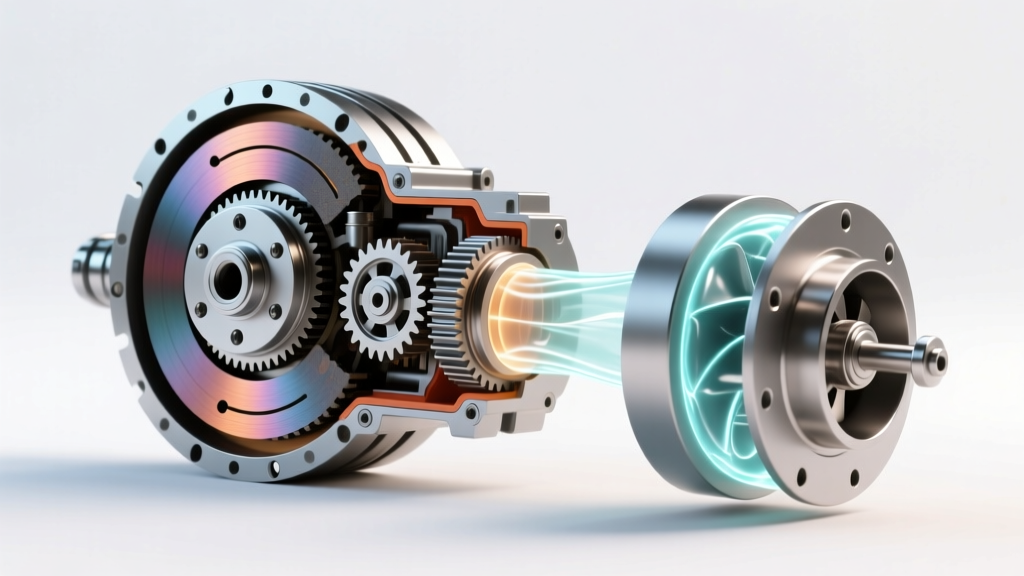
The stator is the heart of torque multiplication. It redirects fluid returning from the turbine back into the impeller. Inside the stator is a one-way roller or sprag clutch. In a high-horsepower application (500+ HP), the hydraulic force exerted on the stator fins can exceed the mechanical grip of the sprag. When the sprag rolls out or shatters, the stator freewheels in both directions. The immediate symptom is a severe loss of low-end torque multiplication; the vehicle will accelerate sluggishly off the line, feeling as though it is starting in second gear, yet it will still cruise normally at highway speeds.
2. Turbine and Impeller Fin Deformation
Factory converters use thin, stamped steel fins brazed to the hub. Under the shock load of a transbrake release or a high-boost turbo spool, these fins can physically bend or tear away from the brazing. Once the fin pitch is altered, the hydraulic efficiency drops, resulting in massive slip, erratic RPM fluctuations, and rapid fluid degradation. Performance converters mitigate this by using furnace-brazed fins and billet steel stators, but extreme shock loads (like 1.5-second 60-foot times on drag radials) can still compromise the brazing over time.
3. Torque Converter Clutch (TCC) Friction Burnout
Modern performance driving requires a lockup clutch to manage heat on the highway. However, standard paper-based TCC friction material will instantly glaze and burn when subjected to the torque output of a modified V8. Upgraded converters utilize Kevlar, carbon, or sintered bronze friction linings. If the transmission's TCC apply strategy (PWM or ECCC) is not tuned to provide adequate line pressure during lockup, the clutch will micro-slip, generating localized temperatures exceeding 400°F and destroying the friction material.
Diagnostic Matrix: Stock vs. Performance TC Failure Symptoms
Diagnosing a failing performance converter requires looking beyond standard OBD2 codes. Below is a comparative framework to help you isolate the issue based on real-world driving symptoms.
| Symptom Category | Stock Converter Failure | High-Stall Performance Converter Failure |
|---|---|---|
| Off-the-Line Acceleration | Sluggish, feels like slipping clutch | RPMs flare to 3,000+ with zero forward bite (Fin/Brazing failure) |
| Highway Cruising (TCC Lockup) | Shudder at 45-55 MPH, P0741 code | Severe vibration, TCC slip PID shows >100 RPM variance (Kevlar clutch glazing) |
| Thermal Behavior | Gradual temp increase over months | Instant fluid temp spikes (>220°F) during 1/4 mile passes due to excessive slip |
| Stall Test Results | RPMs fail to reach 1,800 | RPMs exceed manufacturer spec (e.g., stalls at 3,500 RPM on a 2,800 RPM rated unit) |
| Debris in Pan | Fine metallic paste, some brass | Large chunks of brazing material, shattered sprag needles, Kevlar fibers |
Platform-Specific Weak Points and Upgrades
The way a torque converter interacts with the transmission pump and input shaft varies wildly by platform. Understanding these nuances is critical for performance applications.
GM 4L60E / 4L65E (The 300-600 HP Street/Strip Build)
The 4L60E is notorious for input shaft failure when paired with high-stall converters. The factory 27-spline input shaft can twist and snap under the torque multiplication of a 3,000+ RPM stall converter. When upgrading, it is mandatory to install a hardened 29-spline or 32-spline input shaft. Furthermore, the 4L60E's front pump stator support tube often cracks under high line pressure. Installing a Sonnax heavy-duty stator support tube (part number 77733-01K) is a required supporting modification to prevent the converter hub from wobbling and destroying the front pump seal.
GM 6L80 / 6L90 (The Modern Boosted Application)
The 6L80 utilizes a variable displacement pump and complex ECCC (Electronic Controlled Capacity Clutch) lockup strategies. When a high-stall converter (like a Circle D 3200 Series) is installed, the factory TCC apply valve bore in the valve body wears rapidly due to the aggressive locking and unlocking required to manage the increased heat. If you notice TCC slip codes (P0741, P0742) after a converter upgrade, the converter is likely fine; the valve body is bypassing fluid. You must ream the valve body and install a Sonnax oversized TCC apply valve kit to restore hydraulic integrity.
ZF 8HP (The 8-Speed European Powerhouse)
Found in everything from BMW M-cars to the Dodge Hellcat, the ZF 8HP relies on a highly integrated torque converter with a multi-plate TCC. In supercharged or heavily boosted applications, the factory damper springs inside the converter cover cannot handle the torsional vibrations, leading to catastrophic spring failure and input drum damage. Performance upgrades for the 8HP require converters with billet covers, triple-disc TCC clutches, and specialized damper tuning. Fluid capacity is also critical; the ZF 8HP requires exactly 8.5 to 9.5 liters of specific ZF 8-speed fluid (Shell M-1375.4 specification) to maintain proper cooling flow through the converter.
Installation Specs: Preventing Premature Death
Many performance torque converters 'go bad' within the first 500 miles simply due to improper installation. Follow these exact specifications to ensure longevity:
- Pre-Lubrication: Never install a dry converter. Pour a minimum of 1.5 to 2.0 quarts of your chosen ATF (e.g., Mobil 1 Synthetic or Amsoil Signature) directly into the converter hub before mating it to the transmission. This prevents dry-start cavitation that will instantly score the thrust bearings.
- Pull-Through Gap Measurement: Once the transmission is bolted to the engine block, measure the gap between the torque converter mounting pads and the flexplate. For GM applications, this gap must be between 3/4' and 1'. If the gap is less than 1/4', the converter is not fully seated in the transmission pump gear, and starting the engine will shatter the pump housing.
- Fastener Torque Specs: Use high-grade flexplate bolts (Grade 10.9 or ARP 2000). For GM M8x1.25 bolts, torque to 35 lb-ft with a drop of blue threadlocker. For Ford M10 bolts, torque to 45 lb-ft. Never use standard hardware store bolts.
- Cooler Line Pressure: Performance converters require aggressive cooling. Ensure your transmission cooler lines are upgraded to -8 AN or 1/2' ID minimum. A high-stall converter requires a dedicated transmission cooler capable of dissipating at least 25,000 GVW of heat.
Cost Breakdown: Performance TC Replacement in 2026
Upgrading or replacing a failed performance torque converter is a significant investment. Prices have stabilized in 2026, but labor and supporting parts remain a major factor. Below is a realistic cost matrix for a professional installation:
| Component / Service | Estimated Cost Range | Notes |
|---|---|---|
| Performance Torque Converter | $750 - $1,600 | Billet single-disc (lower end) vs. Triple-disc billet (upper end) |
| Transmission Removal & Install Labor | $900 - $1,500 | Based on 6-9 hours at $150/hr shop rate |
| High-Performance ATF & Filter | $180 - $280 | Requires 11-14 quarts of synthetic fluid (e.g., Red Line D4) |
| Supporting Mods (Flexplate, Cooler) | $300 - $650 | Billet flexplate and heavy-duty transmission cooler |
| Total Estimated Investment | $2,130 - $4,030 | Varies heavily by vehicle platform and shop rates |
Final Thoughts on Converter Longevity
So, can a torque converter go bad after a performance upgrade? Absolutely, if the surrounding ecosystem is not calibrated to handle the increased hydraulic and thermal loads. As noted by experts at Transmission Digest, the vast majority of premature performance converter failures are traced back to inadequate cooling, improper TCC tuning, or failure to upgrade the transmission's internal pump and shaft components. By selecting the correct stall speed for your camshaft profile, ensuring your valve body can maintain 180-200 PSI of line pressure, and strictly adhering to installation tolerances, your high-stall torque converter will provide years of reliable, hard-hitting performance.