The Short Answer: Do Manual Transmissions Use Torque Converters?
If you are asking, do manuals have torque converters? the definitive answer is no. Standard manual transmissions rely on a dry friction clutch assembly to couple and decouple the engine's rotating mass from the transmission input shaft. Torque converters are exclusively the domain of traditional planetary automatic transmissions, continuously variable transmissions (CVTs), and some specialized heavy-duty industrial drivetrains.
However, to truly understand why automotive engineers chose fluid coupling for automatics and mechanical friction for manuals, we must perform a technical deep-dive into the physics, mechanical linkages, and hydraulic circuits that define both systems. Furthermore, as modern automatics utilize Torque Converter Clutches (TCC) to mimic the rigid lockup of a manual, the lines between these two technologies have fascinating intersections.
Engineering Principle: A manual transmission requires a physical disconnect to allow gear synchronization (via synchros) and driver-modulated slip for standing starts. A torque converter provides 'slip' via fluid dynamics, allowing an automatic vehicle to idle in gear without stalling the engine.
Manual Friction Clutch: Mechanical Lockup and Modulation
The manual clutch assembly is a triumph of mechanical friction. It consists of three primary components: the flywheel (attached to the engine crankshaft), the friction disc (splined to the transmission input shaft), and the pressure plate (bolted to the flywheel). When the clutch pedal is released, the diaphragm spring inside the pressure plate clamps the friction disc against the machined surface of the flywheel.
Installation and Torque Specifications
Precision is paramount when installing a manual clutch. Improper torque sequencing leads to warped pressure plates, premature release bearing wear, and severe drivetrain harmonics. Taking the ubiquitous GM LS-platform and Tremec T56 Magnum 6-speed manual as a benchmark, the installation specifications are rigorous:
- Flywheel to Crankshaft Bolts: 74 lb-ft (typically tightened in a crisscross pattern to ensure uniform seating against the crank flange).
- Pressure Plate to Flywheel: 35 lb-ft. These must be torqued gradually in a star pattern to prevent warping the clutch cover.
- Bellhousing to Engine Block: 35 lb-ft. Misalignment here exceeding 0.005 inches of runout will destroy the input shaft bearing and cause catastrophic clutch chatter.
Modern performance clutches, such as twin-disc ceramic setups from McLeod or RAM, utilize sintered iron or ceramic pucks. While these materials offer immense thermal capacity (handling 1,000+ horsepower), they sacrifice the smooth, organic modulation required for daily driving, resulting in aggressive engagement and low-speed chatter.
The Automatic Torque Converter: Fluid Dynamics and Torque Multiplication
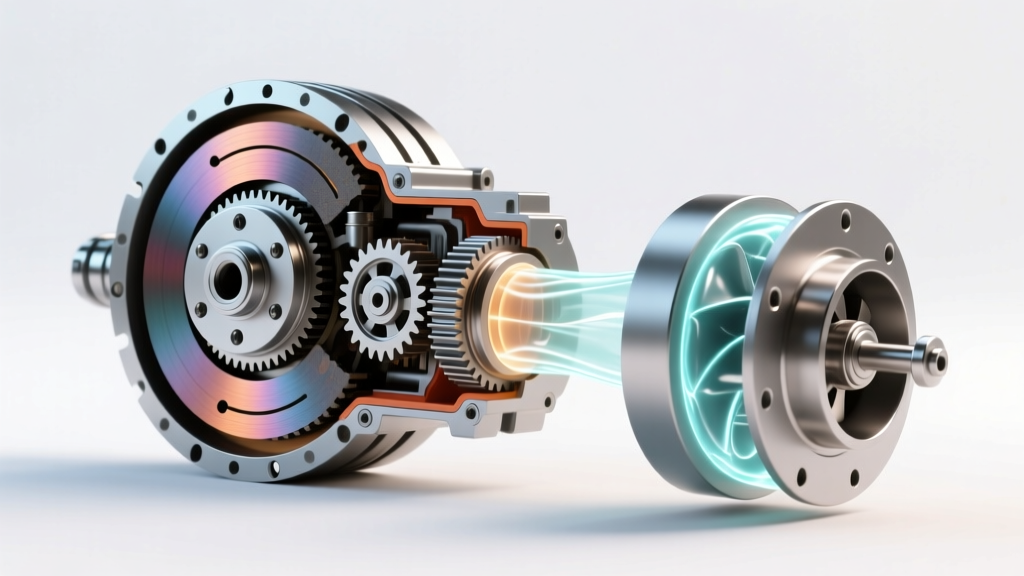
Unlike the rigid mechanical lockup of a manual clutch, a torque converter is a hydrodynamic fluid coupling. It transfers power using automatic transmission fluid (ATF) and consists of three main internal elements: the impeller (pump), the turbine, and the stator.
How Fluid Coupling Replaces the Friction Disc
The impeller is welded directly to the converter housing, which is bolted to the engine flexplate. As the engine spins, the impeller throws ATF outward via centrifugal force. This fluid strikes the blades of the turbine, which is splined to the transmission input shaft, causing it to rotate. The stator, mounted on a one-way roller clutch in the center, redirects the returning fluid to multiply torque during initial acceleration (stall phase).
Let us look at the GM 6L80 (RPO MYC) 6-speed automatic. The OEM torque converter (Part No. 24238079) features a stall speed of approximately 1,800 to 2,000 RPM. This means the engine can rev to 2,000 RPM against the brakes before the turbine is forced to spin, providing the necessary torque multiplication to move a 5,500-lb truck from a dead stop without a mechanical friction plate to modulate.
The Bridge: The Torque Converter Clutch (TCC)
Because fluid coupling inherently generates slip (and therefore immense heat and parasitic power loss), modern automatics feature a Torque Converter Clutch (TCC). This is essentially a large, internally mounted friction clutch. When the vehicle reaches cruising speed, the transmission control module (TCM) applies hydraulic pressure (often 120-140 PSI in the 6L80) to lock the turbine directly to the impeller housing. This eliminates slip, yielding the 1:1 mechanical efficiency of a manual transmission.
Head-to-Head: Friction Clutch vs. Torque Converter
Understanding the operational differences is critical for diagnostics and drivetrain tuning. Below is a structured comparison of the two coupling methods.
| Characteristic | Manual Friction Clutch | Automatic Torque Converter |
|---|---|---|
| Coupling Medium | Dry Mechanical Friction (Organic, Kevlar, Ceramic) | Hydrodynamic Fluid (ATF) + Internal TCC Lockup |
| Torque Multiplication | None (1:1 ratio always) | Up to 2.0x - 2.5x via Stator redirection |
| Heat Generation | High only during driver-modulated slip (starts) | High during stall/slip phases; requires dedicated cooler |
| Creep Ability | None (requires clutch feathering) | Inherent (fluid slip allows idle creep) |
| Parasitic Loss | Minimal (mechanical drag from release bearing) | Moderate (fluid shear losses when TCC is unlocked) |
| Lifespan | 60,000 - 100,000 miles (highly driver-dependent) | 150,000+ miles (TCC friction material is primary wear item) |
Diagnostic Symptoms: Clutch Slip vs. TCC Shudder
Because the type of this article is categorized under torque converter symptoms, it is vital to contrast how a failing manual clutch presents versus a failing torque converter clutch (TCC). Misdiagnosing these issues can lead to unnecessary transmission removals.
Manual Clutch Failure Indicators
- RPM Flare Without Acceleration: Under heavy load (e.g., 4th gear at 60 MPH, wide-open throttle), engine RPMs rise disproportionately to vehicle speed. This indicates the friction material is glazed or worn past the rivets.
- Pedal Engagement Point Shift: If the clutch disengagement point moves to the very top of the pedal travel, the hydraulic master/slave cylinders may be failing, or the pressure plate diaphragm fingers are severely worn.
- Chatter on Engagement: Often caused by oil contamination on the friction disc (from a rear main seal leak) or a warped flywheel.
Torque Converter and TCC Failure Indicators
- TCC Shudder: A rhythmic, low-frequency vibration (usually between 30-50 MPH) that feels like driving over rumble strips. This occurs when the TCC friction material degrades and the apply pressure oscillates, failing to maintain a rigid lockup. In the ZF 8HP series, early lockup strategies make the TCC highly susceptible to shudder if the specific ZF LifeguardFluid 8 is not used or degrades.
- Stall Speed Deviations: If a vehicle's stall speed drops significantly below factory spec, the stator's one-way roller clutch has likely failed and is freewheeling in both directions, destroying torque multiplication and causing severe sluggishness off the line.
- Contaminated Fluid: A failing TCC will shed metallic and friction material into the ATF, turning it dark brown and giving it a burnt odor. This debris will rapidly destroy the transmission's internal solenoid valves and clutch packs.
Replacement Costs and Service Realities
The financial implications of servicing these two distinct systems vary wildly based on labor intensity and parts pricing.
Manual Clutch Replacement:
Replacing a manual clutch requires separating the transmission from the engine block to access the bellhousing. For a standard rear-wheel-drive application (like a Ford Mustang or Chevy Camaro), labor typically ranges from $600 to $1,200. A high-quality OEM replacement kit (flywheel, pressure plate, disc, throw-out bearing, and alignment tool) from suppliers like Sachs or Exedy costs between $300 and $800. Total out-the-door cost: $900 - $2,000.
Torque Converter Replacement:
Replacing a torque converter in an automatic requires dropping the entire transmission assembly, draining the fluid, and often removing the crossmember and driveshaft. Furthermore, the internal transmission cooler lines must be flushed to remove shredded TCC material. A new OEM torque converter for a GM 6L80 costs roughly $400 to $700, while a high-stall aftermarket unit from Circle D or Vigilante can exceed $1,200. Labor ranges from $800 to $1,500, plus the cost of 10-12 quarts of synthetic ATF and a new filter. Total cost: $1,500 - $3,000+.
Summary: The Right Tool for the Drivetrain
While manuals do not have torque converters, the evolution of the Torque Converter Clutch (TCC) means modern automatics effectively house a 'clutch' inside their fluid couplings. According to engineering standards outlined by SAE International, the choice between a dry friction clutch and a hydrodynamic torque converter ultimately comes down to the application's need for torque multiplication, thermal management, and driver modulation. Understanding the deep mechanical differences between these systems is the first step in mastering drivetrain diagnostics, performance tuning, and long-term reliability.