The High-Stakes World of Heavy-Duty Clutch Diagnostics
When a Class 8 commercial vehicle or a heavy-duty towing rig begins exhibiting clutch chatter, slipping under load, or engagement anomalies, the root cause is rarely as simple as a worn friction disc. Modern heavy-duty diesel powerplants, such as the Cummins X15 or the Detroit DD15, generate immense low-end torque—frequently exceeding 2,050 lb-ft. This extreme rotational force places extraordinary thermal and mechanical stress on the entire driveline. As of 2026, while Automated Manual Transmissions (AMTs) like the Eaton Endurant HD have captured a massive share of the over-the-road freight market, traditional manual heavy-duty clutches remain the undisputed kings of severe-duty, heavy-haul, and performance towing applications where ultimate heat dissipation and driver control are mandatory.
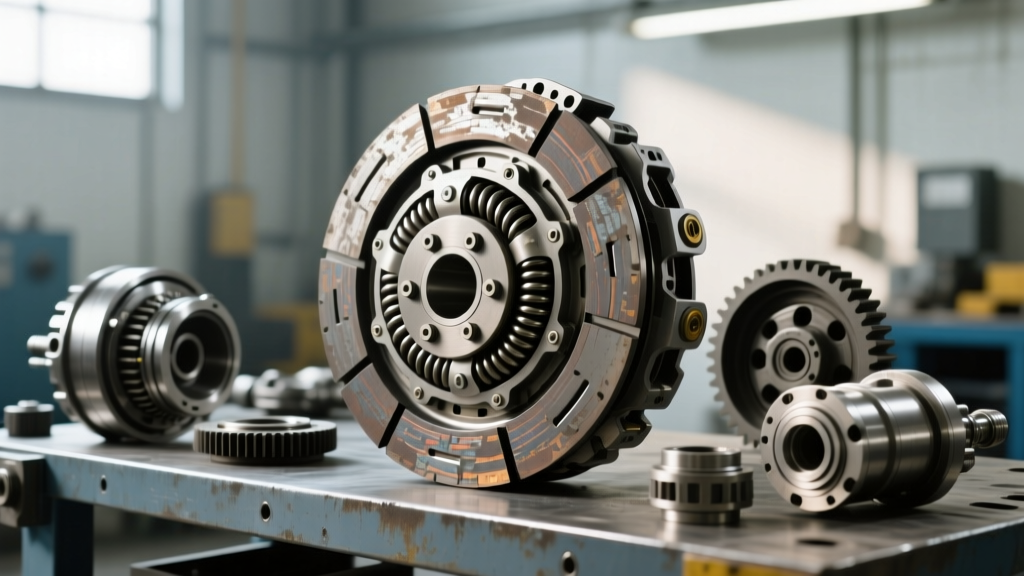
Diagnosing failures and executing performance upgrades in this segment requires a departure from light-duty automotive logic. You are dealing with 15.5-inch twin-plate assemblies, massive clutch brakes, and hydraulic linkages that demand exact tolerances. In the heavy-duty diesel bay, veteran technicians have a saying regarding precision measurement and clutch care: careful with that mic. In this context, 'mic' doesn't mean audio equipment; it is shop shorthand for the micrometer and dial indicator setup. If you are not measuring flywheel runout, step height, and release bearing travel to the thousandth of an inch, you are simply guessing—and in a Class 8 truck, guessing results in catastrophic driveline failure.
Why 'Careful With That Mic' is the Golden Rule
The phrase clutch careful with that mic is a mandate for precision. Heavy-duty clutch systems operate on incredibly tight margins. A variance of just a few thousandths of an inch in flywheel step height or release bearing preload can lead to incomplete clutch brake engagement, gear grinding, or premature release bearing failure.
Flywheel Runout and Step Height Precision
Before installing any heavy-duty clutch assembly, the flywheel must be measured using a magnetic-base dial indicator. According to Cummins engineering specifications for the X15 and legacy ISX15 engines, maximum allowable flywheel face runout is typically 0.006 inches (0.15 mm). If the runout exceeds this, the clutch will experience localized hot-spotting, leading to severe chatter under heavy loads and eventual warping of the intermediate pressure plate in twin-disc setups.
Furthermore, the 'step height'—the distance from the flywheel friction surface to the clutch mounting surface—must be verified with an outside micrometer. For a standard Eaton Fuller 15.5-inch clutch, maintaining the exact OEM step height ensures the clutch pack is properly clamped. If the flywheel has been resurfaced improperly and the step height is altered, the diaphragm spring will operate outside its optimal load window, resulting in a heavy pedal feel and reduced clamping force.
Clutch Brake Squeeze and Release Travel
Unlike light-duty vehicles, heavy commercial trucks utilize a clutch brake to stop the transmission input shaft from spinning, allowing for smooth gear engagement from a standstill. The 'clutch brake squeeze'—the distance the release bearing travels to compress the clutch brake against the transmission housing—must be precisely set. Using a caliper or micrometer to measure the release bearing travel at the transmission housing is critical. The ideal clutch brake squeeze is between 0.50 and 0.56 inches. Too little squeeze, and the truck will grind going into first or reverse; too much squeeze, and you will destroy the clutch brake and damage the transmission input shaft bearing.
Common Commercial Clutch Symptoms Under Heavy Loads
Identifying the exact symptom is the first step in formulating an upgrade or repair path. Heavy-duty clutch failures manifest differently than passenger car issues due to the sheer mass of the vehicle and the torque multiplication involved.
- Chatter at Engagement (Loaded): Often misdiagnosed as a worn friction disc, chatter in a Class 8 truck is frequently caused by oil contamination from a leaking rear main seal, or a warped intermediate drive plate in a twin-clutch setup. It can also stem from broken engine mounts allowing the powertrain to shift under load.
- Slipping on 6%+ Grades: If the truck loses RPM correlation to vehicle speed on an incline, the clamping force is compromised. This is common when organic single-plate clutches are subjected to the 1,850+ lb-ft torque outputs of modern performance-tuned diesels.
- Clutch Drag / Grinding in Neutral: If the transmission grinds when shifting into gear while the pedal is fully depressed, the clutch is not fully releasing. This points to hydraulic system air, a worn clutch brake, or incorrect pedal free-travel adjustment (standard free travel is 1.5 inches at the pedal pad).
Performance Upgrades: Single-Plate vs. Twin-Plate Cerametallic
When towing gross combination weights (GCW) exceeding 110,000 lbs, or when operating in mountainous terrain, the stock organic clutch becomes the weak link. Upgrading to a twin-plate cerametallic clutch is the standard performance solution for heavy-duty applications.
| Clutch Configuration | Friction Material | Max Torque Capacity | Best Application | Approx. 2026 Cost (Kit) |
|---|---|---|---|---|
| 15.5" Single-Plate | Organic | 1,450 lb-ft | Regional haul, flatland freight | $1,200 - $1,600 |
| 15.5" Twin-Plate | Organic / Cerametallic Mix | 1,850 lb-ft | Heavy haul, standard over-the-road | $1,800 - $2,400 |
| 15.5" Twin-Plate | Full Cerametallic | 2,250+ lb-ft | Severe-duty, heavy-haul, performance towing | $2,800 - $3,600 |
According to Eaton Roadranger technical guidelines, twin-plate clutches distribute the friction load across four surfaces instead of two. This effectively doubles the thermal capacity of the system. Cerametallic materials, while harsher on engagement and requiring a slightly more aggressive pedal technique, resist fade at temperatures that would instantly glaze organic materials. For fleets running high-torque, low-RPM downspeed powertrains, the twin-plate cerametallic upgrade is a mandatory reliability investment.
Installation Torque Specs & Best Practices
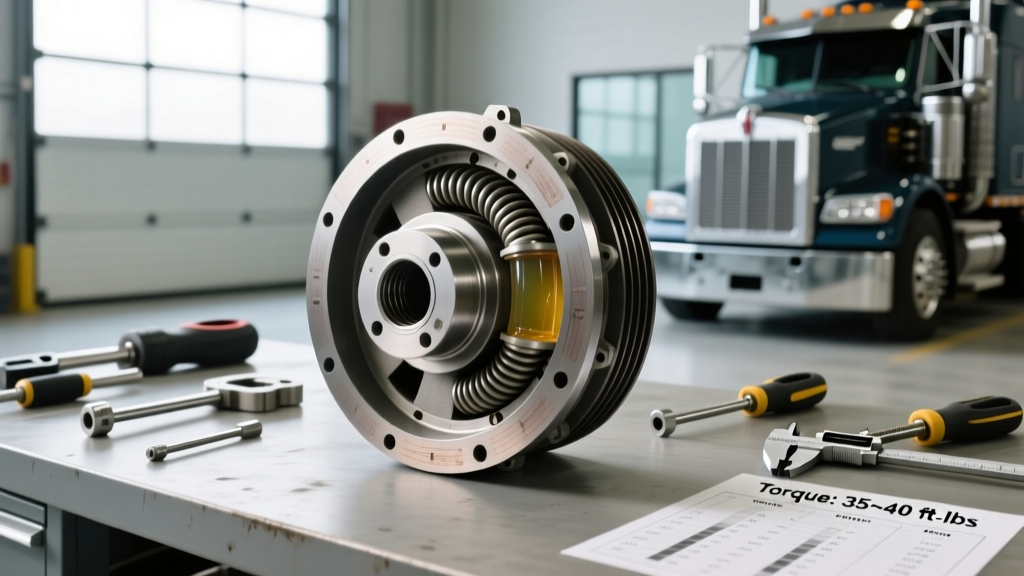
Executing a heavy-duty clutch replacement requires heavy machinery and strict adherence to torque specifications. The flywheel alone can weigh over 150 lbs, and the clutch assembly can exceed 120 lbs. Always use a transmission jack and a dedicated clutch alignment arbor.
Critical Torque Specifications
When mating the flywheel to the crankshaft flange on a Cummins X15 or similar heavy-duty block, the capscrews must be torqued in a strict star pattern to prevent flywheel distortion. The standard specification for heavy-duty flywheel capscrews is typically 250 lb-ft (339 Nm), though some yield-torque applications require a multi-step torque-to-angle procedure. Always verify the exact OEM service manual specification for your specific engine serial number.
The clutch cover (pressure plate) bolts must also be torqued evenly, usually to 35-50 lb-ft depending on the manufacturer, tightening one turn at a time in a crisscross pattern to ensure the diaphragm spring is seated perfectly flat. Failure to do so will result in an out-of-balance assembly that causes severe driveline vibration at highway speeds.
The 2026 Diagnostic Landscape
As we navigate the 2026 commercial vehicle landscape, the integration of electronic clutch actuators and automated manuals has changed the diagnostic approach for fleet technicians. However, for the owner-operators, heavy-haul specialists, and extreme-duty towing communities, the manual heavy-duty clutch remains a vital, high-performance component. Whether you are diagnosing a slipping Eaton Solo 15.5-inch or upgrading to a high-capacity twin-plate for a custom heavy wrecker, the fundamentals remain unchanged. Respect the tolerances, verify your hydraulic free-play, and above all, when performing heavy-duty clutch care: careful with that mic. Precision is the only barrier between a profitable haul and a catastrophic roadside failure.