The Diagnostic Baseline: Why the Hayden Rapid Cool 679 Dominates Towing Setups
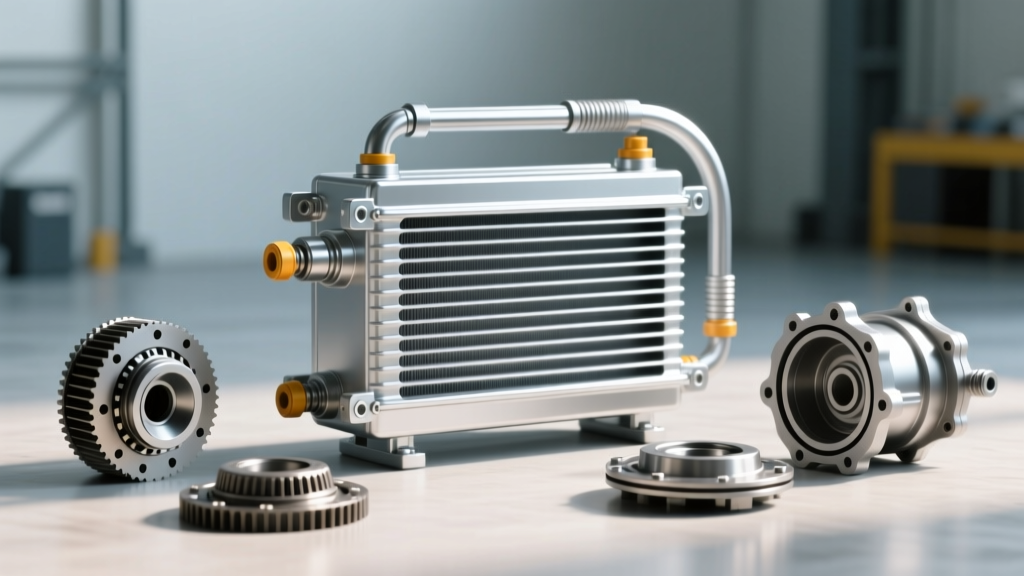
As we navigate the 2026 landscape of heavy-duty towing and overlanding, modern drivetrains like the GM 6L80, Ford 10R80, and ZF 8HP are under immense thermal stress. While factory transmission cooling systems are adequate for daily driving, they rapidly fail under sustained grade towing or low-speed rock crawling. Enter the Hayden Rapid Cool transmission oil cooler 679. Rated at 24,000 GVW with a stacked-plate core measuring 11-1/2" x 9" x 3/4", the Part #679 has become the gold standard for auxiliary cooling. However, installing a premium cooler is only half the battle; diagnosing flow restrictions, bypass valve failures, and fitting leaks separates a successful build from a burnt-up clutch pack.
In this comprehensive diagnostic guide, we will troubleshoot common installation and operational failures of the Hayden 679, while comparing its real-world failure modes and diagnostic footprint against top competitors like Derale and Mishimoto.
Symptom Diagnosis: Troubleshooting the Hayden 679 in 6L80 and 4L60E Applications
Even the best stacked-plate cooler cannot overcome poor routing or OEM thermal management flaws. When customers report high transmission fluid temperatures (TFT) despite installing the Hayden 679, we look at three primary failure vectors.
Symptom 1: Persistent Overheating (>230°F) Under Load
If your scan tool shows TFTs climbing past 230°F on a 6L80 or 4L60E after installing the Hayden 679, the issue is rarely the cooler itself. The most common diagnostic culprit is incorrect series routing.
- The Mistake: Routing the hot fluid from the transmission directly into the auxiliary cooler, and then into the OEM radiator.
- The Physics: The OEM radiator's internal cooler is designed to shed heat into the engine coolant. If engine coolant is at 210°F, and your auxiliary-cooled ATF enters the radiator at 180°F, the radiator will actually heat the transmission fluid.
- The Fix: The correct routing is always: Transmission OUT → OEM Radiator IN → OEM Radiator OUT → Hayden 679 IN → Hayden 679 OUT → Transmission RETURN.
Symptom 2: The OEM Thermal Bypass Valve Trap
Modern transmissions, particularly the GM 6L80, 6L90, and 8L90, feature a thermal bypass valve inside the transmission case or the OEM cooler lines. This valve is designed to bypass the cooler entirely when the fluid is cold to help the transmission reach operating temperature faster.
Diagnostic Tip: If your Hayden 679 lines remain ice-cold while the transmission pan is hot to the touch (over 180°F), your OEM thermal bypass valve is stuck open. According to Sonnax technical resources, the internal bypass plunger can wear or bind. Installing a thermal bypass delete kit (such as the Sonnax 15802-01K) is mandatory for dedicated towing vehicles to ensure 100% of the fluid flows through the Hayden 679 at all times.
Symptom 3: Inverted Flare Leaks at the Fittings
The Hayden 679 utilizes 1/2"-20 UNF inverted flare fittings. A frequent symptom of DIY installations is a slow weep of ATF+4 or Dexron VI at the header plate.
- Root Cause: Over-torquing. The aluminum header plate on stacked-plate coolers is relatively thin. Applying 30+ ft-lbs of torque will distort the flare seat or crack the brazed joint.
- Torque Spec: The correct torque for 1/2"-20 inverted flare steel line nuts into an aluminum cooler header is strictly 15 to 18 ft-lbs.
- Tooling: Use a crowfoot wrench on an inch-pound or low-range foot-pound torque wrench. Furthermore, ensure the flare on the hard line or adapter hose is perfectly concentric; an off-center flare will leak regardless of torque.
Brand Showdown: Hayden 679 vs. Derale vs. Mishimoto
When building a custom cooling loop for a high-stress application like a tuned Duramax or a supercharged 5.3L LS, choosing the right brand dictates your maintenance and diagnostic intervals. Below is a technical comparison of the market leaders based on our shop's diagnostic data.
| Brand & Model | Core Design | GVW Rating | Fitting Type | Common Failure Mode / Diagnostic Issue | Avg. Price (2026) |
|---|---|---|---|---|---|
| Hayden 679 (Rapid Cool) | Stacked-Plate (Brazed Aluminum) | 24,000 | 1/2"-20 Inverted Flare | Header plate cracking from over-torquing; debris clogging tight plate channels if inline filter is omitted. | $65 - $85 |
| Derale 15850 (Hyper-Cool) | Stacked-Plate with Turbulators | 25,000 | 1/2" Inverted Flare / Barb | Barb fittings blowing off under high-pressure spikes (e.g., 10R80 lockup apply); requires EFI-style clamps. | $90 - $120 |
| Mishimoto MMTC-U (Universal) | Stacked-Plate (CNC/TIG) | 20,000 (Est.) | -10 AN O-Ring Boss | Galvanic corrosion between steel AN adapters and aluminum cooler body if anti-seize is not used during assembly. | $130 - $160 |
Deep Dive: Flow Restriction and Pressure Drop
When diagnosing a slipping transmission after a cooler install, you must measure pressure drop. The transmission oil pump (gerotor or variable displacement) has to push fluid through the cooler. If the cooler restricts flow, line pressure drops, causing clutch slip and rapid heat generation.
According to Hayden Automotive's engineering specs, a properly functioning stacked-plate cooler like the 679 should exhibit a pressure drop of less than 3 to 5 PSI at standard operating flow rates (approx. 1.5 to 2.0 GPM). Tube-and-fin coolers (like older Derale Series 8000 models) can exhibit a 7 to 10 PSI drop due to the longer, continuous tubing path. If your diagnostic gauge shows a 15+ PSI drop across the cooler, the internal plates are clogged with clutch material or degraded OEM rubber hose debris. Always install a 100-micron inline magnetic filter on the return side when flushing or installing a new cooler.
Advanced Routing Diagnostics: Hose Selection and Clamping
A massive percentage of 'cooler failure' callbacks are actually hose and clamp failures. The pressure inside a transmission cooler return line can spike to 150+ PSI during cold weather or aggressive torque converter lockup apply.
The Worm-Gear Clamp Mistake
Using standard worm-gear (hose) clamps on SAE J1532 transmission cooler hose is a critical error. The slotted band of a worm-gear clamp acts like a cheese grater on the rubber hose when subjected to thermal cycling and pressure spikes, eventually cutting through the reinforcement braid.
The Diagnostic Standard: You must use EFI-style fuel injection clamps (which feature a solid, rolled-edge band) or OEM-style constant-tension spring clamps. When securing the 11/32" or 1/2" transmission hose to the Hayden 679 barbed adapters (if using the hose-and-clamp kit variant), torque the EFI clamps to exactly 35 in-lbs.
Final Verdict: Selecting and Maintaining Your Cooler
The Hayden Rapid Cool transmission oil cooler 679 remains our top recommendation for 80% of auxiliary cooling applications due to its unbeatable price-to-performance ratio, low pressure drop, and compact 3/4" thickness that allows for easy mounting in front of the A/C condenser.
However, successful thermal management requires a holistic diagnostic approach. Before blaming the cooler for high temps, verify your series routing, defeat the OEM thermal bypass valve, and ensure your hose clamps are rated for high-pressure EFI applications. For those running custom -AN hardline setups in high-vibration environments (like diesel sled pullers or rock crawlers), the Mishimoto AN-based units offer a more serviceable, albeit more expensive, connection point. For further reading on fluid dynamics and cooler sizing, consult the Transmission Digest archives on variable-displacement pump management.
By treating the transmission cooling system as a pressurized, closed-loop hydraulic circuit rather than an afterthought, you can easily extend the life of your 6L80 or 4L60E well past the 200,000-mile mark, even under the harshest 2026 towing conditions.