The Hidden Cost of Drivetrain Parasitic Loss
When beginners build their first go kart, they almost exclusively obsess over engine displacement, carburetor upgrades, and exhaust flow. However, a heavily modified 196cc engine producing 8 horsepower is entirely useless if the chassis and drivetrain squander that power before it reaches the rear tires. In the world of small-engine motorsports, drivetrain efficiency is directly tied to both top speed and fuel economy. While 'fuel economy' in a go kart isn't measured in miles-per-gallon like a daily commuter car, it dictates your run-time per tank, thermal management, and overall Brake Specific Fuel Consumption (BSFC).
A standard 4-stroke kart engine, such as the ubiquitous Honda GX200 or Predator 212, produces roughly 9.5 lb-ft of peak torque. If your chain is misaligned, your bearings are preloaded, and your torque converter is slipping excessively, you can easily lose 1.5 to 2 horsepower to parasitic drag. That represents a massive 20% loss in mechanical efficiency, forcing the engine to work harder, burn more fuel, and generate excess heat. Understanding how to minimize this friction is the hallmark of an expert kart builder.
Centrifugal Clutch vs. Torque Converter: The Efficiency Showdown
The most critical decision affecting your kart's fuel efficiency and power delivery is the choice between a centrifugal clutch and a Continuously Variable Transmission (CVT) torque converter. Both serve to disconnect the engine from the wheels at idle, but their mechanical efficiency profiles are vastly different.
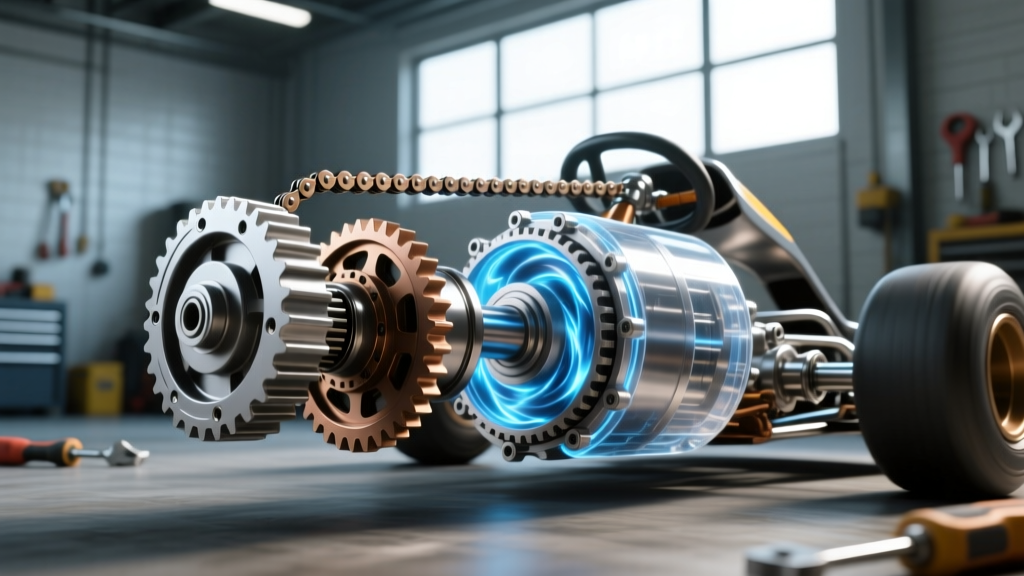
A standard centrifugal clutch (like the popular Max-Torque 12-tooth #35 clutch) operates on a simple friction pad mechanism. Once the engine reaches the engagement RPM (typically around 2,300 RPM), the shoes expand and lock against the drum. At this point, the clutch achieves a near 1:1 mechanical lockup. The only parasitic loss in the system is the rolling resistance of the chain and the rear axle bearings. This makes the centrifugal clutch incredibly fuel-efficient at cruising and top speeds, as there is zero slippage.
Conversely, a torque converter (such as the Comet 30 Series TAV2) uses a belt-driven, variable-pitch pulley system. This provides a massive mechanical advantage for low-speed torque multiplication, making it ideal for off-road karts or heavy rigs. However, this comes at a strict efficiency penalty. In low gear, belt slip and friction can result in drivetrain efficiencies as low as 70-75%. The energy lost to slip is converted into heat, which not only degrades the drive belt but forces the engine to consume more fuel to maintain speed. Even in 'overdrive' (top speed), a torque converter rarely exceeds 88% efficiency due to the continuous flexing and friction of the asymmetrical drive belt.
| Drivetrain Component | Peak Efficiency | Parasitic Loss | Fuel Economy & Run-Time Impact |
|---|---|---|---|
| Centrifugal Clutch (e.g., 12T #35) | 96-98% (Locked) | ~2-4% (Chain/Bearings) | Excellent; maximizes cruise run-time |
| Torque Converter (30 Series CVT) | 85-88% (Overdrive) | 12-15% (Belt slip/heat) | Poor in low gear, moderate at cruise |
| #35 Roller Chain (Dry/Dirty) | 92-94% | 6-8% (Friction) | High fuel burn, rapid component wear |
| #219 Roller Chain (PTFE Lubricated) | 97-98% | 2-3% (Friction) | Optimal for endurance and efficiency |
Chain Selection, Tension, and Lubrication Dynamics
The chain is the physical link transferring power from the transmission to the live axle. The three most common chain sizes in karting are #35, #420, and #219. Your choice here heavily influences rotational mass and friction.
The #35 chain is the standard for beginner and recreational karts. It is robust, cheap, and handles the torque of a 6.5 HP engine with ease. However, it is relatively heavy and features a larger 3/16-inch roller diameter, which increases the friction footprint against the sprocket teeth. The #420 chain is even heavier and generally reserved for larger, higher-torque applications; using it on a standard 196cc kart is a guaranteed way to sap horsepower and reduce fuel efficiency due to unnecessary rotational inertia.
For maximum efficiency, expert builders turn to the #219 chain. Originally designed for industrial applications, the #219 chain features a smaller 5/32-inch roller and a tighter pitch. This reduces the overall weight of the chain loop by nearly 15% compared to a #35 chain and drastically lowers the friction coefficient at the sprocket interface. When paired with a PTFE-based dry chain lubricant (such as Maxima Chain Wax), the #219 chain operates with minimal parasitic drag. Wet, sticky lubricants should be strictly avoided in off-road or dusty environments; they attract abrasive silica dust, creating a grinding paste that increases rolling resistance by up to 8% and accelerates sprocket wear.
Tension Specification: Chain tension is a frequent point of failure for beginners. A chain pulled 'guitar-string tight' will induce massive radial loads on the engine crankshaft bearing and the rear axle bearings, causing immediate parasitic drag and premature failure. The correct specification for a kart chain is 1/4-inch to 3/8-inch of vertical slack on the bottom run when the rear axle is rotated to the tightest point in its travel (accounting for minor axle or sprocket runout).
Sprocket Ratios and the BSFC Sweet Spot
Fuel economy in a small 4-stroke engine is entirely dictated by keeping the engine within its optimal Brake Specific Fuel Consumption (BSFC) range. BSFC is a measure of how efficiently an engine burns fuel to produce power. According to Honda's official GX200 engineering data, the engine produces its most efficient power band between 3,000 and 3,600 RPM. If your kart is geared incorrectly, you will force the engine out of this sweet spot, resulting in rich, unburnt fuel conditions or lugging.
Beginners often make the mistake of 'over-gearing' their karts (using a small rear sprocket, like a 50-tooth) in pursuit of a higher theoretical top speed. In reality, the engine lacks the torque to pull this tall gear, causing it to lug at 2,500 RPM under load. The engine's mechanical governor will dump more fuel into the cylinder to prevent stalling, ruining fuel economy and causing severe carbon buildup.
Conversely, 'under-gearing' (using a massive 70-tooth rear sprocket) forces the engine to scream at 6,500 RPM just to maintain a moderate cruising speed. This high-RPM friction drastically increases fuel consumption. The ideal starting ratio for a standard 196cc engine on a 12-inch rear tire is a 12-tooth driver and a 60-tooth axle sprocket (a 5:1 ratio). This allows the engine to cruise comfortably at 3,400 RPM at roughly 25 MPH, sitting perfectly in the peak BSFC efficiency window.
Precision Alignment and Bearing Drag
The final frontier of go kart drivetrain efficiency lies in the rear axle assembly. The rear axle spins on two or three pillow block or flange bearings (typically 5/8-inch inner diameter, such as the FL205-12). According to SKF's bearing friction calculations, a properly lubricated and aligned deep groove ball bearing generates less than 0.1 Nm of friction torque. However, improper installation can multiply this drag exponentially.
When beginners tighten the rear axle nut, they often crank it down with an impact wrench or excessive force on a breaker bar. This applies axial preload to the bearings, forcing the steel balls into the races with immense pressure. This 'bearing bind' can increase friction torque to over 0.5 Nm per bearing—effectively acting as a constant, light brake drag that the engine must constantly fight, burning excess fuel in the process.
Expert Axle Assembly Protocol
- Endplay Specification: The rear axle must have exactly 0.005-inch to 0.010-inch of lateral endplay. This is achieved by using precision machined shims between the bearing hanger and the axle hub.
- Torque Spec: The 5/8-inch castellated axle nut should be torqued to 35-40 ft-lbs, then backed off slightly to the nearest cotter pin hole to ensure the bearing is not preloaded.
- Sprocket Alignment: The engine driver sprocket and the rear axle sprocket must be perfectly coplanar. Use a laser alignment tool or a precision machined straight-edge. The maximum allowable offset is 0.020-inch. Misalignment forces the chain to twist laterally, generating severe side-load friction and heat.
- Bearing Lubrication: Ensure your pillow block bearings feature a zerk fitting and are packed with a high-quality synthetic lithium-complex grease. Purge the old grease until fresh grease is visible at the seals to eliminate internal contamination drag.
Summary: The Efficiency Checklist
Optimizing your go kart drivetrain for fuel economy and speed is not about buying the most expensive parts; it is about mechanical sympathy and precision. By selecting the appropriate clutch for your terrain, minimizing rotational mass with a #219 chain, gearing the kart to respect the engine's BSFC curve, and eliminating bearing preload, you can reclaim up to 20% of your engine's lost horsepower. The result is a kart that runs cooler, accelerates harder, and requires significantly fewer trips to the fuel pump.