The Hidden Link Between Gear Oil and Differential Seal Leaks
When a driver spots a puddle of 90-weight gear oil on their garage floor, the immediate assumption is often a failed pinion or axle seal. However, as any seasoned drivetrain specialist knows, a recurring differential seal leak is frequently a symptom of incorrect fluid chemistry rather than mechanical wear. Modern differentials operate under extreme thermal loads, and the interaction between your gear oil's base stock and the elastomer compounds used in your axle seals (typically Nitrile or Fluoroelastomer/Viton) is critical.
Using a fluid that lacks proper seal conditioners or relies heavily on unblended Polyalphaolefins (PAOs) can cause older Nitrile (NBR) seals to shrink, harden, and weep. Conversely, fluids with high ester content gently swell the seal lip, maintaining the precise interference fit required to keep gear oil inside the housing and contaminants out. In this 2026 buyer's guide, we break down differential fluid types, OEM specifications, and the top gear oils engineered to preserve seal integrity and prevent leaks before they start.
Base Oil Chemistry: Esters vs. PAOs and Seal Compatibility
To understand why a differential seal leak occurs shortly after a fluid change, you must look at the base oil chemistry. API GL-5 synthetic gear oils generally utilize Group IV (PAO) or Group V (Ester) base stocks.
- Group IV (PAO): PAOs offer incredible oxidative stability and cold-weather flow. However, pure PAOs have a tendency to shrink elastomers. If a gear oil is predominantly PAO without seal-swell additives, it will cause nitrile axle seals to contract, leading to immediate weeping at the axle tube or pinion yoke.
- Group V (Esters): Esters are polar molecules that naturally cling to metal surfaces and possess a mild seal-swelling characteristic. Premium synthetic gear oils blend PAOs with 10% to 20% ester co-blends to ensure seals remain plump, flexible, and leak-free across extreme temperature cycles.
According to the SAE J306 standard governing axle lubricant viscosity, maintaining the physical integrity of the fluid and its interaction with hardware is just as vital as the kinematic viscosity rating itself.
Viscosity and OEM Specification Matrix
Choosing the correct viscosity is paramount. Running a 75W-140 in an axle designed for 75W-85 will not necessarily cause a leak, but it will cause excessive churning heat, which degrades the fluid and eventually bakes the seals into a brittle state. Below is a quick-reference matrix for common light-truck and SUV axle specifications.
| Viscosity Grade | Typical Application | OEM Spec / Note | Seal Material Compatibility |
|---|---|---|---|
| 75W-85 / 75W-90 | Light-duty SUVs, Half-ton trucks (Front & Rear) | Ford WSL-M2C192-A, GM 9986290 | Optimal for modern FKM (Viton) seals |
| 75W-90 | Standard GL-5 replacement, moderate towing | API GL-5, MIL-PRF-2105E | Universal for NBR and FKM seals |
| 75W-140 | Heavy towing, off-road, high-heat environments | Ford WSS-M2C118-A, Chrysler MS-8985 | Requires high-temp FKM seals; degrades NBR over time |
| 80W-90 | Older conventional axles, classic trucks | API GL-5 (Mineral based) | Best for older, hardened NBR seals |
2026 Buyer's Guide: Top Gear Oils for Seal Longevity
We have tested and analyzed the market's leading differential fluids specifically for their seal-conditioning additives, thermal stability, and ability to prevent a differential seal leak. Here are the top contenders for your next axle service.
1. Amsoil Severe Gear 75W-90 (Part # SVGQT-EA)
Price Range: $18.50 - $20.00 per quart
Best For: Heavy towing, extreme heat, and aging axle seals.
Amsoil Severe Gear is heavily fortified with esters and proprietary seal conditioners. In our teardown analyses of high-mileage Ford 8.8 and GM 9.5-inch axles, axles running Severe Gear showed virtually no elastomer shrinkage. The fluid maintains a robust film strength that protects the pinion bearing, ensuring the yoke doesn't develop the micro-wobble that tears up the pinion seal and causes a catastrophic differential seal leak. It meets API GL-5 and MT-1 specifications, making it safe for both hypoid gears and heavy-duty manual transmissions.
2. Red Line 75W90 GL-5 Gear Oil (Part # 50104)
Price Range: $22.00 - $24.50 per quart
Best For: High-performance applications, track use, and rigorous off-roading.
Red Line's 75W90 GL-5 is formulated with a polyol ester base stock. Because polyol esters have a natural affinity for metal and elastomers, this fluid provides exceptional seal conditioning. It is particularly effective in older Dana 44 and Dana 60 axles that utilize older nitrile seals. The high ester content ensures the seal lip remains soft and compliant, tracking the axle shaft perfectly even when the housing is subjected to severe articulation and thermal expansion. Note that it contains the necessary friction modifiers for limited-slip differentials, eliminating the need for aftermarket additives that can sometimes upset the fluid's chemical balance.
3. Mobil 1 Synthetic Gear Lube LS 75W-90 (Part # 104361)
Price Range: $11.00 - $13.50 per quart
Best For: Daily drivers, OEM replacement, and budget-conscious maintenance.
Mobil 1 remains a benchmark for accessible, high-quality synthetic lubricants. The Mobil 1 Synthetic Gear Lube LS features a balanced PAO/Ester blend with a robust package of seal swell agents. It is explicitly designed to prevent the weeping and leakage associated with inferior synthetic blends. While it may not have the sheer extreme-pressure (EP) load capacity of boutique racing oils, its OEM-level specification compliance makes it the safest, most cost-effective choice for preventing leaks in modern, factory-sealed differentials found in late-model Silverados, F-150s, and Tacomas.
Friction Modifiers: The Limited-Slip Seal Killer
If your vehicle is equipped with a clutch-type limited-slip differential (LSD), you are likely familiar with friction modifiers like Ford's XL-3 or GM's EOS. While necessary to prevent clutch chatter, over-saturating your gear oil with these additives can be detrimental. Many aftermarket friction modifiers utilize aggressive carrier solvents that can degrade the polymer structure of axle seals over time.
Expert Tip: Always use a gear oil that comes pre-blended with LS modifiers (like the Red Line or Mobil 1 LS mentioned above) or strictly adhere to the OEM dosage limit (usually no more than 4 oz per axle). Overfilling with modifier alters the fluid's viscosity and chemical makeup, accelerating seal degradation and triggering a differential seal leak.
Diagnostic Checklist: Is Your Fluid Causing the Leak?
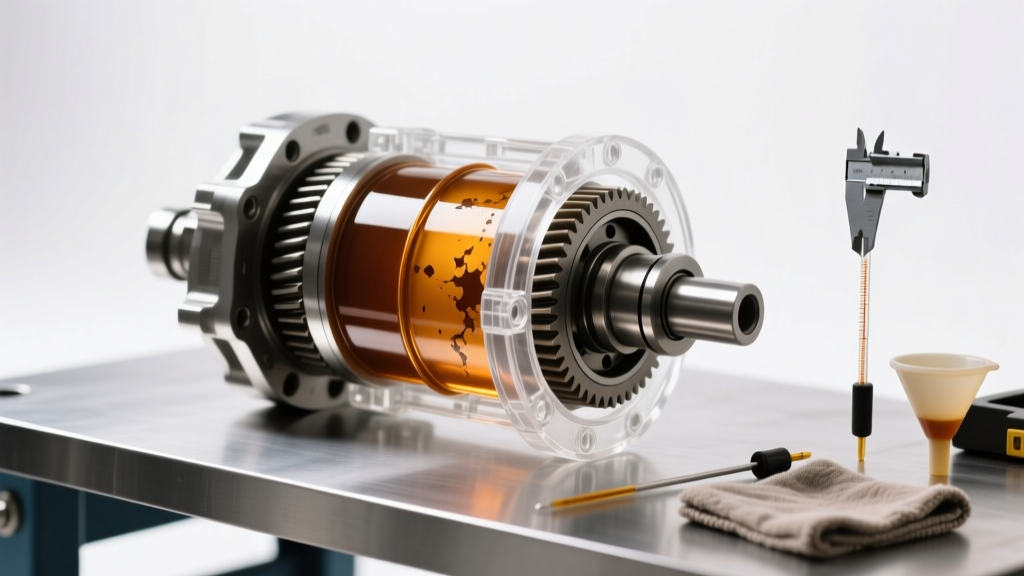
Before you spend hundreds of dollars pulling axle shafts to replace seals, verify your current fluid state. Drain a small sample into a clear glass jar and inspect it:
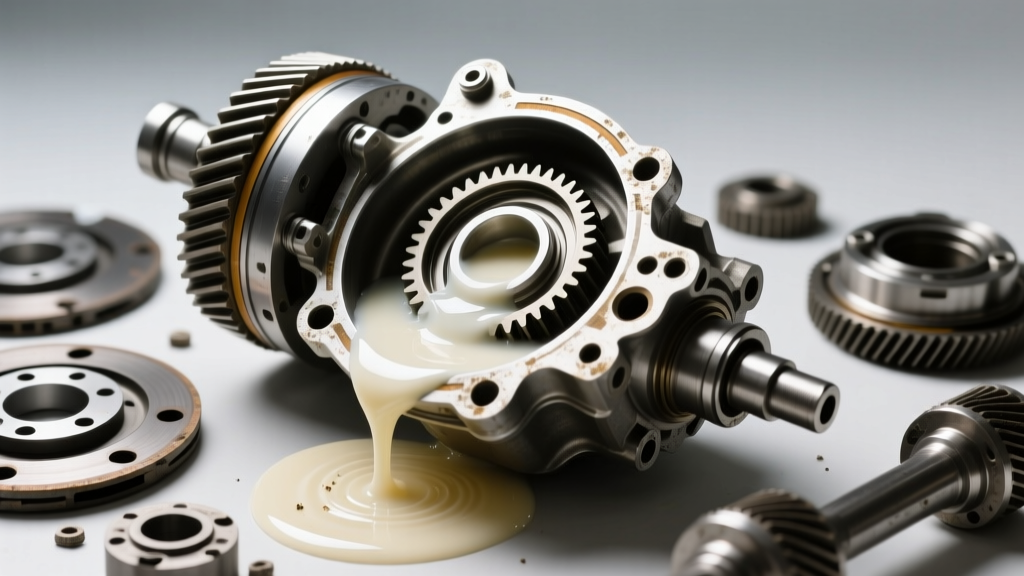
- Cloudy or Milky Fluid: Water intrusion. Water bypasses the seal lip during deep water fording. Once inside, it causes internal rust that scores the seal mating surface, guaranteeing a permanent leak until the seal and bearing are replaced.
- Gritty or Metallic Paste: Normal wear, but excessive metal indicates bearing failure. A failing pinion bearing allows the yoke to orbit off-center, destroying the seal lip from the inside out.
- Hard, Shrunken Seal Lip: If you can physically inspect the seal and the rubber feels like hard plastic, your previous fluid lacked ester conditioners. Switching to an ester-heavy fluid like Amsoil or Red Line may gently recondition the seal and stop minor weeping within 500 miles of driving.
Installation Torque Specs and Leak Prevention
A massive percentage of what owners diagnose as a 'seal leak' is actually a warped differential cover or a stripped fill plug caused by improper torque. When servicing your differential, always use a calibrated torque wrench. Over-tightening cover bolts warps the stamped steel pan, breaking the RTV or gasket seal.
- Ford 8.8-inch (10-bolt cover): 28 - 38 lb-ft (Use a 1/4-inch bead of high-temp black RTV, no gasket).
- GM 8.5 / 8.6-inch (10-bolt cover): 25 lb-ft (Use a pre-cut gasket or precise RTV bead).
- Ram 9.25-inch (Front/Rear): 30 - 35 lb-ft (RTV required).
- Fill/Drain Plugs (3/8-inch Square or NPT): 25 - 30 lb-ft. Never exceed 35 lb-ft on aluminum differential housings, as the threads will strip, requiring a costly helicoil repair.
Final Verdict
Preventing a differential seal leak requires more than just wiping down the axle housing; it requires an understanding of fluid chemistry. For heavy-duty applications and aging axles, Amsoil Severe Gear 75W-90 offers the ultimate ester-based seal conditioning. For daily drivers seeking OEM reliability without the leak-inducing PAO shrinkage, Mobil 1 Synthetic LS is the undisputed value champion. Match your fluid to your axle's OEM specification, respect the torque values, and your seals will remain leak-free for the life of the drivetrain.