The Economics of Drivetrain Lubrication
When managing a fleet of work trucks or maintaining a personal off-road rig, maintenance budgets require strict scrutiny. In financial accounting, incremental or differential costs are costs in making decisions between two or more alternatives. In the context of automotive drivetrain maintenance, this concept perfectly describes the choice between conventional, synthetic blend, and full synthetic differential gear oils. Choosing the right fluid is not merely about picking a viscosity; it is a calculated financial decision weighing upfront fluid costs against long-term axle longevity, fuel efficiency, and service interval extensions.
At AutoGearNexus, we break down the true cost of ownership for differential and axle systems. In this 2026 cost analysis guide, we will dissect differential gear oil specifications, compare real-world pricing, and apply the differential cost framework to help you make the most economically sound decision for your specific drivetrain.
Decoding Gear Oil Specifications (SAE & API)
Before calculating costs, we must establish the technical baseline. Gear oil is governed by two primary classification systems: the Society of Automotive Engineers (SAE) for viscosity, and the American Petroleum Institute (API) for performance and additive packages.
Viscosity Grades and the SAE J306 Standard
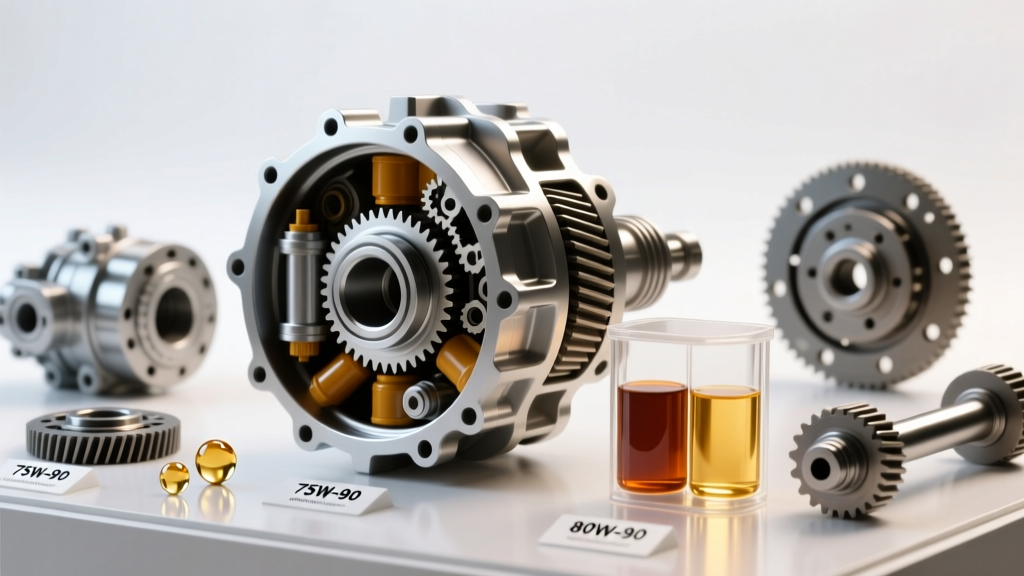
The most common differential viscosities are 75W-90, 80W-90, and 75W-140. The 'W' denotes winter (cold-temperature) flow characteristics, while the second number represents high-temperature shear stability. A 75W-90 full synthetic offers superior cold-weather flow, reducing parasitic drivetrain drag and improving fuel economy by up to 1.5% in freezing climates compared to an 80W-90 conventional mineral oil.
API GL-4 vs. GL-5 and Yellow Metal Compatibility
Almost all modern hypoid ring and pinion gearsets require API GL-5 fluid. GL-5 contains high levels of sulfur-phosphorus extreme pressure (EP) additives designed to prevent micropitting and spalling under the intense sliding friction of hypoid gears. However, these same EP additives can corrode yellow metals (brass, bronze, copper). If you are servicing an older transfer case or a transaxle with brass synchronizers, a GL-4 fluid is mandatory to prevent catastrophic component degradation.
2026 Price Breakdown Matrix
To understand the incremental costs, we must look at the retail pricing of premium gear oils and the total fill cost for a standard rear axle. Prices below reflect average 2026 North American retail rates.
| Fluid Type | Viscosity / API | Price Per Quart | Avg. Diff Capacity | Total Fluid Cost | Service Interval |
|---|---|---|---|---|---|
| Conventional Mineral | 80W-90 GL-5 | $8.50 | 2.5 Quarts | $21.25 | 30,000 Miles |
| Synthetic Blend | 75W-90 GL-5 | $12.00 | 2.5 Quarts | $30.00 | 50,000 Miles |
| Full Synthetic (Premium) | 75W-90 GL-5 | $17.50 | 2.5 Quarts | $43.75 | 100,000 Miles |
| Heavy-Duty Synthetic | 75W-140 GL-5 | $21.00 | 3.5 Quarts | $73.50 | 100,000 Miles |
At first glance, the full synthetic option presents a $22.50 incremental cost over the conventional fluid. However, when factoring in the extended 100,000-mile service interval—effectively eliminating two intermediate fluid changes—the synthetic option yields a net savings of roughly $40 to $60 over the lifespan of the vehicle, excluding the value of reduced labor costs and downtime.
Applying the Framework: Real-World Axle Scenarios
Let us apply the differential cost decision-making framework to two distinct vehicle profiles to see how operational demands dictate fluid selection.
Scenario A: The Commuter (GM 8.6" 10-Bolt Rear Axle)
Vehicle: 2021 Chevrolet Silverado 1500 (Daily Driver, Light Towing)
Capacity: 2.08 Quarts
Recommendation: 75W-90 Full Synthetic (e.g., Mobil 1 or Amsoil Severe Gear)
Analysis: For a light-duty commuter, the primary goal is fuel efficiency and long-term bearing protection. The 75W-90 synthetic reduces rotational mass drag. The incremental cost of upgrading from the factory-fill conventional to a premium synthetic is roughly $18 total. Given the low thermal stress of daily commuting, a 75W-140 fluid would be an unnecessary expense and could actually increase operating temperatures due to higher fluid shear friction.
Scenario B: The Heavy Hauler (Ford 10.5" Sterling Axle)
Vehicle: 2020 Ford F-250 Super Duty (Fifth-Wheel Towing, 10,000+ lbs)
Capacity: 3.5 Quarts
Recommendation: 75W-140 Full Synthetic with Friction Modifier
Analysis: When towing heavy loads up mountain grades, differential fluid temperatures can easily exceed 250°F (121°C). At this threshold, conventional 80W-90 fluid suffers severe viscosity breakdown, leading to metal-on-metal contact and accelerated ring and pinion wear. The incremental cost of 3.5 quarts of 75W-140 synthetic ($73.50) versus conventional 80W-90 ($29.75) is $43.75. Compared to the $2,500+ cost of a remanufactured Sterling 10.5" axle assembly or a precision ring-and-pinion rebuild, this $43.75 differential cost is an absolute necessity for risk mitigation.
The Hidden Cost of Friction Modifiers
If your vehicle is equipped with a clutch-type Limited Slip Differential (LSD), such as the Eaton Truetrac or Auburn Gear LSD, gear oil specifications must include a friction modifier. Without it, the clutch packs will bind and chatter during low-speed cornering, leading to premature wear and eventual failure.
Many premium synthetic gear oils claim to be 'LS Compatible,' but real-world testing often shows that dedicated friction modifiers are still required for optimal performance. When budgeting your differential service, you must account for this additive:
- Motorcraft XL-3 Friction Modifier: ~$12.00 per 4 oz bottle (Part # XL-3)
- GM ACDelco Limited Slip Axle Lubricant: ~$14.50 per 4 oz bottle (Part # 88900333)
- Red Line Limited Slip Friction Modifier: ~$16.00 per 4 oz bottle
The incremental cost of adding a friction modifier is minor, but the cost of ignoring it is a destroyed clutch pack and a compromised differential.
Precision Service: Torque Specs and Fill Procedures
A proper cost analysis also includes the labor and precision required to perform the service correctly. Over-torquing drain plugs can strip the axle housing threads, turning a $40 fluid change into a $500 helicoil repair or housing replacement. Always adhere to manufacturer torque specifications:
- GM 8.6" / 9.5" 10-Bolt & 14-Bolt (Cover Bolts): 20 - 25 lb-ft (Use a criss-cross pattern and apply RTV silicone or a new gasket).
- Ford Sterling 10.5" (Drain & Fill Plugs): 35 - 45 lb-ft (Ensure the magnetic drain plug is cleaned of metallic debris before reinstallation).
- Dana 44 / Dana 60 (Fill Plugs): 25 - 35 lb-ft (Fill until fluid is level with the bottom of the fill hole threads).
- Toyota 8" / 9" Dropouts (Drain Plug): 30 - 36 lb-ft (Requires a 24mm or 10mm hex socket depending on the year).
Conclusion: Making the Final Decision
Ultimately, the choice of differential gear oil is a masterclass in applied economics. By understanding that incremental or differential costs are costs in making decisions, fleet managers and enthusiasts can look past the sticker price of a single quart of oil. Evaluating the total cost of ownership—including fluid longevity, thermal stability under load, parasitic drag reduction, and the prevention of catastrophic hypoid gear failure—proves that investing in high-quality, specification-correct synthetic gear oils is the most financially sound decision you can make for your drivetrain.