The Critical Role of Gear Marking Compound in Axle Builds
Setting up a hypoid ring and pinion gear set is one of the most precise tasks in automotive drivetrain assembly. Whether you are rebuilding a classic GM 12-bolt, a heavy-duty Dana 60, or a modern Ford 8.8 independent rear suspension (IRS), the survival of your gears depends entirely on the contact pattern. To visualize this pattern, mechanics rely on a specialized differential gear marking compound. This high-contrast paste transfers the exact footprint of the pinion gear onto the ring gear, revealing microscopic alignment errors before the differential is filled with gear oil and subjected to thousands of pound-feet of torque.
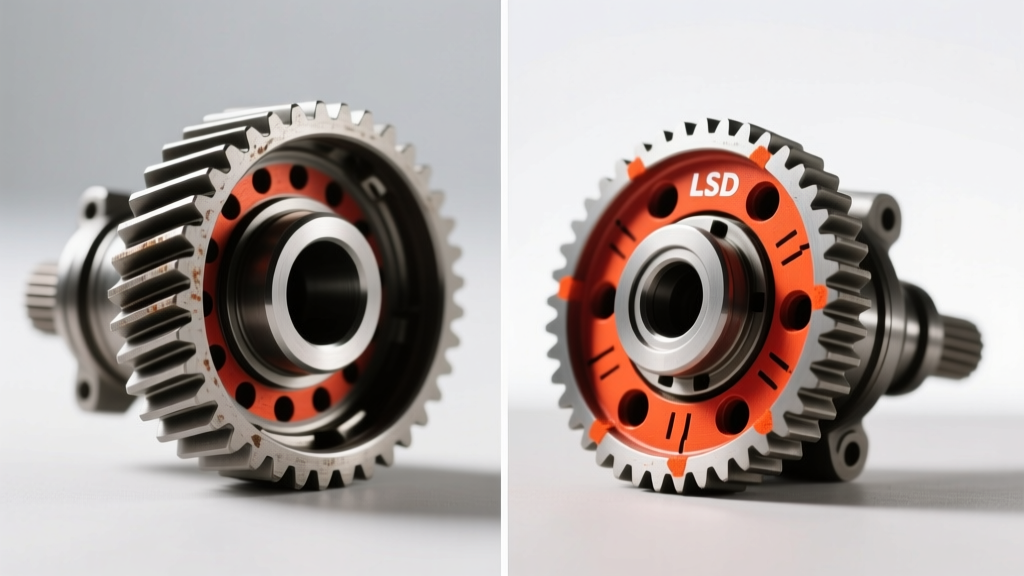
However, the process of applying this compound and reading the resulting pattern changes drastically depending on whether you are building an open differential or a limited slip differential (LSD). In 2026, with the proliferation of advanced helical and clutch-based LSDs in both OEM and aftermarket applications, understanding the friction variables between these two differential types is mandatory for a successful axle build.
Open vs. Limited Slip: How Internal Friction Alters the Pattern
The fundamental difference between an open differential and an LSD lies in internal friction and side-gear preload. This mechanical difference directly impacts how the ring gear rotates during the patterning process, which in turn affects the integrity of the marking compound transfer.
The Open Differential Setup
An open differential features spider gears and side gears that spin freely when one axle shaft is held stationary. When applying your differential gear marking compound to an open carrier, you can easily hold the pinion yoke to create drag while rotating the ring gear by hand (or vice versa). Because there is virtually zero internal bind, the gears mesh smoothly, allowing the yellow ochre or white lithium paste to transfer cleanly onto the gear teeth without smearing. This makes open differentials highly forgiving for novice builders learning to read drive and coast side patterns.
The Limited Slip Differential (LSD) Challenge
When upgrading to a clutch-type LSD (such as the Eaton Posi, Auburn Gear, or Ford Traction-Lok) or a helical gear LSD (like the Torsen or Detroit Truetrac), internal friction spikes dramatically. Clutch packs are preloaded with S-wave washers and friction modifiers, creating anywhere from 30 to 80 lb-ft of breakaway torque. Helical LSDs generate immense internal axial thrust under rotation.
If you attempt to pattern an LSD using the same free-spinning hand-rotation method used on an open diff, the internal bind will cause the ring gear to chatter and skip across the pinion. This smears the marking compound, resulting in a false, elongated pattern that will trick you into adjusting your pinion depth shims incorrectly. Once installed under load, a gear set patterned with a smeared LSD compound will rapidly succumb to pitting, spalling, and catastrophic tooth shear.
| Differential Type | Internal Friction | Patterning Technique Required | Risk of Compound Smear |
|---|---|---|---|
| Open Differential | Near Zero | Hand rotation with light pinion drag | Low |
| Clutch-Type LSD | High (30-80 lb-ft) | Case spreader tool or heavy braking force | Very High |
| Helical/Torsen LSD | Moderate to High | Axle shaft insertion with brake rotor drag | Moderate |
2026 Buyer’s Guide: Top Differential Gear Marking Compounds
Not all marking pastes are created equal. The viscosity, tackiness, and contrast of the compound dictate how well it will hold up against the rotational torque required to pattern an LSD. Here is a comparison of the industry-standard compounds available today.
1. Permatex Gear Marking Compound (Part #80038)
- Base: Yellow Ochre / Mineral Oil
- Price Range: $12.00 - $16.00
- Best For: Open differentials, Torsen/Helical LSDs, and OEM dealership warranty work.
- Expert Take: Permatex 80038 is the gold standard for general use. It provides excellent yellow-on-black contrast. However, its relatively low tack means it can sling off the teeth if you are forced to rotate a tight clutch-type LSD multiple times at high speeds to get a readable pattern.
2. Torco GPC Gear Pattern Compound
- Base: High-Tack Synthetic Polymer
- Price Range: $18.00 - $24.00
- Best For: Clutch-type LSDs, high-preload racing differentials, and heavy-duty Dana 60/70 axles.
- Expert Take: Torco's formulation is significantly stickier than standard yellow ochre. When setting up an Auburn or Eaton LSD where you must use a heavy-duty case spreader (like the OTC 7150) and a breaker bar to rotate the carrier, Torco GPC stays adhered to the tooth flank, yielding a razor-sharp footprint without smearing.
3. CRC Engine Assembly Lube (Alternative)
- Base: Molybdenum Disulfide (Moly)
- Price Range: $8.00 - $12.00
- Expert Take: While technically an assembly lube, some old-school builders use dark moly paste on the drive side and white lithium grease on the coast side for a dual-tone pattern. We do not recommend this for modern, tight-tolerance LSDs, as the dark moly can obscure the precise toe and heel boundaries required for high-load applications.
Step-by-Step: Patterning an LSD Without Smearing
To achieve a factory-quality pattern on a limited slip differential, you must simulate the rotational mass and drag of the vehicle. According to Yukon Gear & Axle's official setup documentation, skipping the preload step is the number one cause of premature gear failure in aftermarket LSD installs.
- Install the Carrier with a Case Spreader: For clutch-type LSDs, do not hammer the carrier into the housing. Use a differential case spreader tool to open the housing by no more than 0.015 inches. Drop the LSD in and release the spreader to achieve the correct carrier bearing preload.
- Torque the Bearing Caps: Immediately torque the bearing caps to factory specifications. For a Ford 8.8, this is 70-85 lb-ft. For a GM 10-bolt (8.5-inch), it is 60 lb-ft. For a Dana 44, it is 60-75 lb-ft. Never reuse stretched carrier bearing cap bolts.
- Apply the Compound: Apply a thin, even coat of Torco GPC or Permatex 80038 to the drive and coast sides of 3 to 4 ring gear teeth. Less is more; a thick glob will squeeze out and ruin the pattern boundaries.
- Rotate Under Load: Insert an old axle shaft into the LSD side gear. Attach a brake rotor or a specialized holding fixture to the axle shaft to create drag. Use a wrench on the pinion nut to rotate the pinion gear through the ring gear 4 to 5 times in both directions. The drag on the axle shaft forces the LSD clutch packs to engage, locking the side gears to the case and forcing the ring gear to rotate smoothly against the pinion without chatter.
- Read the Pattern: Wipe the teeth clean and inspect. You are looking for a pattern that is centered on the tooth face, slightly biased toward the toe, and avoiding the very top (face) and bottom (root) of the tooth.
Diagnosing the Pattern: Backlash and Pinion Depth
Once the differential gear marking compound has transferred the footprint, you must interpret it. As detailed in Ring & Pinion's comprehensive pattern reading guide, the pattern dictates your next shim adjustment.
- Pattern High on the Face: The pinion is too far away from the ring gear centerline. You must decrease the pinion depth shim thickness to move the pinion deeper into the housing.
- Pattern Low on the Flank (Root): The pinion is too deep. Increase the pinion depth shim thickness to pull the pinion away from the ring gear.
- Backlash Adjustments: Backlash (the rotational play between the ring and pinion) should generally be set between 0.006" and 0.010" for street-driven LSDs, and 0.012" to 0.016" for off-road or high-heat racing applications. Adjust backlash by moving the carrier side shims or adjusting the threaded bearing collars (on Dana and Chrysler axles) equally from side to side to maintain carrier bearing preload.
Final Thoughts on Drivetrain Longevity
The transition from an open differential to a limited slip unit offers massive traction benefits, but it demands a higher level of precision during assembly. By selecting the correct high-tack differential gear marking compound and utilizing case spreaders and axle drag to counteract internal LSD friction, you ensure that your ring and pinion gears will operate quietly and survive the extreme torque loads of modern V8 and turbocharged platforms. Never rush the patterning process; the $20 you spend on premium marking paste and the extra hour spent simulating LSD drag will save you from a $1,500 gear replacement down the road.