The Short Answer: Yes, But It Is Hidden in the Transaxle
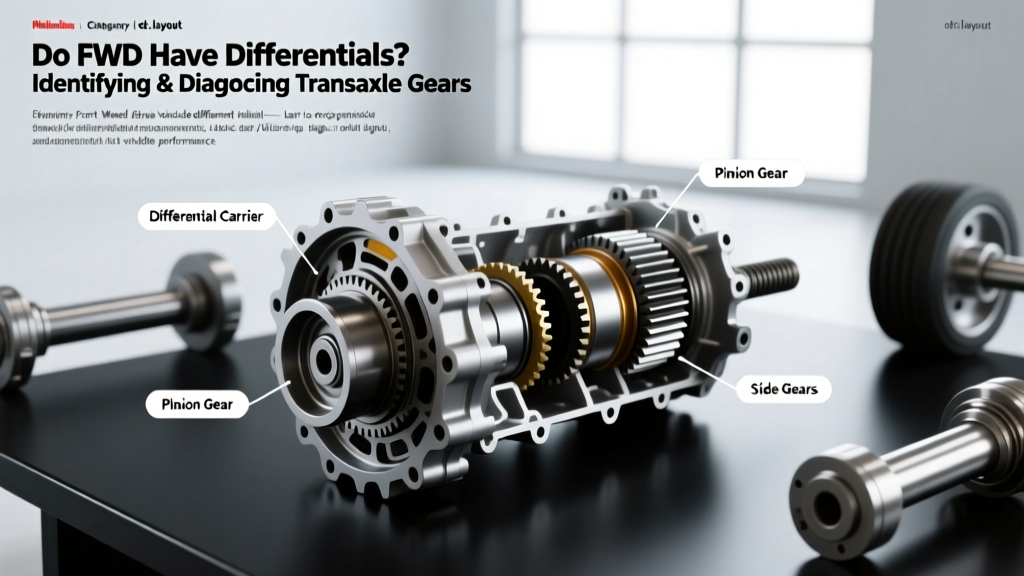
When enthusiasts, novice mechanics, or DIYers ask, 'do fwd have differentials?', the answer is an absolute yes. However, unlike Rear-Wheel Drive (RWD) or traditional 4WD trucks where the differential is a distinct, pumpkin-shaped housing bolted to the rear axle, Front-Wheel Drive (FWD) vehicles integrate the differential directly into the transmission casing. This combined unit is known as a transaxle.
Because the FWD differential shares a housing (and often the same lubricant) with the transmission gears and synchronizers, diagnosing differential failures requires a specialized approach. Misdiagnosing a worn ring-and-pinion gear as a failing transmission bearing is a common and costly mistake. In this 2026 diagnostic guide, we will break down FWD drivetrain component identification, map out exact failure symptoms, and provide actionable troubleshooting steps to isolate transaxle differential faults.
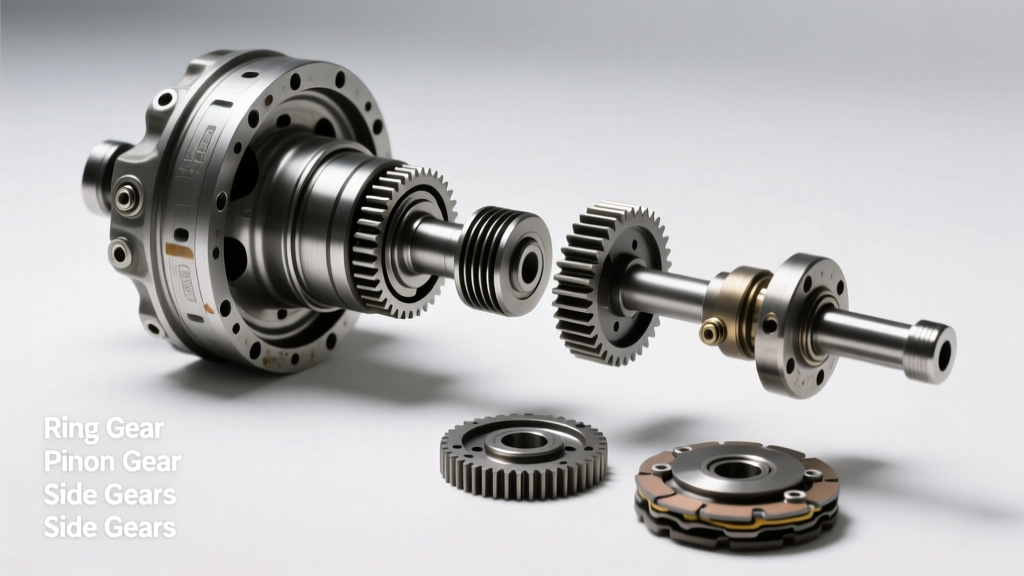
FWD Differential Component Identification
To troubleshoot effectively, you must first visualize the internal architecture of a FWD transaxle. The differential section typically sits at the bottom or side of the transmission case, driven by the final drive countershaft.
Core Internal Components
- Ring Gear: A large, helical-cut gear bolted to the differential carrier. It receives rotational force from the transmission's output pinion gear.
- Drive Pinion Gear: The smaller gear on the transmission countershaft that meshes with the ring gear to provide the final gear reduction (e.g., a 4.11:1 final drive ratio).
- Differential Carrier (Case): The housing that holds the spider gears and side gears, rotating with the ring gear.
- Spider Gears (Pinion Gears) & Side Gears: The internal cross-axis gears that allow the left and right CV axles to rotate at different speeds during cornering.
- Carrier Bearings: Tapered roller bearings that support the differential carrier within the transaxle housing. These are a primary source of whining noises when worn.
Diagnosing FWD Differential Failure Symptoms
Because the differential is enclosed in the transaxle, visual inspection is impossible without a full teardown. Diagnosis relies heavily on NVH (Noise, Vibration, and Harshness) analysis and fluid inspection. Below is a diagnostic matrix for identifying FWD differential faults.
| Symptom | Probable Differential Cause | Verification Method |
|---|---|---|
| High-pitch whine on deceleration | Pinion bearing wear or improper ring/pinion backlash | Coast-down test at 40 mph in neutral; if noise persists, it is bearing-related. |
| Clunk on load reversal (shifting R to D) | Excessive spider gear backlash or worn carrier pin | Static load test; rock vehicle in gear. Isolate from engine mount clunk. |
| Tire chirping/binding in tight turns | Failing LSD clutch packs (helical/viscous) or wrong fluid | Figure-8 test on wet asphalt; check for binding/hopping sensation. |
| Growling that changes with speed, not load | Pitted carrier tapered roller bearings | Use wireless Bluetooth chassis ears (e.g., Pico NVH) on the transaxle case. |
Step-by-Step Troubleshooting & Verification
When a customer complains of drivetrain noise, you must isolate the transaxle differential from the engine, transmission internals, and CV axles. Follow this diagnostic sequence.
1. The 'Chassis Ear' and Stethoscope Test
Modern 2026 diagnostic workflows rely on wireless NVH sensors. Clamp the receiver nodes directly to the transaxle differential housing (near the axle output flanges) and the transmission bell housing. Drive the vehicle at 50 mph. If the dominant frequency and amplitude spike at the differential node during coast-down, you have confirmed carrier or pinion bearing failure. According to Sonnax Transmission Tech Resources, misdiagnosing bearing noise often leads to unnecessary transmission rebuilds when only the final drive section requires service.
2. Fluid Inspection and Drain Plug Analysis
Many FWD transaxles share Automatic Transmission Fluid (ATF) or Manual Transmission Fluid (MTF) between the gearsets and the differential. Pull the drain plug and inspect the fluid.
- Glitter/Suspension: Fine metallic paste is normal for clutch-type Limited Slip Differentials (LSDs) as the friction modifiers break down.
- Chunky Metal Shards: Indicates catastrophic spider gear failure or carrier bearing disintegration.
- Brass/Yellow Flakes: Points to synchronizer wear (manual) or thrust washer wear (automatic), not the differential.
3. Axle Nut and CV Joint Isolation
A failing inner CV joint (tripod style) often mimics differential spider gear backlash, causing a clunk when shifting from Reverse to Drive. To isolate this:
1. Raise the vehicle on a lift.
2. Check the inner CV joint for excessive plunge play (in-and-out movement).
3. Check the transaxle output flange for rotational backlash while holding the opposite wheel stationary.
If the axle has play but the transaxle flange does not, the CV joint is the culprit, not the differential.
FWD vs. RWD Differential Maintenance Specs
Understanding the fluid and torque requirements is critical for FWD differential longevity. Unlike a solid rear axle that takes 75W-140 gear oil, FWD differentials have strict, often proprietary, fluid requirements.
| Platform / Transaxle | Differential Type | Fluid Specification | Drain/Fill Plug Torque | Axle Nut Torque |
|---|---|---|---|---|
| Honda K-Series (e.g., Civic Type R) | Helical LSD (Integrated) | Honda Genuine MTF or DW-1 (Model dependent) | 32 lb-ft (43 Nm) | 180 lb-ft (244 Nm) |
| Ford MTX-75 (Focus ST) | Open / Quaife ATB | Motorcraft 75W-90 BO-FF | 26 lb-ft (35 Nm) | 184 lb-ft (250 Nm) |
| VW MQB (Golf GTI - VAQ) | Electronic LSD (VAQ) | Shares DSG fluid (G 052 171 A2) | N/A (Sealed unit) | 147 lb-ft + 90° |
| Hyundai/Kia EV FWD (e.g., Ioniq 5) | Single-Speed Reduction | EV-specific Low-Viscosity Fluid | 29 lb-ft (39 Nm) | 145 lb-ft (196 Nm) |
Real-World Case Studies: Common FWD Transaxle Failures
Case 1: The Honda K20C1 'Clunk'
Owners of high-horsepower FWD Hondas often report a metallic clunk under hard acceleration. While many assume the differential spider gears are shattering, the root cause is frequently the differential pin retaining bolt backing out due to inadequate factory threadlocker application. When diagnosing a K20C1 transaxle, if the clunk is accompanied by a sudden loss of drive to one wheel, the differential pin has likely sheared. The fix requires a transaxle teardown, installing an upgraded aftermarket differential pin (e.g., PPG or MFactory), and applying high-strength red Loctite 271 to the retaining bolt, torqued to 20 lb-ft.
Case 2: VW/Audi DSG VAQ Binding
The VAQ (Vorderachsquersperre) is an electronically controlled multi-plate clutch pack integrated into the FWD DSG transaxle. A common symptom of VAQ failure is understeer and tire chirping during low-speed parking maneuvers. This is rarely a mechanical gear failure; instead, it is caused by degraded friction plates or contaminated DSG fluid. Flushing the DSG with exact OEM fluid and performing a 'VAQ Basic Settings' adaptation via VCDS/ODIS usually resolves the binding without transaxle removal.
The 2026 EV Factor: Electric FWD Transaxles
As the automotive landscape shifts, the question 'do fwd have differentials?' extends to Electric Vehicles (EVs). FWD EVs utilize an 'e-Axle' or electric drive unit (EDU). These units contain a single-speed reduction gearset and an open or electronic differential. Because electric motors deliver instant, massive torque (often exceeding 300 lb-ft at 0 RPM), the differential side gears and spider pins in EV transaxles are subjected to extreme shear stress. Diagnosing EV differential whine requires specialized high-frequency acoustic cameras, as the noise profile blends with the inverter whine and motor harmonics. Always consult manufacturer-specific EV safety protocols before attempting to drain or service an e-Axle differential.
Expert Summary
FWD vehicles absolutely have differentials, but their integration into the transaxle demands a refined diagnostic approach. By mastering component identification, utilizing wireless NVH tools to separate gear noise from bearing noise, and adhering to strict fluid and torque specifications, you can accurately diagnose FWD drivetrain issues without resorting to premature transmission replacements. For deeper dives into gear tooth contact patterns and backlash adjustment, refer to the engineering guides available at Ring & Pinion Tech Support and the fundamental mechanics outlined by How a Car Works.