Introduction to Front Axle Diagnostics
When a 4WD system exhibits binding, whining, or failure to engage, the front differential is often the primary suspect. However, modern front drivetrains are complex assemblies of gears, bearings, and electronic actuators. Accurately diagnosing front differential 4x4 problems requires more than just guessing; it demands precise component identification and an understanding of how solid axles and Independent Front Suspension (IFS) systems transfer torque. Whether you are working on a classic Jeep Wrangler with a Dana 44 or a modern Chevrolet Silverado with an 8.25-inch IFS, identifying the exact failing component is the difference between a $200 targeted repair and a $2,500 unnecessary rebuild.
Mapping the Front Differential: Solid Axle vs. IFS
Before diagnosing a failure, you must identify the architecture of your front axle. The internal component layout dictates the diagnostic pathway.
Solid Axle (Dana 30/44) Component Breakdown
Solid front axles, prevalent in Jeep, Ram, and Ford Super Duty applications, house all differential components inside a single rigid pumpkin. Key components to identify include:
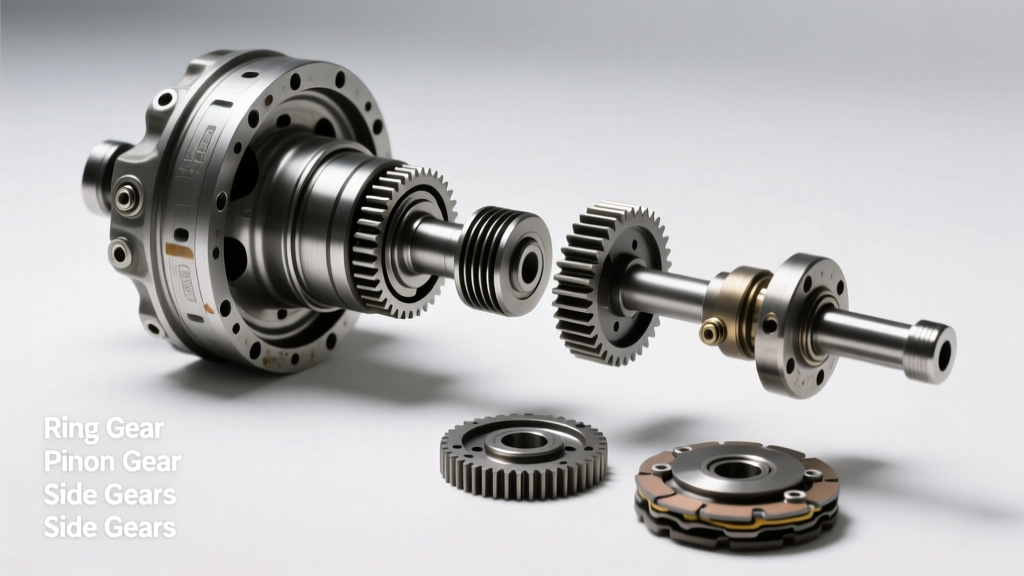
- Ring and Pinion Gear Set: The hypoid gear pair that turns power 90 degrees from the driveshaft to the axles.
- Carrier and Spider Gears: The open or limited-slip differential case that allows wheels to rotate at different speeds during cornering.
- Pinion and Carrier Bearings: Tapered roller bearings that support the gear mesh under extreme load.
- Spindle Bearings and Locking Hubs: External components that disconnect the wheels from the axle shafts in 2WD mode.
Independent Front Suspension (GM 8.25 / Ford 8.8)
IFS systems integrate the differential into the engine crossmember, utilizing CV axles to reach the wheels. Crucial components include:
- Center Axle Disconnect (CAD): An electronic or vacuum-actuated collar (common on GM trucks) that locks the passenger-side inner stub shaft to the differential side gear.
- Inner and Outer CV Joints: Constant velocity joints that accommodate suspension articulation.
- Electronic Front Axle Actuator: The motor responsible for physically moving the shift fork or CAD collar.
Symptom-to-Component Diagnostic Matrix
Use the following matrix to cross-reference auditory and physical symptoms with their corresponding internal components.
| Symptom Profile | Operating Condition | Probable Failing Component | Verification Method |
|---|---|---|---|
| High-pitched whining | Deceleration (Coast side) | Pinion bearing or Ring/Pinion coast-side gear wear | Chassis ear on differential housing; check pinion yoke play |
| Low-frequency howl | Acceleration (Drive side) | Ring/Pinion drive-side wear or low fluid level | Infrared thermometer on housing (look for >200°F); fluid inspection |
| Clunking on engagement | Shifting from 2WD to 4WD | CAD collar, shift fork, or worn spider gear cross-pin | Scan tool actuator test; visual inspection of shift motor |
| Binding / Hopping | Tight turns on dry pavement | Seized limited-slip clutches or locked transfer case | Tire rotation test; verify transfer case is fully in 2WD |
| Grinding / Vibration | Highway speeds in 2WD | Failed front driveshaft U-joint or disconnected CAD failing to disengage | Remove front driveshaft and test drive; check CAD collar position |
Deep Dive: Identifying the Culprits Behind Common Front Differential 4x4 Problems
1. Actuator and Disconnect Collar Failures (GM CAD Systems)
One of the most frequent front differential 4x4 problems on 2001-2024 GM HD trucks is the failure to engage or disengage 4WD. This is rarely a gear issue; it is an identification failure of the Center Axle Disconnect (CAD). The CAD uses a shift fork pushed by an electric actuator (often Dorman Part #600-400 or GM OEM #26060073) to slide a splined collar. If the collar is identified with excessive wear on the engagement teeth, it will grind and fail to lock the passenger-side axle to the differential side gear. Furthermore, moisture ingress into the actuator motor causes internal corrosion, resulting in a 'Service 4WD' message on the dash.
2. Ring and Pinion Wear vs. Carrier Bearing Failure
Distinguishing between a failing ring and pinion and a failing carrier bearing requires identifying the exact frequency of the noise. According to Ring & Pinion technical guidelines, gear noise is typically tied to vehicle speed and load, occurring in narrow RPM bands. Conversely, a failing carrier bearing produces a continuous low-frequency rumble that changes pitch with vehicle speed but is largely unaffected by throttle load. If you drain the differential fluid and find fine metallic 'glitter', this indicates normal bearing wear. If you find chunks of metal or shattered needle bearings, the pinion or carrier bearings have catastrophically failed, likely taking the ring and pinion gear teeth with them due to improper mesh.
3. CV Axle and Inner Stub Shaft Issues
In IFS setups, what sounds like a front differential problem is often an inner CV joint or stub shaft issue. When the inner CV joint tripod bearings wear, they create a cyclic clicking or vibration that mimics differential gear chatter. To isolate this, identify the inner stub shaft seal. If it is leaking, water has likely contaminated the CV joint grease. Replacing the CV axle assembly (e.g., Cardone or OEM GM part numbers) resolves the issue without opening the differential pumpkin.
Precision Diagnostics: Backlash and Rotating Torque
If you have identified the ring and pinion as the source of your front differential 4x4 problems, you must measure backlash before teardown. Using a dial indicator with a 0.001-inch resolution, mount the base to the differential housing and the tip against a ring gear tooth. Rotate the gear back and forth while holding the pinion yoke stationary.
Expert Insight: Acceptable backlash for most Dana 44 and GM 8.25 IFS differentials is between 0.006" and 0.010". If your measurement exceeds 0.015", the carrier bearings have worn, allowing the ring gear to pull away from the pinion under load, causing severe gear whine and eventual tooth shearing.
Additionally, measure rotating torque using an inch-pound torque wrench on the pinion nut. A new bearing setup should yield 15-25 in-lbs of rotating torque. If it reads below 10 in-lbs, the pinion bearing crush sleeve has collapsed or was under-torqued during the last service.
Critical Torque Specs and Fluid Capacities
Proper reassembly is critical to preventing recurring front differential 4x4 problems. Always refer to Dana Incorporated or OEM service manuals for your specific application, but use the following baseline specifications as a professional reference:
| Component / Application | Torque Specification | Fluid Capacity & Type |
|---|---|---|
| Dana 44 Ring Gear Bolts | 70 - 85 lb-ft (with Loctite 272) | ~2.5 Pints (75W-90 or 75W-140 Synthetic) |
| Dana 44 Pinion Nut | 200 - 250 lb-ft (or to achieve 15-25 in-lb rotating torque) | N/A |
| GM 8.25 IFS Drain/Fill Plug | 24 lb-ft | ~1.8 Quarts (75W-90 Synthetic) |
| Ford 8.8 IFS Ring Gear Bolts | 70 - 85 lb-ft | ~2.8 Pints (75W-140 Synthetic) |
| Spicer 130 Series U-Joint Strap Bolts | 15 - 25 lb-ft | N/A |
Sourcing OEM and Aftermarket Components
When replacing internal components, avoid unbranded offshore gear sets. For solid axles, source your rebuild kits from reputable manufacturers. A complete Yukon Gear & Axle YK D44-TJ master rebuild kit (including Timken bearings, shims, and ring gear bolts) typically retails between $180 and $240. A matching 4.10 ratio ring and pinion set will cost an additional $250 to $350.
For GM IFS actuator problems, bypass the fragile OEM plastic housings and install an upgraded aluminum-housed actuator, which prevents the internal motor from seizing due to thermal expansion and moisture. Expect to pay between $150 and $280 for premium aftermarket CAD actuators. By accurately identifying the exact component causing your front differential 4x4 problems, you can execute a targeted, cost-effective repair that restores full capability to your drivetrain.