Decoding the Drivetrain Meaning for the Modern Technician
When customers and enthusiasts search for the drivetrain meaning, they are often met with textbook definitions that blur the lines between the powertrain and the driveline. From a professional repair standpoint, understanding the exact drivetrain meaning is critical for accurate diagnostics and billing. According to SAE International standards, the powertrain encompasses the engine and transmission, while the drivetrain strictly refers to the components that deliver power from the transmission output shaft to the driving wheels. This includes the driveshaft, CV axles, U-joints, differential, and transfer case.
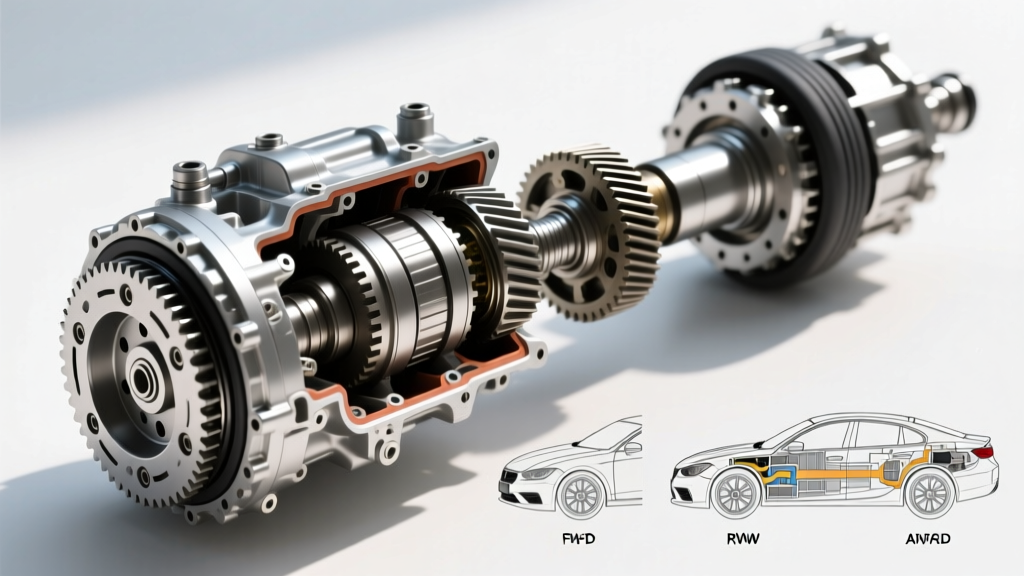
However, in modern dealership service departments and independent shops, warranty providers often lump the transmission into the 'drivetrain warranty' coverage. As we navigate the 2026 automotive landscape, the repair complexity of these systems varies wildly depending on the layout. This model-specific repair guide breaks down the real-world failure modes, labor matrices, and diagnostic realities of Front-Wheel Drive (FWD), Rear-Wheel Drive (RWD), and All-Wheel Drive (AWD) configurations.
Front-Wheel Drive (FWD): Transaxle & CV Axle Overhauls
In an FWD layout, the transmission and differential are housed in a single unit known as a transaxle. This packaging efficiency creates significant repair challenges, particularly regarding heat management and component accessibility. Let us examine the ubiquitous Toyota U881E 8-speed automatic transaxle found in late-model Camry and Highlander platforms.
Common Failure Modes: CV Joints and Differential Bearings
The most frequent drivetrain service on FWD vehicles is CV axle replacement. The outboard CV joint endures extreme articulation angles during steering maneuvers, leading to boot tears and subsequent joint starvation. When replacing a front CV half-shaft, technicians must adhere to strict torque specifications to prevent hub bearing failure. The typical 32mm or 34mm CV axle nut on these platforms requires a massive 217 lb-ft (294 Nm) of torque. Failing to use a calibrated torque wrench—and instead relying on pneumatic impact guns—often leads to stretched wheel studs or collapsed wheel bearings within 5,000 miles.
Internally, FWD transaxles suffer from differential carrier bearing wear. Because the differential is bathed in the same Automatic Transmission Fluid (ATF) as the gearsets, metallic debris from a failing bearing will circulate through the valve body and solenoid packs, necessitating a complete teardown rather than a simple bearing swap.
Pro-Tip: When diagnosing FWD drivetrain vibration, perform a 'neutral coast-down' test. If the vibration persists when the transmission is shifted to neutral at 60 mph, the issue is downstream of the transaxle (axles, wheels, tires). If the vibration disappears, the fault lies within the transaxle torque converter or internal gearsets.
Rear-Wheel Drive (RWD): Driveshaft Harmonics & Differential Seals
Rear-wheel drive platforms separate the transmission and the differential, linking them via a driveshaft. This layout is favored for performance and towing, but it introduces rotational mass and harmonic balancing issues. Consider the Ford Mustang and F-150 platforms equipped with the 10R80 10-speed automatic transmission and the Super 8.8 Independent Rear Suspension (IRS) or solid rear axles.
Precision Diagnostics: Driveshaft Runout and U-Joint Phasing
A common complaint on high-mileage RWD vehicles is a 'clunk' on engagement or a high-frequency shudder at 70-80 mph. This is rarely a transmission issue; it is a driveline angle or balance issue. Technicians must use a magnetic dial indicator to measure driveshaft runout. Acceptable runout is typically less than 0.010 inches (0.25 mm) near the center support bearing and U-joints.
When servicing the rear differential pinion seal—a frequent leak point due to high internal fluid temperatures—technicians must be meticulous. The pinion nut on a Ford 8.8 or Super 8.8 axle is a staking nut or crush-sleeve dependent. If equipped with a crush sleeve, the nut must be tightened incrementally while measuring rotational preload with an inch-pound torque wrench. Target preload for used bearings is typically 8 to 14 in-lb. Over-tightening by even a fraction of a turn will destroy the crush sleeve and the pinion bearings, turning a $40 seal job into a $1,200 differential rebuild.
U-Joint and Strap Bolt Specifications
Replacing U-joints requires replacing the strap bolts, as they are torque-to-yield. For most Ford 10R80 applications utilizing a 1310 or 1330 series driveshaft, the U-joint strap bolts are torqued to 25 lb-ft (34 Nm). Applying threadlocker is mandatory to prevent catastrophic driveline separation at highway speeds.
All-Wheel Drive (AWD): Transfer Case Actuation & Coding
Modern AWD systems are marvels of electromechanical engineering, but they are also the most expensive to repair. Unlike traditional 4WD systems with mechanical locking hubs, modern AWD relies on electronically controlled clutch packs inside a transfer case. The BMW xDrive system, paired with the legendary ZF 8HP 8-speed transmission, serves as the perfect case study for AWD repair complexity.
The ATC Transfer Case and VTG Gear Failures
BMW's xDrive utilizes an ATC (Active Transfer Case) bolted to the rear of the ZF 8HP transmission. The most prevalent failure is not the clutch pack itself, but the plastic Variable Torque Geometry (VTG) actuator gear inside the servo motor. Over time, the plastic teeth strip, causing the transfer case to default to an open state, triggering the dreaded '4x4 System Malfunction' dash warning.
Repairing this requires dropping the transfer case, splitting the housing, and replacing the actuator gear with an upgraded billet aluminum aftermarket alternative. However, the mechanical repair is only half the battle. The transfer case fluid (BMW TF 0870 specification) has a strict fill capacity of roughly 0.6 Liters. Overfilling will blow the output shaft seals; underfilling will cause immediate clutch pack shudder.
Furthermore, replacing the servo motor or the entire transfer case requires proprietary coding via ISTA (Integrated Service Technical Application) to calibrate the clutch pack engagement points. Skipping the software calibration will result in aggressive, jerky power transfers that mimic a failing transmission.
2026 Repair Cost & Labor Matrix
Understanding the financial impact of these layouts is essential for service writers and shop owners. The following table outlines average out-of-warranty repair costs based on independent shop labor rates of $145-$185 per hour.
| Drivetrain Layout | Common Repair Procedure | Specific Component / Model | Parts Cost (Est.) | Labor Hours | Total Cost Range |
|---|---|---|---|---|---|
| FWD | CV Axle & Boot Replacement | Toyota U881E Platform | $120 - $250 | 1.2 - 1.5 | $294 - $527 |
| FWD | Transaxle Differential Rebuild | Honda 10-Speed Auto | $450 - $800 | 8.0 - 10.0 | $1,610 - $2,650 |
| RWD | Driveshaft Center Support Bearing | Ford 10R80 / Super 8.8 | $80 - $150 | 2.0 - 2.5 | $370 - $612 |
| RWD | Rear Differential Pinion Seal | Ford Solid Axle / IRS | $35 - $60 | 1.5 - 2.0 | $252 - $430 |
| AWD | Transfer Case Actuator Gear | BMW xDrive (ATC35L) | $150 - $300 | 3.5 - 4.5 | $657 - $1,132 |
| AWD | Complete Transfer Case Assembly | BMW xDrive (OEM Unit) | $2,200 - $3,500 | 3.5 - 4.5 | $2,707 - $4,332 |
Essential Diagnostic Tooling for Drivetrain Layouts
To accurately diagnose these systems and honor the true drivetrain meaning in your service bays, standard OBD2 scanners are insufficient. Technicians must invest in advanced NVH (Noise, Vibration, and Harshness) diagnostic equipment.
- Pico NVH Kit: Utilizes accelerometers and a GPS antenna to pinpoint whether a vibration is tire-speed, engine-speed, or driveshaft-speed related. Essential for RWD and AWD harmonic diagnosis.
- Dial Indicators & Magnetic Bases: Mandatory for measuring driveshaft runout and differential pinion gear backlash (typically set between 0.006 and 0.010 inches for most passenger vehicles).
- OEM-Level Bi-Directional Scanners: Required for AWD systems like BMW xDrive or Audi Quattro to command clutch pack engagement, read transfer case fluid temperature, and perform module adaptations.
Ultimately, mastering the repair nuances of FWD, RWD, and AWD layouts requires moving beyond basic part swapping. It demands a deep understanding of rotational physics, precise torque applications, and the software ecosystems that govern modern torque distribution. By respecting the engineering intent of each layout, technicians can deliver lasting repairs and avoid the costly comebacks that plague the industry.