The True Cost of Neglect: Fluid Maintenance vs. Complete Replacement
The front differential is one of the most abused yet overlooked components on modern AWD and 4WD vehicles. It transfers torque from the transmission to the front axle shafts while allowing the left and right wheels to rotate at different speeds during cornering. Inside the housing, the ring and pinion gears, spider gears, and carrier bearings operate under extreme pressure and heat. When the gear oil degrades, loses its viscosity, or becomes contaminated with metallic particulates, lubrication fails. This leads to accelerated gear scoring, bearing seizure, and catastrophic housing failure.
When this failure occurs, you are no longer looking at a routine maintenance task; you are facing the cost to replace front differential assemblies. In 2026, the dealership invoice for a complete front differential replacement—including OEM ring and pinion sets, carrier assemblies, bearings, seals, and labor—routinely ranges from $2,200 to $4,500 depending on the vehicle platform. For heavy-duty trucks like the Ram 2500 with an AAM 9.25 front axle or a Jeep Wrangler Rubicon with a Dana 44, that cost can easily exceed $5,000. Conversely, a proactive front differential fluid change requires roughly $50 to $90 in synthetic gear oil and takes under an hour in your driveway. Understanding the exact procedure and adhering to strict service intervals is the most cost-effective way to protect your drivetrain.
Factory-Recommended Front Differential Service Intervals
Many owner's manuals list the front differential fluid as 'lifetime' or recommend intervals of 100,000 miles. As drivetrain engineers and independent mechanics will confirm, 'lifetime' simply means the lifetime of the warranty. For vehicles subjected to towing, off-roading, deep water fording, or extreme temperature fluctuations, the fluid breaks down much faster. Below is a realistic, expert-recommended interval chart for popular 4WD and AWD platforms.
| Vehicle Platform | Front Axle Type | Normal Duty Interval | Severe Duty Interval | Fluid Capacity |
|---|---|---|---|---|
| Jeep Wrangler (JL/JK) | Dana 30 / Dana 44 | 40,000 miles | 15,000 miles (or after water submersion) | 2.5 - 3.0 pints |
| Ford F-150 (4WD) | Ford 8.8 IFS | 50,000 miles | 30,000 miles (towing/off-road) | 3.0 pints |
| Chevy Silverado 1500 | GM 9.5 IFS | 50,000 miles | 25,000 miles | 3.4 pints |
| Subaru Outback/Forester | Subaru R160/R190 | 60,000 miles | 30,000 miles | 1.5 - 2.0 pints |
Note: If your vehicle's front differential breather tube is submerged in water during off-road trail riding, water will be sucked into the housing as the differential cools. The fluid must be changed immediately to prevent emulsification and rapid gear corrosion.
Essential Tools and OEM Fluid Specifications
Before crawling under the vehicle, you must gather the correct tools and fluids. Using the wrong viscosity or forgetting a limited-slip friction modifier will result in chattering clutches or premature gear wear.
Fluid Selection
- Standard Open Differentials: A high-quality 75W-90 or 80W-90 Full Synthetic GL-5 gear oil is standard. We recommend AMSOIL Severe Gear 75W-90 or Royal Purple Max Gear for superior film strength and shear stability.
- Limited-Slip Differentials (LSD): If your front axle features a clutch-type LSD (like the Ford Traction-Lok or Mopar Trac-Lok), you must add a friction modifier. For Mopar applications, use part number 05010320AA. For Ford, use XL-3. Alternatively, use a synthetic gear oil that already has the modifier built-in, such as Valvoline Full Synthetic Limited-Slip 75W-90.
- Heavy-Duty / Towing: For 3/4-ton and 1-ton trucks, step up to a 75W-140 synthetic gear oil to maintain viscosity under extreme thermal loads.
Required Tools
- 3/8-inch and 1/2-inch drive ratchets with extensions
- 10mm, 12mm, 14mm, and 15mm sockets (for differential cover bolts)
- 3/8-inch square drive or 8mm hex bit (for drain/fill plugs on IFS units)
- Calibrated torque wrench (inch-pounds and foot-pounds)
- Manual fluid transfer pump
- Brake cleaner, RTV silicone (if removing a cover), and a brass wire brush
Step-by-Step Front Differential Fluid Change Procedure
Front differentials generally fall into two categories: solid axles with a removable cover (e.g., Jeep Dana 44) and Independent Front Suspension (IFS) units with drain and fill plugs (e.g., Ford F-150, Chevy Silverado). This guide covers the universal best practices for both designs.
Step 1: Preparation and Safe Lifting
Park the vehicle on a level surface. The differential must be level to ensure an accurate fluid fill later. Engage the parking brake and chock the rear wheels. If you need to remove a solid axle cover, you must support the vehicle on jack stands so the axle can hang freely, allowing the fluid to drain completely. For IFS units with drain plugs, you can often use drive-on ramps, provided the vehicle remains perfectly level.
Step 2: Draining the Old Gear Oil
For IFS Units (Drain/Fill Plugs): Always remove the fill plug first. This is a critical mechanic's trick; if the fill plug is seized and you drain the fluid first, you will be stuck with an empty differential and no way to refill it. Once the fill plug is loose, place a drain pan underneath and remove the drain plug. Allow the fluid to drain for at least 15 minutes.
For Solid Axles (Removable Cover): Place a large drain pan under the housing. Loosen the bottom cover bolts first, then gently tap the edge of the cover with a rubber mallet to break the RTV seal. Allow the cover to pivot on the top bolts, letting the fluid drain into the pan. Once drained, remove all bolts and the cover.
Step 3: Inspection and Cleaning
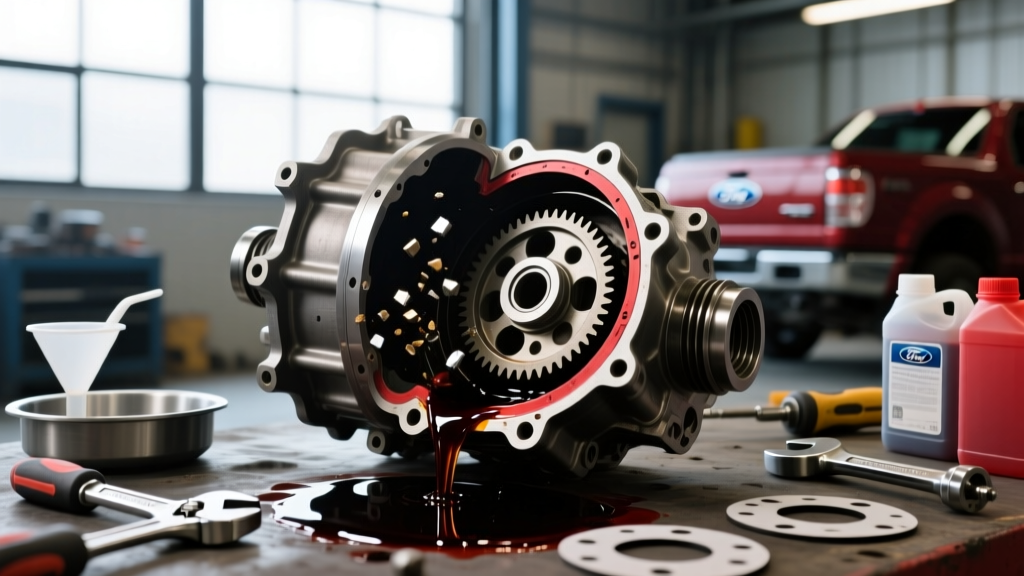
Inspect the drained fluid. A slight metallic sheen is normal due to the molybdenum disulfide additives in GL-5 gear oils. However, if you find large metal chunks, needle bearings, or excessive brass-colored shavings (indicating spider gear thrust washer failure), a fluid change will not save you. At this stage, you are already facing the cost to replace front differential internal components or the entire assembly.
For solid axles, use a brake cleaner and a brass wire brush to meticulously clean the mating surfaces of the housing and the cover. Any leftover RTV or debris will cause leaks. Wipe the inside of the housing with a lint-free shop towel. If your differential has a magnetic drain plug, clean off the metallic sludge collected on the magnet.
Step 4: Refilling to the Correct Level
For IFS Units: Reinstall the drain plug. Torque it to the manufacturer's specification (typically 20 to 25 lb-ft for most Ford and GM 8.8/9.5 axles). Insert the nozzle of your fluid pump into the fill hole and pump the synthetic gear oil until it begins to weep out of the fill hole. This indicates the differential is perfectly level and full. Reinstall the fill plug and torque to 20-25 lb-ft.
For Solid Axles: Apply a continuous 1/4-inch bead of high-temp RTV silicone (like Permatex Ultra Black) to the clean cover. Press the cover into place and hand-thread the bolts. Torque the cover bolts in a crisscross pattern to 25-30 lb-ft. Allow the RTV to cure for the time specified on the tube (usually 1-2 hours) before filling. Once cured, pump fluid into the fill hole until it reaches the bottom edge of the fill port threads.
Troubleshooting: When a Fluid Change Isn't Enough
If you perform a front differential fluid change and still experience whining, howling, or clunking noises, the damage has already been done. Gear whine that changes pitch during acceleration versus deceleration indicates improper ring and pinion backlash or worn gear teeth. A clunk when shifting from drive to reverse suggests excessive backlash in the spider gears or worn slip yokes.
According to drivetrain diagnostics outlined by Popular Mechanics, ignoring these auditory warnings will inevitably lead to total axle lockup on the highway. If your inspection in Step 3 revealed catastrophic internal wear, do not waste money on new fluid. Begin sourcing replacement OEM or aftermarket crate axles (such as those from Currie Enterprises or Dynatrac) and prepare for the comprehensive cost to replace front differential systems, which includes not just the hardware, but the specialized labor required to set precise gear backlash and bearing preload.
By adhering to the severe-duty intervals and utilizing high-quality synthetic lubricants outlined in this guide, you can easily extend the life of your front axle to 200,000 miles and beyond, keeping your hard-earned money out of the dealership's service department.