The Overlooked Front Differential: Service Realities in 2026
When maintaining a 4x4 or AWD vehicle, the automotive community heavily prioritizes the rear differential fluid exchange. It is the workhorse of the drivetrain, handling the brunt of towing loads and torque multiplication. However, the front differential fluid and service is frequently marginalized—often dismissed as a "lifetime" fluid by dealerships or neglected by DIYers due to cramped clearance around Independent Front Suspension (IFS) components.
This cost analysis breaks down the true financial and mechanical implications of front differential service, contrasting it with rear axle maintenance to provide a complete drivetrain budget for 2026.
2026 Cost Breakdown: Front Differential vs. Rear Axle Service
The front differential typically requires less gear oil than the rear, primarily because front ring and pinion sets (especially in IFS setups like the Ford F-150 8.8 or Toyota Tacoma 8-inch clamshell) are physically smaller and lack the massive fluid sumps found in heavy-duty rear axles (like the Dana 60 or Ford 10.5). This lower fluid volume directly impacts the cost of a front differential fluid and service.
| Service Tier | Front Diff Cost (Avg) | Rear Diff Cost (Avg) | Combined Drivetrain Cost |
|---|---|---|---|
| DIY (Synthetic 75W-90) | $25 - $40 | $45 - $75 | $70 - $115 |
| Independent Shop | $85 - $130 | $120 - $180 | $205 - $310 |
| OEM Dealership | $140 - $195 | $180 - $260 | $320 - $455 |
Expert Insight: Dealerships often quote a "4WD Drivetrain Flush" that includes transfer case, front, and rear differentials for upwards of $600. By itemizing and performing the front differential fluid and service yourself, you can reclaim over $150 in labor markup per axle.
Fluid Capacities and Platform-Specific Requirements
To accurately budget your front differential service, you must know your exact axle architecture. Using the wrong viscosity or failing to add a Limited Slip Differential (LSD) friction modifier can lead to chattering clutches or accelerated hypoid gear wear. According to the American Petroleum Institute (API), GL-5 specifications are mandatory for modern hypoid gear sets due to the extreme sliding pressures present on the ring and pinion teeth.
Popular 4x4 Front Differential Specifications
- 2019-2026 Ford F-150 4x4 (8.8 IFS): Requires 1.5 quarts of 75W-85 Premium Synthetic. Motorcraft Part #XY-75W85-QFS. Average DIY cost: $32.
- Jeep Wrangler JL (Dana 30 Front): Requires 1.3 quarts of 75W-85 or 75W-90 GL-5. Mopar Part #68218655AA (Friction Modifier required if equipped with Trac-Lok). Average DIY cost: $38.
- Toyota Tacoma 4WD (8" Clamshell): Requires 1.6 quarts of 75W-85 GL-5. Toyota Genuine Part #08885-02506. Average DIY cost: $41.
Synthetic vs. Conventional Gear Oil: Cost-Benefit Analysis
When planning your front differential fluid and service, you will face the choice between conventional mineral-based 80W-90 and full synthetic 75W-90 or 75W-85 formulations. Conventional gear oils (like Valvoline Daily Protection 80W-90) cost roughly $8 per quart, while premium synthetics (like Amsoil Severe Gear or Mobil 1 Synthetic 75W-90) command $14 to $18 per quart.
Given that a front differential typically holds less than 1.6 quarts, the total price difference between conventional and synthetic is often less than $15. From a cost-analysis perspective, synthetic fluid is the only logical choice for the front axle. Synthetics possess a higher viscosity index, meaning they maintain their protective film strength across the extreme temperature swings experienced by front differentials—from sub-zero winter cold starts (where conventional 80W-90 turns to sludge, starving the pinion bearing) to high-speed highway driving.
DIY Front Differential Service: Tools, Torque, and Technique
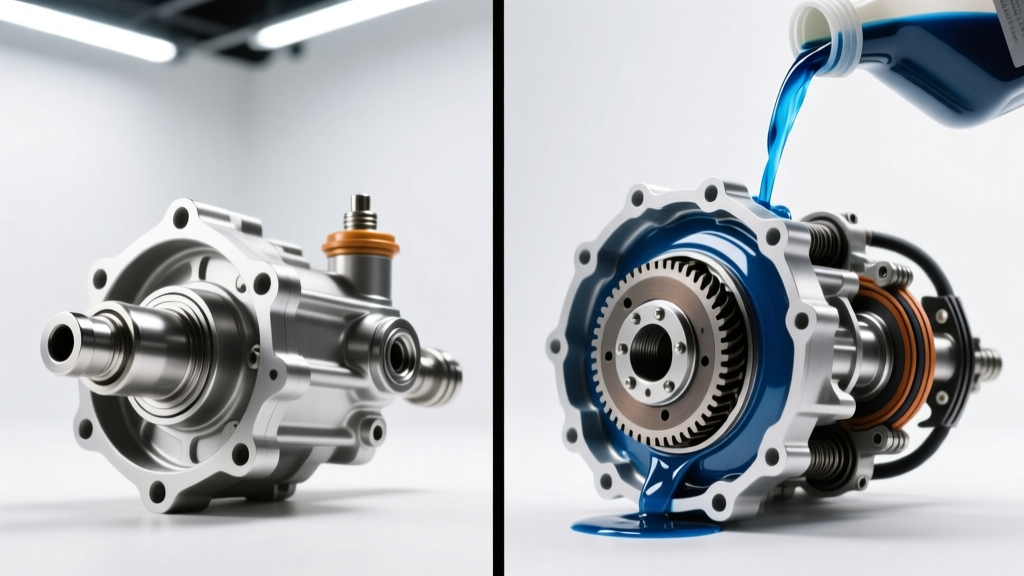
Performing a front differential fluid and service at home is highly cost-effective, but it presents unique physical challenges. Unlike the rear differential, which usually offers clear access to drain and fill plugs, the front diff is often obscured by CV axles, skid plates, and steering linkages.
Hidden DIY Costs to Anticipate
When calculating your DIY budget, do not forget the consumables that professional shops bake into their hourly rate:
- Crush Washers/Gaskets: Reusing copper or aluminum crush washers on fill/drain plugs leads to weeping. Budget $8-$15 for OEM Toyota or Honda crush washers.
- RTV Silicone (If applicable): For solid axle front diffs without drain plugs (e.g., older Dana 44s), you need Permatex Ultra Black (Part #85293) and a $12 gasket scraper. Budget $18.
- Fluid Transfer Pump: A $15 manual pump is mandatory, as front diff fill holes rarely allow for gravity feeding from a bottle.
Critical Torque Specifications
Over-torquing the aluminum housings or thin steel covers of front differentials is a common DIY failure point that leads to expensive warping and fluid leaks. Always use a calibrated 3/8-inch drive torque wrench.
- Toyota IFS Fill/Drain Plugs: 29 lb-ft (39 Nm).
- Ford F-150 IFS Fill Plug: 35 lb-ft (47 Nm).
- Jeep Dana 30 Diff Cover Bolts: 30 lb-ft (40 Nm) in a star pattern.
Limited Slip Additives: The Hidden Variable in Service Costs
If your vehicle is equipped with a clutch-type Limited Slip Differential (LSD) in the front axle—common in performance AWD systems and older Jeep Trac-Lok setups—the cost of your service must include a friction modifier. Failing to add this $8-$12 bottle of modifier (such as Ford Motorcraft XL-3 or Mopar 68218655AA) will result in severe clutch chatter during low-speed turns, ultimately destroying the clutch packs and converting your LSD into an expensive open differential.
Always check the manufacturer's service manual. Some modern synthetic gear oils already contain the necessary friction modifiers, saving you an extra purchase and simplifying the fluid fill process in cramped engine bays. Technical resources from Red Line Synthetic Oil provide excellent compatibility charts for LSD additives versus pre-mixed formulations.
Environmental Factors: Breather Tubes and Water Ingestion
A critical, often zero-cost aspect of the front differential fluid and service is inspecting the axle breather tube. The front differential is mounted lower than the rear and is the first drivetrain component to submerge when crossing water or deep snow. When the hot axle housing hits cold water, the internal air rapidly contracts, creating a vacuum. If the breather tube is cracked, disconnected, or lacks a one-way check valve, water will be sucked directly past the pinion seal into the gear oil.
Water-contaminated gear oil turns into a milky, chocolate-milk-like emulsion that completely strips the API GL-5 extreme pressure (EP) additives from the hypoid gears. Replacing a $2 breather hose during your fluid service can prevent a $2,000 axle rebuild.
The Financial Risk of Neglect: Front Diff Failure Modes
Why invest in the front differential fluid and service if the rear handles the heavy towing? The front differential operates in a harsher thermal and environmental envelope. It is subjected to water ingestion during off-road use, and the CV joint plunging action can introduce microscopic metallic debris into the gear oil. When the fluid shears, the protective boundary layer fails.
Cost of Failure vs. Cost of Maintenance
| Failure Mode | Cause | Estimated Repair Cost (2026) |
|---|---|---|
| Pinion Bearing Seizure | Fluid breakdown / water ingestion | $800 - $1,400 |
| Ring Gear Tooth Spalling | Extreme pressure (EP) additive depletion | $1,200 - $2,200 |
| Actuator Fork Wear (CAD) | Abrasive metallic suspension in degraded oil | $600 - $950 |
Final Verdict: Budgeting Your Drivetrain Maintenance
While the rear differential fluid exchange remains critical for towing and payload stability, the front differential fluid and service is the unsung hero of 4WD reliability. By allocating a mere $30-$40 every 30,000 miles for DIY front axle service, you insulate yourself from the $1,500+ catastrophic failure costs associated with neglected IFS and solid front axles. Always verify your specific API GL-5 requirements, invest in a quality fluid transfer pump, and respect the aluminum torque limits of modern front differential housings.