The Intersection of Gear Ratios and Fluid Dynamics in the 2017 Silverado
When servicing the drivetrain of a 2017 Chevrolet Silverado 1500, most DIYers and even some dealership technicians treat the rear axle as a simple drain-and-fill afterthought. However, understanding the precise 2017 Silverado rear differential fluid capacity is only half the battle. The true longevity of your ring and pinion gears depends heavily on the factory gear ratio, your towing habits, and how those factors generate thermal loads that break down gear oil over time.
Whether your truck is equipped with the 5.3L EcoTec3 V8 (L83) or the 6.2L V8 (L86), paired with the robust 6L80 six-speed automatic transmission, the rear differential is the final point of torque multiplication. In this model-specific repair guide, we will break down exact fluid capacities, the performance implications of GM's axle ratios, and the critical service procedures required to keep your 9.5-inch 10-bolt axle whisper-quiet for well past 150,000 miles.
2017 Silverado Rear Differential Fluid Capacity & Specifications
The 2017 Silverado 1500 utilizes two primary rear axle assemblies depending on the engine configuration and trailering package. Getting the fill level wrong—either overfilling which causes aeration and seal blowout, or underfilling which starves the pinion bearings—will lead to catastrophic failure.
| Axle Assembly | Ring Gear Size | Fluid Capacity | Common Gear Ratios | Recommended Fluid |
|---|---|---|---|---|
| 8.0" (Semi-Floating) | 8.6-inch | 1.6 Quarts (1.5L) | 3.08 (GU5), 3.42 (GU6) | SAE 75W-90 Synthetic |
| 9.5" (Semi-Floating) | 9.5-inch | 2.4 Quarts (2.27L) | 3.42 (GU6), 3.73 (GT4), 4.10 (GT5) | SAE 75W-90 Synthetic |
Note: Always fill to the bottom of the fill plug hole. If your truck is equipped with the Z82 Heavy-Duty Trailering Package, the 9.5-inch axle may feature an external finned aluminum differential cover to aid in heat dissipation. This cover can slightly increase fluid capacity by roughly 0.2 quarts.
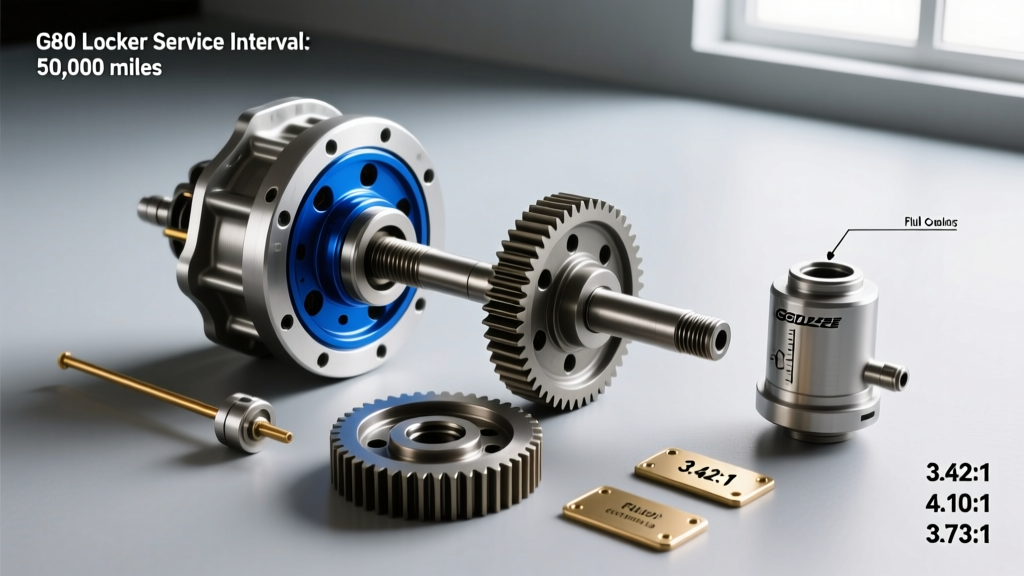
The G80 Locker Warning: Friction Modifier Myths
A common and costly mistake made during rear differential service is the addition of a limited-slip friction modifier. According to Chevrolet's official owner manuals, if your 2017 Silverado is equipped with the Eaton G80 automatic locking rear differential (RPO code G80), you must NOT add any friction modifiers. The G80 is a mechanical flyweight-actuated locker, not a clutch-pack-style limited-slip differential. Adding modifiers designed for Ford or Chrysler clutch-type LSDs will cause the G80 mechanism to slip, fail to engage, and eventually wear out the internal governor weights.
How Gear Ratios Dictate Differential Heat and Fluid Life
Differential gear ratio and performance are intrinsically linked to fluid degradation. The gear ratio determines how many times the driveshaft (and pinion gear) must rotate to turn the wheels (ring gear) once. This mechanical leverage directly impacts the thermal dynamics inside the axle housing.
3.42 vs. 3.73 vs. 4.10: Performance & Thermal Breakdown
- 3.42 (GU6): The most common ratio for standard 5.3L Silverados. It offers excellent highway fuel economy by keeping RPMs low. However, when towing heavy loads (e.g., a 6,000 lb travel trailer), the torque converter in the 6L80 transmission may struggle to stay locked. This forces the engine to work harder, transferring immense low-speed, high-torque stress to the ring and pinion contact patch. This lugging effect generates localized heat spikes that can oxidize standard 75W-90 gear oil prematurely.
- 3.73 (GT4): The sweet spot for mixed-use trucks. The 3.73 ratio multiplies torque more aggressively, reducing the strain on the transmission and allowing the pinion gear to spin faster relative to wheel speed under load. This promotes better fluid splash lubrication inside the housing, carrying heat away from the gear teeth more efficiently than a 3.42 setup under heavy tow.
- 4.10 (GT5): Standard on trucks with the 6.2L V8 or the Max Trailering package. While it runs hotter at 80 MPH on the highway due to higher drivetrain RPMs, it virtually eliminates low-speed lugging when towing near the truck's 12,000 lb max capacity. For 4.10 axles, upgrading to a high-quality synthetic like ACDelco's Dexron 75W-90 is mandatory to prevent thermal shearing.
Step-by-Step 2017 Silverado 9.5-Inch Axle Service Guide
Unlike older differentials that featured a simple drain plug, the 2017 Silverado 9.5-inch 10-bolt rear axle typically requires the removal of the rear cover to properly drain the contaminated fluid and clean out metallic particulates from the magnet. Here is the definitive procedure.
Tools, Torque Specs, and Part Numbers
- Fluid: ACDelco Synthetic 75W-90 Axle Lubricant (Part # 88900333 or 10-9394). Refer to ACDelco's official lubricant specifications for cross-references.
- Sealant: GM RTV Silicone (Part # 12378497) or Permatex Ultra Black.
- Tools: 10mm and 13mm sockets, torque wrench, gasket scraper, brake cleaner, fluid transfer pump.
- Torque Spec: Differential cover bolts (M8) must be torqued to 22 lb-ft (30 Nm).
The Service Procedure
- Prep and Drain: Jack up the rear axle safely on jack stands. Place a drain pan underneath. Use a 10mm/13mm socket to break loose all cover bolts. Leave the top two bolts slightly threaded to act as a hinge, then gently pry the bottom of the cover with a flathead screwdriver to break the RTV seal. Let the fluid drain completely.
- Clean and Inspect: Remove the cover entirely. Inspect the fluid for excessive glitter (normal fine metallic paste is acceptable; chunks or shards indicate bearing or gear failure). Clean the internal magnet. Spray the cover and axle mating surface with brake cleaner and scrape off all old RTV. Crucial: Ensure no RTV debris falls into the ring gear.
- Seal and Reinstall: Apply a continuous 3mm bead of GM RTV to the cover. Reinstall the cover and hand-thread all bolts. Follow a crisscross star-pattern tightening sequence. Torque all bolts to exactly 22 lb-ft. Allow the RTV to cure for at least 2 hours before filling.
- Fill the Axle: Remove the fill plug located on the front or side of the differential housing (depending on the exact casting). Using a transfer pump, inject the 75W-90 synthetic fluid until it begins to weep out of the bottom of the fill hole. Reinstall and tighten the fill plug to 24 lb-ft.
Diagnosing Gear Ratio-Related Whine and Chatter
If you have completed the fluid service but still experience noise, the issue may be tied to your specific gear ratio and wear patterns. A coast-side whine (heard when letting off the throttle) often points to pinion bearing preload loss, common in high-mileage 3.42 axles that have spent their lives towing. A drive-side howl usually indicates ring and pinion gear wear or improper backlash.
Furthermore, if your truck has been lifted and fitted with oversized tires (e.g., 33s or 35s) without re-gearing, your effective gear ratio has dropped numerically. A factory 3.73 ratio with 35-inch tires effectively behaves like a 3.08, forcing the differential to operate under extreme, sustained torque loads, generating excessive heat and accelerating fluid breakdown. In these modified scenarios, dropping the differential cover every 15,000 miles to inspect for gear spalling is highly recommended.
Conclusion
Understanding the 2017 Silverado rear differential fluid capacity is just the starting point for proper drivetrain maintenance. By respecting the thermal realities of your specific gear ratio, avoiding harmful friction modifiers in G80-equipped axles, and adhering strictly to GM's RTV and torque specifications, you can ensure your Silverado's rear end performs flawlessly whether you are commuting empty or towing maximum payload. For deeper insights into mechanical locker operation, consult Eaton's differential engineering resources to understand exactly how your axle manages torque distribution under load.