The Hidden Economics of Front Differential Maintenance
While rear differentials and transfer cases often dominate the conversation regarding 4WD and AWD drivetrain maintenance, the front differential is a frequently neglected component that endures immense mechanical stress. Whether you are navigating the rock-crawling trails in a Jeep Wrangler Rubicon or towing a 10,000-pound trailer with a Ram 2500, the front independent front suspension (IFS) or solid axle assembly relies entirely on the shear stability of its gear lubricant. In 2026, the cost of drivetrain neglect has never been higher, with replacement ring and pinion sets for heavy-duty front axles easily exceeding $1,200 before labor.
This comprehensive cost analysis breaks down the exact expenses associated with a front differential service, focusing specifically on applications that mandate the use of 75w140 differential oil. We will examine fluid pricing, labor rates, hidden mechanical costs, and the precise torque specifications required to keep your front axle operating flawlessly.
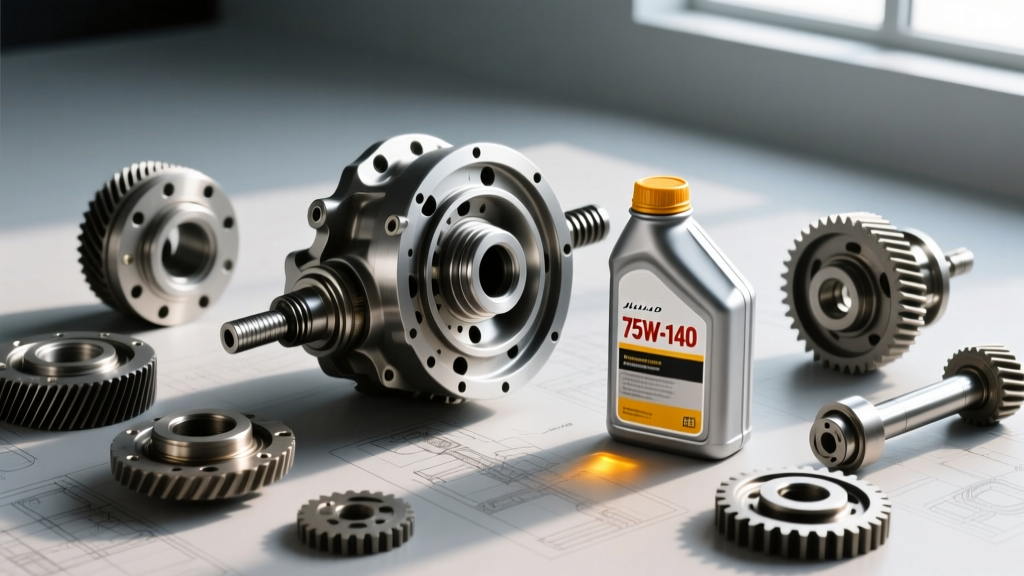
Why Front Differentials Demand 75W-140 Gear Oil
Before analyzing the cost, it is critical to understand why a heavier viscosity like 75W-140 is specified for certain front axles. Modern hypoid gear sets generate extreme sliding friction and localized heat at the pinion and ring gear contact patch. According to the Lubrizol Gear Oil Formulation Guide, API GL-5 certified fluids contain high levels of sulfur-phosphorus extreme pressure (EP) additives designed to sacrifice themselves under heavy loads, preventing metal-on-metal welding.
While 75W-90 is standard for light-duty commuting, vehicles equipped with factory towing packages, locking front differententials, or those subjected to severe off-road articulation require the thicker hydrodynamic film provided by 75W-140 synthetic oil. This heavier grade resists thermal breakdown and shear degradation when the front axle is forced to pull the vehicle's weight over obstacles or through deep snow, protecting the pinion bearings from catastrophic cage failure.
2026 Fluid Price Matrix: OEM vs. Aftermarket 75W-140
The front differential typically holds significantly less fluid than the rear axle or transfer case—usually between 1.5 and 3.0 quarts depending on the housing. However, the price per quart for high-quality synthetic 75W-140 varies wildly. Below is a 2026 market breakdown of the most popular choices for heavy-duty and off-road front axles.
| Brand & Product | Viscosity | API Spec | Avg. Price/Qt (2026) | Best Application |
|---|---|---|---|---|
| Mobil 1 Synthetic Gear Lube | 75W-140 | GL-5 / MT-1 | $13.50 - $15.00 | GM IFS, Ford Super Duty |
| Amsoil Severe Gear | 75W-140 | GL-5 / MT-1 | $18.95 - $20.50 | Rock Crawling, Heavy Towing |
| Red Line ShockProof Heavy | 75W-140 (Eq.) | GL-5 | $23.00 - $25.00 | Competition / High-Shock Loads |
| OEM Mopar Synthetic Plus | 75W-140 | GL-5 | $16.00 - $18.50 | Ram AAM 9.25 / 11.5 Axles |
| Valvoline SynPower Full Syn | 75W-140 | GL-5 / MT-1 | $11.50 - $13.00 | Budget Fleet Maintenance |
Note: Always verify if your specific front differential requires a limited-slip friction modifier additive. Most modern open front diffs do not, but electronic locking differentials (e-Lockers) may have specific additive requirements outlined in the factory service manual.
Labor Cost Analysis: Dealership vs. Independent vs. DIY
Labor rates for drivetrain services have surged alongside general automotive repair costs. A standard front differential drain and fill is generally billed at 1.0 to 1.5 hours of shop time.
- Franchise Dealership ($165 - $225/hr): Expect to pay between $220 and $380 total. Dealerships use OEM-branded fluids and often perform a multi-point inspection, but you are paying a premium for overhead. Furthermore, some dealerships refuse to service modified vehicles with aftermarket differential covers.
- Independent 4x4 Shop ($110 - $150/hr): Total cost usually lands between $140 and $250. Independent shops specializing in trucks and Jeeps are often more meticulous about cleaning the magnetic fill plugs and inspecting the axle breather tubes.
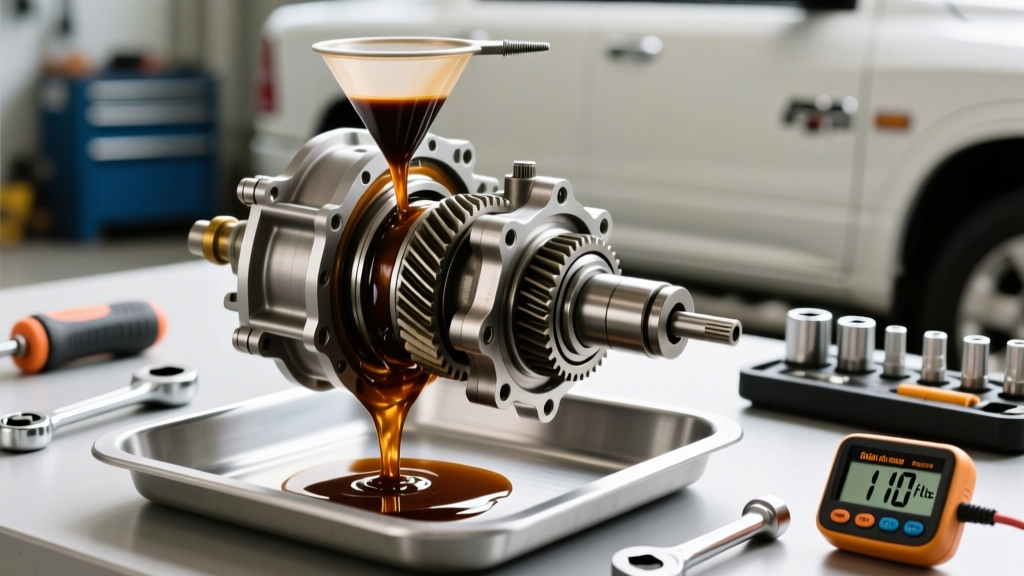
- DIY Driveway Service ($25 - $60 total): By sourcing your own 75w140 differential oil and utilizing a manual fluid pump, your only costs are the fluid, a drain pan, and basic hand tools. This is the most cost-effective route, provided you adhere strictly to torque specifications.
The 'Seized Fill Plug' Tax: Hidden Costs You Must Anticipate
Any veteran drivetrain technician will warn you about the most common hidden cost in front differential services: the seized fill plug. Many modern front axles, such as the GM 8.25-inch IFS and the AAM 9.25 found in Ram trucks, feature aluminum differential housings paired with steel or zinc-plated fill plugs. Over years of exposure to road salt, water, and galvanic corrosion, these plugs weld themselves to the housing.
If a shop breaks or strips the fill plug during removal, the cost of the service skyrockets. Extracting a snapped plug requires drilling, tapping, and installing a Helicoil or Timesert thread repair kit. In worst-case scenarios where the aluminum housing is compromised, the entire front differential assembly or a bare OEM housing (part numbers like GM 84300112) must be replaced, turning a $150 fluid service into a $1,500+ nightmare. Pro Tip: Always apply a high-quality anti-seize compound (like Loctite LB 8008) to the threads of the replacement plug, and consider upgrading to an aftermarket billet aluminum or stainless steel plug with an O-ring seal.
Real-World Front Axle Capacities and Torque Specifications
Precision is paramount when servicing the front differential. Overfilling can cause fluid to aerate and blow past the axle tube seals into the wheel bearings, while underfilling leads to immediate pinion bearing starvation. Below are the factory specifications for three of the most common heavy-duty and off-road front axles on the road today.
- GM 8.25' IFS (Silverado/Sierra 1500, Colorado)
- Capacity: 1.7 Quarts (1.6 Liters)
- Fill/Drain Plug Torque: 24 lb-ft (32 Nm)
- Fluid Note: Requires a fluid transfer pump due to the high location of the fill hole relative to the skid plate.
- Dana 60 Solid Axle (Ford F-250/F-350 Super Duty)
- Capacity: 2.7 to 3.0 Quarts (varies by cover depth)
- Fill Plug Torque: 35 lb-ft (47 Nm)
- Fluid Note: Often requires 3 quarts of 75W-140 when equipped with deep-cover aftermarket diff pans.
- Dana 44 AdvanTEK (Jeep Wrangler JL Rubicon)
- Capacity: 2.0 Quarts (1.9 Liters)
- Fill Plug Torque: 25 lb-ft (34 Nm)
- Fluid Note: The factory electronic locker (e-Locker) does not require a traditional limited-slip friction modifier.
Water Ingestion and the 'Chocolate Milk' Failure Mode
The front differential is uniquely vulnerable to water ingestion compared to the rear axle or transfer case. Because it sits at the lowest point of the front suspension and is directly exposed to river crossings, deep puddles, and snowbanks, water can easily be sucked past the axle shaft seals or through a clogged, submerged axle breather tube.
When water mixes with 75W-140 gear oil, the mechanical churning of the ring gear emulsifies the fluid, turning it into a thick, milky substance that mechanics refer to as 'chocolate milk.' This emulsified fluid loses its hydrodynamic film strength and its ability to carry heat away from the hypoid gears. According to Dana Spicer Axle Maintenance Resources, operating a differential with water-contaminated fluid for even a few hundred miles will cause microscopic pitting on the gear teeth and accelerate corrosion on the carrier bearings. If your drained fluid resembles a milkshake, you must flush the housing with a cheap flushing oil and perform a secondary fill with your premium 75W-140 synthetic to ensure total moisture evacuation.
Final ROI Verdict: Is the Upfront Cost Justified?
Investing $40 to $60 in premium 75w140 differential oil and spending an hour in your driveway yields one of the highest returns on investment in automotive maintenance. Replacing a front ring and pinion set, along with crushed pinion bearings and scored axle shafts, routinely costs between $1,800 and $3,500 at a specialized 4x4 shop. By adhering to a strict 30,000-mile service interval for severe-duty vehicles, utilizing the correct API GL-5 rated synthetic fluids, and respecting factory torque specifications, you ensure that your front differential remains a silent, reliable partner in traction for the life of the vehicle.