The True Cost of Front Differential Service in 2026
For decades, servicing a front differential was a straightforward, messy affair: pull the drain plug, let the gear oil drain, and refill. However, the widespread adoption of Independent Front Suspension (IFS) in modern trucks and SUVs has fundamentally changed the economics of axle maintenance. Today, many front differentials are sealed units lacking a dedicated drain plug, requiring specialized extraction equipment and significantly altering the cost structure of routine maintenance.
Whether you are driving a Ford F-150 with a 9.75-inch IFS axle, a Jeep Wrangler JL with a Dana 44 M210, or a Toyota Tacoma, understanding the real-world costs of front differential fluid service is critical for your 2026 maintenance budget. Below is a comprehensive breakdown of what you can expect to pay across different service channels.
2026 Front Differential Service Cost Breakdown
| Service Method | Estimated Cost Range | Time Required | Pros & Cons |
|---|---|---|---|
| DIY (Manual/Pneumatic Extraction) | $35 - $65 | 45 - 90 Minutes | Pros: Cheapest; ensures quality fluid. Cons: Requires purchasing a fluid transfer pump ($25-$40). |
| Independent Mechanic | $110 - $180 | 1 - 1.5 Hours | Pros: Professional disposal; includes visual inspection. Cons: Higher labor rates; may use bulk generic fluids. |
| Dealership 'Flush' Service | $190 - $280+ | 1 - 2 Hours | Pros: OEM-specific fluids; warranty compliance. Cons: High cost; pressure flushing can damage pinion seals. |
Note: Prices reflect national averages for early 2026 and may vary based on regional labor rates and specific vehicle requirements.
Active AWD Diagnostics: How Technicians Define Differential Pressure
As automotive drivetrains have evolved, the front axle is no longer just a passive gear set. Modern AWD and 4WD systems—such as GM's Twinster, Audi's Quattro Ultra, and Ford's active torque management setups—utilize complex hydraulic clutch packs integrated into or adjacent to the front differential to manage torque vectoring and axle disconnects. This brings us to a critical diagnostic metric that separates master technicians from parts-swappers.
When diagnosing binding, shuddering, or torque-vectoring failures in active front axles, experts define differential pressure as the hydraulic variance (delta) between the baseline pump pressure and the applied clutch-pack engagement pressure. In a healthy system, the hydraulic pump maintains a steady baseline pressure, and the solenoid valves modulate this pressure to engage the clutches.
However, as front differential fluid ages, it undergoes viscosity shear. The extreme mechanical shearing action of the hypoid ring and pinion gears literally tears the long-chain polymers in the gear oil apart. When the fluid thins out, the hydraulic pump struggles to maintain the necessary differential pressure across the clutch packs. If a technician connects a bidirectional scan tool and a hydraulic manifold gauge, they will define differential pressure drops as the primary indicator of fluid degradation.
Expert Insight: If your AWD system is throwing a 'Clutch Pack Slip' or 'Axle Disconnect' code, do not immediately replace the $1,200 electronic clutch assembly. Have a drivetrain specialist measure the hydraulic delta. A simple $50 front differential fluid service using a high-shear-stability synthetic often restores the differential pressure and cures the fault.
OEM Specifications: Capacities, Torques, and Part Numbers
Using the correct fluid viscosity and API rating is non-negotiable. Most modern front differentials require an API GL-5 rated fluid, which contains high levels of Sulfur-Phosphorus extreme pressure (EP) additives necessary to protect the sliding contact of hypoid gears. Below are the exact specifications for some of the most popular 4WD platforms on the road today.
Vehicle-Specific Front Axle Data Table
| Vehicle Platform (2024-2026) | Axle Type | Fluid Capacity | OEM Fluid Spec | Fill Plug Torque |
|---|---|---|---|---|
| Ford F-150 (14th Gen) | 9.75" IFS | 1.5 Quarts (1.4L) | SAE 75W-85 API GL-5 | 18 lb-ft (24 Nm) |
| Jeep Wrangler JL / Gladiator | Dana 44 M210 | 1.3 Quarts (1.2L) | SAE 75W-85 API GL-5 | 25 lb-ft (34 Nm) |
| Toyota Tacoma (4th Gen) | 8.0" IFS | 1.1 Quarts (1.0L) | SAE 75W-85 API GL-5 | 29 lb-ft (39 Nm) |
| GM Silverado 1500 | 8.25" IFS | 1.4 Quarts (1.3L) | SAE 75W-85 API GL-5 | 24 lb-ft (32 Nm) |
The Danger of Over-Torquing Aluminum Housings
One of the most common and costly mistakes made during DIY or rushed shop services is over-torquing the fill plug. Modern IFS front differentials utilize lightweight cast-aluminum housings. The fill plug boss is relatively thin. Applying 50+ lb-ft of torque with a standard 1/2-inch drive ratchet will easily strip the threads or crack the aluminum housing. A cracked diff housing requires a complete axle assembly replacement—a catastrophic failure that turns a $40 maintenance task into a $2,500 repair. Always use a calibrated 3/8-inch drive torque wrench set precisely to the manufacturer's specification.
The 'No Drain Plug' Tax: Extraction vs. Flushing
Why do dealerships charge upwards of $250 for a front differential service? The answer lies in the 'No Drain Plug' design. To save weight and reduce manufacturing costs, OEMs like Ford and GM have eliminated bottom drain plugs on many IFS front axles. The only access point is the fill hole, located midway up the side of the differential housing.
To remove the old fluid, technicians must use a pneumatic or manual fluid transfer pump (often called a Mityvac) inserted through the fill hole to suck the viscous gear oil out. This process takes longer than gravity draining, increasing billable labor time.
A Warning on Dealership 'Power Flushing': Some service centers attempt to speed up this process by using high-pressure flush machines. They pump new fluid in under high PSI while simultaneously extracting the old fluid. Never allow a shop to pressure-flush your front differential. The high-pressure fluid can easily bypass and blow out the internal axle tube seals or the main pinion seal, forcing gear oil into your CV joints or onto the ground. Manual, low-pressure extraction is the only safe method recommended by Dana Spicer technical guidelines.
Gear Oil Chemistry: Why Shear Stability Matters
When selecting an aftermarket fluid, do not simply buy the cheapest API GL-5 bottle on the shelf. Front differentials in 4WD vehicles endure immense shock loads, especially when the front axle is locked or binding during low-traction off-road maneuvers.
Premium synthetic gear oils, such as those detailed in AMSOIL's Severe Gear lineup, utilize specialized polyalphaolefin (PAO) base stocks that resist viscosity shear far better than conventional petroleum-based oils. While a conventional 75W-85 fluid might shear down to a 70W viscosity after 15,000 miles of heavy towing or off-roading, a high-quality synthetic will maintain its protective hydrodynamic film. This shear stability is exactly what maintains the hydraulic integrity in active differentials, ensuring the clutch packs receive the correct pressure without slipping.
Diagnosing Front Differential Noise Through Fluid Analysis
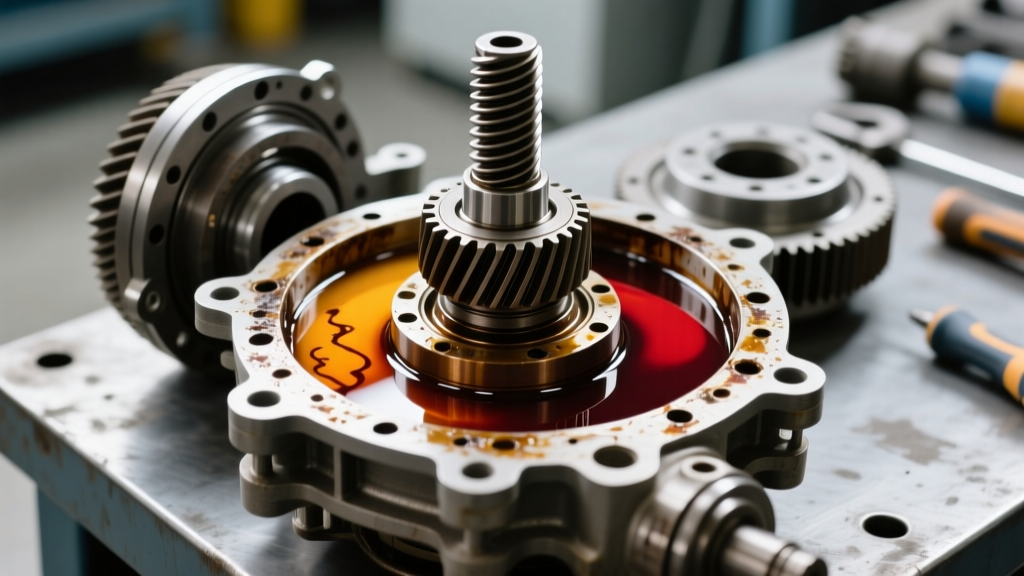
When you extract your front differential fluid, take a moment to analyze what comes out. The condition of the old oil is a direct window into the mechanical health of your ring and pinion gears:
- Dark Brown/Black with a Burnt Smell: Indicates extreme heat and fluid breakdown. Often caused by low fluid levels, excessive towing, or dragging brakes. The fluid has lost its EP additives.
- Glitter/Silver Sparkles: Normal wear-in for a brand-new axle (under 5,000 miles). If found on a high-mileage axle, it indicates accelerated bearing or gear wear.
- Chunky Metal Flakes (Magnetic): Critical failure imminent. Large, jagged metal shards on the drain plug magnet (if equipped) or in the extraction tube mean the ring and pinion gears are chipping. A rebuild is required.
- Milky/Chocolate Milk Appearance: Water intrusion. The front axle breather tube is likely clogged, or the axle tube seals have failed, allowing water from puddles or boat launches to mix with the gear oil. This rapidly destroys bearings.
Final Verdict: Protect Your Drivetrain Investment
The front differential is arguably the most abused component in a 4WD vehicle, yet it receives the least attention. By understanding the true cost of service, respecting the precise torque specifications of aluminum housings, and understanding how mechanics define differential pressure in modern active axles, you can save thousands of dollars in premature drivetrain failures. Budget $50 and an hour of your weekend twice a year, and your front axle will outlast the vehicle itself.