The Journey of Torque: Understanding Your 4x4 Drivetrain
When new off-road enthusiasts or first-time truck owners browse forums, one of the most common questions they ask is, "What's a car differential, and how does it work with my transfer case?" It is a fantastic question that strikes at the very heart of four-wheel-drive (4WD) and all-wheel-drive (AWD) engineering. To understand your vehicle's capability, you have to understand the journey of torque from the engine to the dirt.
In a rear-wheel-drive car, the drivetrain is relatively simple. But in a 4x4 truck or SUV—whether it is a classic Jeep Wrangler with a solid front axle or a modern independent-front-suspension (IFS) pickup—the power must be split, multiplied, and redirected multiple times before it reaches the rubber. If you have ever wondered what's a car differential in the context of a multi-axle vehicle, the answer lies in its partnership with the transfer case. Together, these two components dictate whether you glide smoothly down the highway or crawl over boulders.
The Core Question: What's a Car Differential in a 4WD System?
At its most basic level, a differential is a gear assembly that splits engine torque two ways, allowing the left and right wheels on a single axle to rotate at different speeds. Why is this necessary? When your vehicle turns a corner, the outside wheel travels a longer distance than the inside wheel. If both wheels were locked together on a solid shaft, the tires would chirp, skip, and violently bind on dry pavement. The differential prevents this by compensating for the difference in wheel speed.
In a 4WD or AWD vehicle, you typically have two differentials: one in the front axle housing and one in the rear axle housing. However, having two differentials creates a new problem. If the front wheels lose traction, an open front differential will send all the power to the spinning wheel, leaving you stuck. This is where the transfer case enters the conversation, acting as the master coordinator of the entire drivetrain.
Transfer Case vs. Differential: The Power Split
While the differential splits power left-to-right across a single axle, the transfer case splits power front-to-back between the two axles. The transfer case is bolted directly to the rear of the transmission. It receives the rotational force from the transmission's output shaft and uses a heavy-duty chain or gear-driven mechanism to send that force down the rear driveshaft (to the rear differential) and the front driveshaft (to the front differential).
To visualize this relationship, review the breakdown of drivetrain components below:
| Component | Location | Primary Function | Typical Fluid Type |
|---|---|---|---|
| Transmission | Bolted to Engine | Multiplies torque via gear ratios | ATF / Manual Gear Oil |
| Transfer Case | Bolted to Transmission | Splits power Front-to-Rear; provides Low-Range gearing | ATF (Dexron VI) or Specialty Fluid |
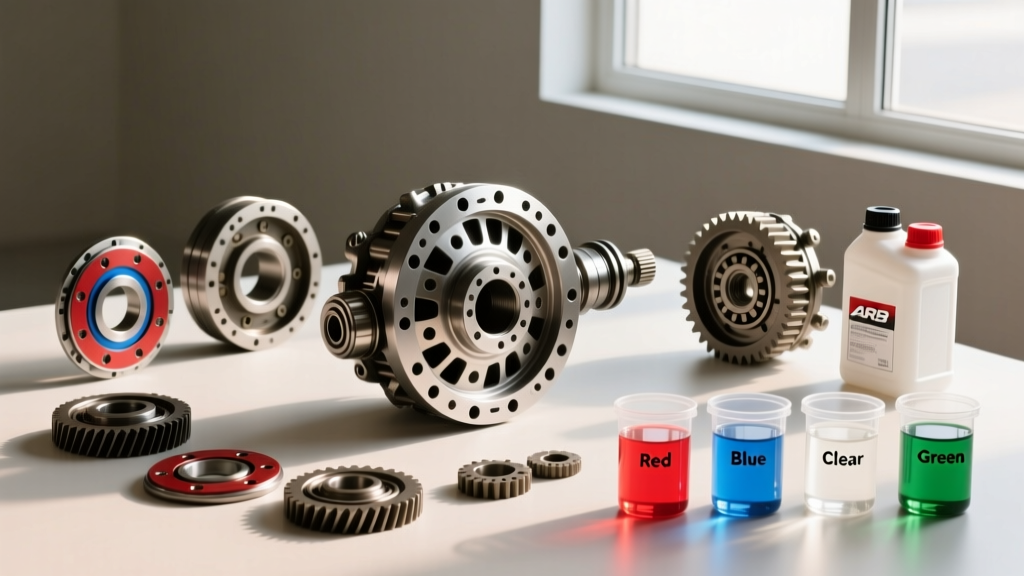
| Front Differential | Front Axle Housing | Splits power Left-to-Right (Front Wheels) | 75W-90 or 80W-90 GL-5 Gear Oil |
| Rear Differential | Rear Axle Housing | Splits power Left-to-Right (Rear Wheels) | 75W-90 or 80W-90 GL-5 Gear Oil |
The Danger of Driveline Binding (A Beginner's Mistake)
Understanding the relationship between the transfer case and the differentials is critical to avoiding catastrophic mechanical failure. In a traditional part-time 4WD system (like those using the legendary New Venture Gear NV231 or NV241 transfer cases), engaging 4-High or 4-Low physically locks the front and rear output shafts together inside the transfer case. This forces the front and rear driveshafts to spin at the exact same RPM.
Here is the problem: the front and rear axles travel slightly different distances, and the front and rear differentials cannot compensate for the front-to-back speed differences. If you drive a part-time 4WD vehicle in 4-High on dry, high-traction pavement, the tires cannot slip enough to relieve the stress. This results in driveline binding. The kinetic energy has nowhere to go, resulting in a violent "axle hop," premature wear on the transfer case chain, and severe stress on the differential ring and pinion gears. Always reserve part-time 4WD for loose surfaces like mud, snow, sand, or gravel where the tires can slip and relieve the binding pressure.
2026 Drivetrain Maintenance: Fluids, Specs, and Torque
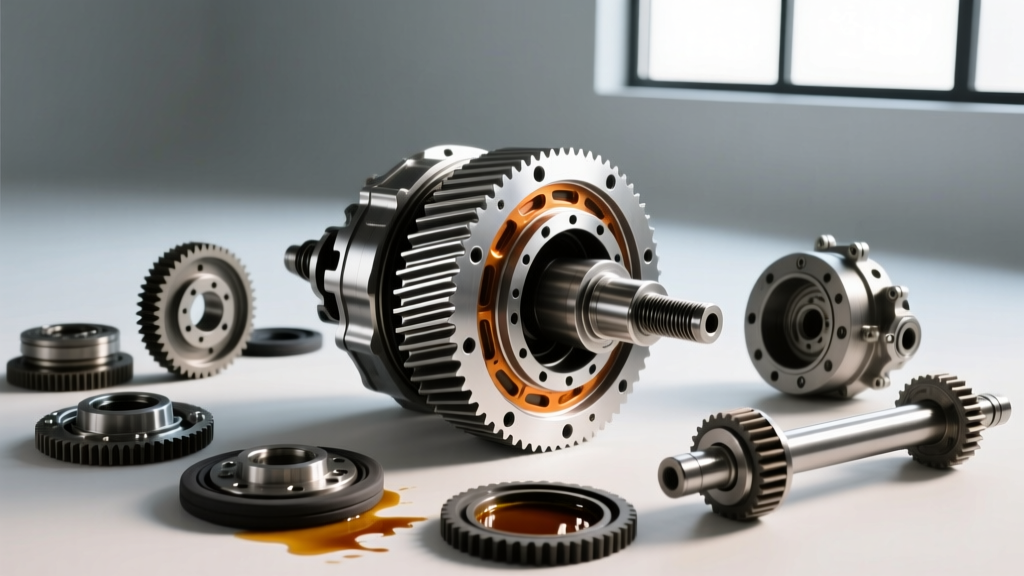
Because the transfer case and the differentials operate under immense stress, proper fluid maintenance is non-negotiable. As of 2026, dealership labor rates for a complete 4x4 drivetrain fluid service (transfer case, front diff, and rear diff) typically range from $450 to $650. Doing it yourself in your driveway costs between $90 and $130 in high-quality synthetic fluids, making it one of the most cost-effective DIY maintenance jobs you can perform.
However, you must use the correct fluids and adhere to precise torque specifications to avoid stripping threads or blowing out seals. According to engineering guidelines from Dana Incorporated and BorgWarner, here are the baseline specifications for common light-truck setups:
Rear Differential Service (Dana 44 & Ford 8.8)
- Dana 44 (Jeep/Truck): Requires approximately 2.0 quarts of 75W-90 GL-5 gear oil (e.g., AMSOIL Severe Gear). The 10-bolt diff cover requires a new gasket or RTV silicone. Critical Torque Spec: Tighten the 1/2-inch cover bolts to exactly 25 lb-ft in a crisscross pattern. Over-torquing will warp the cast-iron or aluminum cover, leading to chronic gear oil leaks.
- Ford 8.8 (F-150/Ranger): Features a sealed axle with a fill plug rather than a removable cover. Requires about 2.5 quarts of 75W-140 (if equipped with a limited-slip clutch pack, add 4 oz of friction modifier). Critical Torque Spec: The 3/8-inch Allen fill plug must be torqued to 33 lb-ft.
Transfer Case Service (NV241HD & BorgWarner 4494)
- NV241HD (Ram/Jeep Heavy Duty): Unlike the differentials, this gear-driven transfer case does not use thick gear oil. It requires approximately 2.0 quarts of ATF+4. Critical Torque Spec: The drain and fill plugs are easily stripped if over-tightened with a breaker bar. Torque to 15 to 20 lb-ft.
- BorgWarner 4494 (GM Full-Size Trucks): Uses specific Auto-Trak II fluid to accommodate the internal clutch packs that manage the AWD torque bias. Never substitute standard ATF, or the clutches will chatter and fail prematurely.
Diagnosing Noises: Is it the Diff or the Transfer Case?
When a drivetrain starts making noise, beginners often misdiagnose the source. Because the transfer case, driveshafts, and differentials are all physically linked, vibrations and sounds travel through the chassis, making them tricky to isolate.
Whining or Howling: If you hear a distinct whine that changes pitch precisely with your vehicle speed (not engine RPM), it is almost always a differential issue. Specifically, it points to worn ring and pinion gears or failing pinion bearings inside the axle housing. Transfer cases rarely whine unless the internal planetary gears are starved of fluid.
Clunking or Binding: A heavy metallic clunk when shifting from Drive to Reverse usually indicates excessive backlash in the differential gears or a worn Spicer U-joint (like the common Spicer 5719 series) on the driveshaft. However, if you feel a binding sensation or hear a ratcheting noise from the center console while turning on dry pavement, your transfer case's internal chain may be stretched, or the shift fork pads may be worn, preventing the transfer case from fully disengaging 4WD.
Final Thoughts on Drivetrain Synergy
So, what's a car differential? It is the unsung hero of cornering and traction, working in perfect tandem with the transfer case to conquer any terrain. By understanding how the transfer case splits power front-to-back, and how the differentials split power left-to-right, you can make smarter decisions about traction management, off-road driving, and preventative maintenance. Keep your fluids clean, respect your torque specs, and your 4x4 drivetrain will deliver reliable performance for hundreds of thousands of miles.