The Intersection of Cloud Telematics and Physical Drivetrain Leaks
In the modern automotive landscape, the line between mechanical engineering and data science has completely blurred. When Ford’s engineering team analyzes fleet-wide drivetrain warranty claims for the 12th-generation F-150 (2021–2026), they rely on advanced statistical frameworks—specifically, graphical model based estimation and inference for differential privacy. This computer science methodology allows OEMs to map the correlation between high-torque towing events, ambient temperatures, and pinion seal degradation across millions of connected AWD trucks, all without ever exposing the GPS routes, geofencing data, or personal driving habits of individual owners.
By injecting mathematical noise into the telematics datasets, engineers can infer the exact failure rate of a BorgWarner 4412 Transfer Case output seal or a Super 8.8 rear differential pinion seal, while maintaining strict compliance with global data privacy laws. You can read more about the underlying frameworks at the NIST Privacy Engineering Collaboration Space.
But while cloud-based inference predicts when a seal might fail on a macro level, it cannot stop 75W-85 synthetic gear oil from dripping onto your garage floor. Algorithms don't turn wrenches. This model-specific repair guide bridges the gap between predictive AWD telematics and the physical, hands-on repair of the Ford Super 8.8 rear axle and BorgWarner TOD (Torque-On-Demand) system.
Model-Specific Focus: Ford 12th-Gen F-150 Super 8.8 Rear Axle
The Super 8.8 rear differential was introduced to handle the massive low-end torque of the 3.5L PowerBoost hybrid and high-output EcoBoost engines. Unlike the legacy 8.8, the Super 8.8 features a larger ring gear, 35-spline axle shafts (on Tremor and Heavy Duty Payload packages), and enhanced thermal management. However, the increased torque loads place immense stress on the pinion and axle shaft seals.
Diagnostic Matrix: Physical Symptoms vs. Telematics Flags
Before grabbing a drain pan, cross-reference your physical inspection with the vehicle's OBD-II and OTA (Over-The-Air) telematics logs. Modern F-150s will flag drivetrain binding before a visual leak becomes obvious.
| Leak Source | Physical Symptom | Telematics / OBD-II Flag | Est. Repair Cost (2026) |
|---|---|---|---|
| Pinion Seal | Fluid slung forward onto driveshaft; whining on decel. | U3000 (Control Module), Drivetrain Temp Warning | $350 - $450 |
| Axle Shaft Seal | Fluid inside the wheel well; brake pad contamination. | C0062 (Longitudinal Acceleration Sensor - AWD bind) | $275 - $325 (per side) |
| Differential Cover | Seeping at the 10-bolt pan; low fluid volume. | None (Gradual loss) | $150 - $200 |
| BW 4412 Front Output | Fluid at the transfer case/rear driveshaft junction. | AWD Disabled Message, C0051 | $600 - $850 (T-case drop) |
Step-by-Step Pinion Seal Replacement (Super 8.8)
Replacing the pinion seal on the Super 8.8 requires extreme precision. The most common mistake made by generalist shops is over-tightening the pinion nut, which crushes the collapsible spacer too far, over-preloading the bearings, and guaranteeing a catastrophic differential failure within 10,000 miles.
Required Parts and Tools
- Seal: Timken 710983 (or OEM Motorcraft equivalent)
- Nut: New pinion nut (One-time use, prevailing torque)
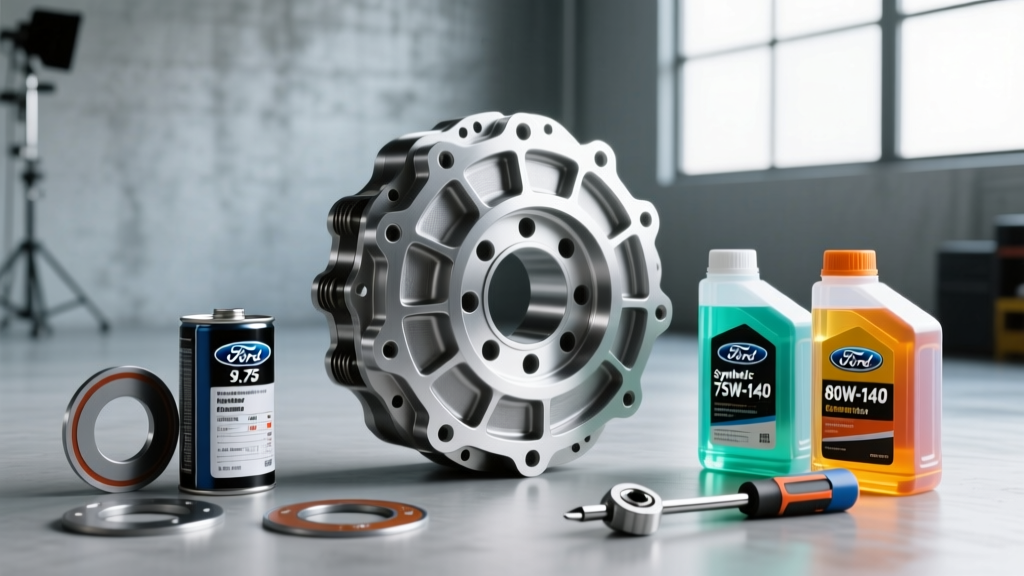
- Fluid: Motorcraft SAE 75W-85 Premium Synthetic Hypoid (XO-75W85-QFS)
- Additive: Motorcraft XL-3 Friction Modifier (if equipped with Traction-Lok LSD)
- Tools: Inch-pound torque wrench, 1/2" drive beam-type torque wrench, pinion flange holder, seal puller.
The Crush Sleeve vs. Solid Spacer Debate
From the factory, the Super 8.8 uses a crush sleeve to set pinion bearing preload. As of 2026, many drivetrain specialists recommend bypassing the crush sleeve entirely during a seal replacement, opting instead for a Ratech solid pinion spacer kit with shims. This eliminates the risk of over-crushing and makes future seal changes significantly safer. If you must reuse the factory crush sleeve, you must measure the rotating torque before removal.
Execution Procedure
- Measure Baseline Preload: With the rear wheels off the ground and brake calipers removed (to eliminate drag), use an inch-pound torque wrench on the pinion nut. Record the rotating torque (typically 8–14 in-lbs for used bearings).
- Mark Alignment: Use a paint pen to mark the pinion nut, washer, and flange. Count the exact number of threads exposed on the pinion shaft.
- Remove Flange: Use a flange holding tool and a high-torque impact or breaker bar to remove the nut. Pull the flange with a 3-jaw puller. Never pry the flange off with a screwdriver, or you will score the seal mating surface.
- Extract and Install Seal: Carefully pry out the old Timken seal. Lubricate the lip of the new seal with fresh 75W-85 gear oil and tap it flush using a seal driver.
- Reassembly: Reinstall the flange. Thread the new pinion nut on. Tighten in 5 lb-ft increments, checking the rotating torque with your inch-pound wrench after every turn. Stop exactly when you reach your baseline measurement plus 1-2 in-lbs. If you exceed this, you have over-crushed the sleeve and must start over with a new spacer and nut.
Axle Shaft Seal & ABS Tone Ring Precautions
A leaking axle shaft seal on the Super 8.8 is often misdiagnosed as a brake fluid leak because the gear oil drips directly onto the inner brake pad. Replacing this seal requires pulling the 35-spline axle shaft, which presents a major hazard to the ABS system.
The ABS tone ring on the 12th-gen F-150 is integrated into the outer wheel bearing hub assembly, but the wiring harness for the differential-mounted speed sensor routes dangerously close to the axle shaft puller path. When unbolting the 4 axle shaft retainer nuts (torqued to 85 lb-ft from the factory), support the heavy 35-spline shaft. Pulling it out abruptly can snag and sever the $180 ABS sensor wire. Once the shaft is out, use a blind-hole puller to extract the old seal, pack the new seal's inner lip with grease, and slide the shaft back in, ensuring the splines do not nick the new seal lip. Use a small amount of RTV silicone on the outer seal rim if the housing bore shows minor pitting.
Fluid Refill, Viscosity, and Calibration
The Super 8.8 differential requires strict adherence to SAE J306 viscosity standards. Ford specifies SAE 75W-85 Synthetic Hypoid gear oil. Do not substitute with thicker 75W-140 unless you are exclusively running severe-duty, high-speed desert towing, as the thicker fluid will cause delayed lubrication at the pinion bearings during cold starts, triggering telematics thermal warnings.
Capacity and Fill Procedure
- Standard Super 8.8 Capacity: 1.75 Liters (3.7 pints)
- Limited Slip Additive: If equipped with an Eaton Traction-Lok, add 4 oz of Motorcraft XL-3 before filling with gear oil to prevent clutch pack chatter during low-speed AWD binding maneuvers.
- Fill Plug Torque: 35 lb-ft (Ensure the rubber O-ring on the fill plug is intact; these are notorious for dry-rotting and causing phantom leaks).
- Cover Bolt Torque: 28 lb-ft in a crisscross pattern. Use a Fel-Pro RDS 55024 rubber gasket instead of RTV silicone for a cleaner, more reliable seal.
Clearing the AWD Telematics Faults
Once the physical leak is repaired and the differential is filled to the bottom of the fill hole, you must address the software side. If the BorgWarner 4412 transfer case or rear differential ran low on fluid, the AWD clutch pack may have experienced micro-slip, generating excessive heat. The F-150's PCM will log a thermal derate event. Simply clearing the DTCs with an OBD-II scanner is not enough. You must perform an AWD Clutch Pack Learn Procedure using a bidirectional scan tool (like an Autel MaxiSys or Ford FDRS) to recalibrate the clutch apply pressures based on the new fluid baseline. Failing to do this will result in harsh engagements and a return of the C0062 telematics fault within 50 miles.