The DPS6 PowerShift Dilemma: Actuator vs. Clutch Pack
The 2012–2018 Ford Focus equipped with the Getrag 6DCT250 (Ford DPS6) dry dual-clutch transmission remains one of the most heavily debated powertrains in modern automotive history. Unlike traditional torque-converter automatics or wet-clutch DCTs, the DPS6 relies on two electrically driven electromechanical clutch actuators to engage the odd and even gear shafts. When these components degrade, drivers experience shuddering, hesitation, and eventual limp-mode triggers. However, blindly throwing parts at the transmission is a costly mistake. A proper clutch system inspection checklist is mandatory to determine whether the fault lies in the actuator motors, the Transmission Control Module (TCM), the clutch fork pivot points, or the clutch packs themselves.
Breaking Down the Ford Focus Clutch Actuator Replacement Cost
When researching the Ford Focus clutch actuator replacement cost, owners often encounter a wide variance in dealership versus independent shop quotes. The DPS6 utilizes two distinct actuators: Actuator A (controlling odd gears 1, 3, 5) and Actuator B (controlling even gears 2, 4, 6). In 2026, supply chain stabilization has normalized pricing for OEM Motorcraft components (such as part number CU5Z-7B438-A), but labor rates continue to climb.
| Cost Component | Dealership Estimate (2026) | Independent Specialist (2026) | DIY / Parts Only |
|---|---|---|---|
| OEM Motorcraft Actuator (Each) | $550 - $700 | $450 - $600 | $380 - $500 |
| Aftermarket Actuator (e.g., LuK, FTE) | N/A (OEM Only) | $300 - $450 | $220 - $350 |
| Labor (R&I Battery, Airbox, Actuator) | $400 - $600 (2.5 - 3.5 hrs) | $300 - $450 (2.5 - 3.5 hrs) | $0 (4-6 hrs DIY) |
| TCM Re-Flash & Adaptation | $150 - $250 | $100 - $150 | $50 (FORScan License) |
| Total Estimated Cost (Single Actuator) | $1,100 - $1,550 | $850 - $1,200 | $430 - $550 |
Note: If both actuators are failing, or if internal clutch pack wear is detected, a full transmission removal is required, pushing the total repair cost well past $3,500.
Master Clutch System Inspection Checklist for the DPS6
Before authorizing any repair, or turning a single wrench, transmission technicians must follow a rigorous diagnostic sequence. The electromechanical nature of the DPS6 means that electrical faults frequently masquerade as mechanical failures.
Phase 1: Advanced PID Data Logging
Standard OBD-II scanners are insufficient for DPS6 diagnostics. You must use advanced software like FORScan with a high-speed OBDLink EX or VCM II adapter to access the TCM's proprietary Parameter IDs (PIDs).
- Retrieve Continuous DTCs: Look for P090C (Clutch Actuator A Circuit Low), P090D (Clutch Actuator B Circuit Low), P287A (Clutch A Stroke Range), or P073E (Reverse Gear Engagement).
- Monitor Clutch Stroke PIDs: Observe the clutch stroke position sensors during a test drive. A healthy actuator should show smooth, linear progression from 0mm to roughly 12mm of engagement. Jagged graphs or sudden drop-offs indicate a failing internal potentiometer or binding clutch fork.
- Check Motor Current Draw: If the PID data shows the actuator motor drawing excessive amperage (spiking above 15-20A during standard shifts), the mechanical clutch fork is binding, or the clutch pack is physically warped.
Phase 2: Electrical & TCM Connector Integrity
The DPS6 TCM is mounted directly on the exterior of the transmission case, subjecting it to extreme thermal cycling and vibration. According to data from the NHTSA Recall Database, fretting corrosion in the TCM harness connectors is a leading cause of actuator communication loss.
- Disconnect the negative battery terminal.
- Unplug the main TCM connectors (C1750A and C1750B).
- Inspect the female pins for green/white copper oxide buildup.
- Perform a voltage drop test on the 12V supply and ground circuits feeding the actuator motors. A voltage drop greater than 0.2V under load indicates harness degradation, which will destroy a replacement actuator prematurely.
Phase 3: Mechanical Fork & Pivot Ball Assessment
This is the most critical step in the clutch system inspection checklist. The actuators push against external clutch forks, which pivot on a steel ball stud inside the bellhousing.
- Remove the Actuator: Unbolt the suspect actuator (three 10mm bolts) to expose the clutch fork pad.
- Inspect the Fork Pad: Look for deep grooving or uneven wear patterns. If the pad is worn more than 1.5mm, the internal clutch release bearing is likely failing.
- Check Pivot Ball Play: Use a pry bar to gently apply leverage to the fork. If you feel a 'click' or excessive free-play before the clutch begins to disengage, the pivot ball stud is worn. Replacing the actuator without addressing a worn pivot ball will result in immediate recurrence of shift shudder.
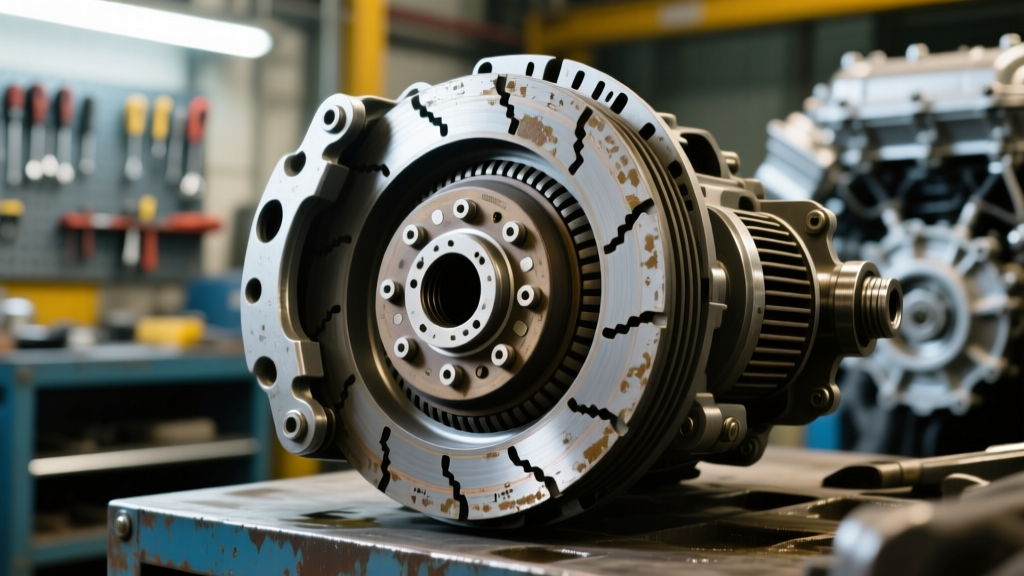
- Bellhousing Weep Hole Check: Inspect the inspection cover and weep hole for excessive black clutch dust or gear oil. Oil contamination from a failing input shaft seal will glaze the dry clutch packs, causing the actuator to overwork and burn out its internal DC motor.
Crucial Torque Specifications & Reassembly Protocol
Improper fastening of the DPS6 actuators leads to misalignment, gear whine, and catastrophic fork failure. Always use a calibrated inch-pound torque wrench for these components. For extended warranty and technical service bulletin (TSB) references, consult the Ford Motor Company Recall & Support portal.
| Component | Fastener Size | Torque Specification | Notes |
|---|---|---|---|
| Actuator to Case Bolts | M6 x 1.0 | 10 Nm (89 lb-in) | Do NOT overtighten; case is cast aluminum. |
| Clutch Fork Pivot Ball Stud | M8 x 1.25 | 25 Nm (18 lb-ft) | Apply high-temp synthetic grease to the ball. |
| TCM to Case Bolts | M6 x 1.0 | 10 Nm (89 lb-in) | Ensure grounding strap is clean and secure. |
| Battery Terminal (Post-Repair) | 10mm Nut | 8 Nm (71 lb-in) | Required for clean TCM reboot sequence. |
Edge Cases: When an Actuator Swap is a Band-Aid
While the Ford Focus clutch actuator replacement cost is a fraction of a full transmission rebuild, it is not a cure-all. If your inspection checklist reveals heavy clutch dust, a burnt smell from the bellhousing, or if the FORScan PID data shows that the clutch touch-point (the exact millimeter where the clutch begins to grab) has migrated beyond 9.5mm, the dry clutch packs are physically worn out.
Furthermore, if the vehicle has been subjected to stop-and-go traffic with severe shuddering for thousands of miles, the dual-mass flywheel (DMF) or the internal release bearings are likely compromised. In these scenarios, installing a new actuator will simply result in the TCM throwing a P287A code within 500 miles because the new motor cannot overcome the mechanical resistance of the worn internal components. Always cross-reference parts availability via the RockAuto Parts Catalog to ensure you can source the complete LuK RepSet (clutch packs, release bearings, and alignment tool) if the teardown reveals internal destruction.
Final Adaptation Requirement
Remember that the DPS6 TCM is a learning computer. Anytime an actuator is replaced, or the battery is disconnected for an extended period, you must perform a 'Clutch Touch Point Adaptation' and 'Shift Drum Adaptation' using bi-directional scan tools. Skipping this software calibration forces the TCM to use base factory maps, resulting in harsh engagements and immediate customer comebacks.